55-Million-Year-Old Crocodile Eggshells Found in Australia


Appointed Wakkaoolithus godthelpiThis type of eggshell belonged to mekosuchine crocodiles and represents the oldest crocodilian eggshells ever found in Australia.
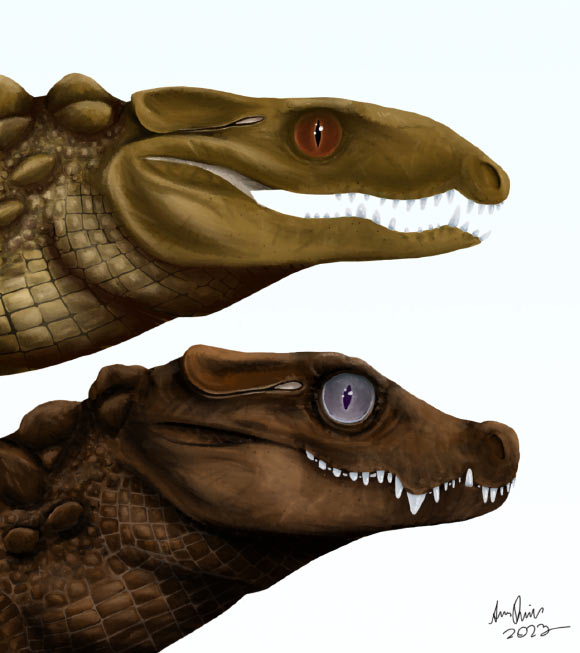
Mekosuchine crocodiles. Image credit: Armin Reindl / CC BY-SA 4.0.
The now-extinct mekosuchines (Mekosuchinae) were the unique local branch of the crocodile family in Australia.
These creatures dominated the continent’s interior waters 55 million years ago (early Eocene).
They were part of the group of species that includes alligators, true crocodiles, gharials and caimans.
But mekosuchines represent a much older branch than the saltwater and freshwater crocodiles found in Australia today.
Modern species arrived on the continent much later, when they came into contact with Southeast Asia around 5 million years ago.
Unlike today’s crocodiles, mekosuchines occupy strange ecological niches.
“It’s a bizarre idea. But some of them appear to have been terrestrial hunters in the forests,” said Michael Archer, a professor at the University of New South Wales.
“There are suggestions of this in a wide range of younger mekosuchine fossils that were discovered earlier in 25-million-year-old deposits from another region: the Riversleigh World Heritage Area, Boodjamulla National Park in Waanyi Country, northwest Queensland.”
“Some riparian species there reached at least 5 m in length. Some were also apparently at least partly semi-arboreal ‘crocs’.”
“They may have been hunting like leopards, dropping from the trees onto whatever they unsuspectingly found for dinner.”
THE Wakkaoolithus godthelpi the eggshells belong to the oldest known member of the Mekosuchinae clade.
“These eggshells gave us insight into the intimate history of mekosuchines,” said Dr Xavier Panadès i Blas, a paleontologist at the Conca Dellà Museum, the Institut Català de Paleontologia Miquel Crusafont and the Autonomous University of Barcelona.
“We can now study not only the strange anatomy of these crocodiles, but also how they reproduce and adapt to changing environments.”
The researchers examined the Wakkaoolithus godthelpi Shell fragments under optical and electron microscope.
Their microstructure suggests that the crocodiles laid eggs on the edges of a lake, their reproductive strategy adapting to fluctuating conditions.
“Mekosuchine crocodiles may have lost much of their inland territory to dryland encroachment – and eventually had to compete in the dwindling waterways not only with new arrivals to Australia, but also with the dwindling numbers of their megafauna-sized prey,” said Dr Michael Stein, a palaeontologist at the University of New South Wales.
“Lake Murgon was surrounded by lush forest, which was also home to the world’s oldest known songbirds, Australia’s first frogs and snakes, a wide range of small mammals with links to South America, and one of the world’s oldest known bats.”
According to the team, fossil eggshells are an underutilized resource in vertebrate paleontology.
“They preserve microstructural and geochemical signals that tell us not only what types of animals laid them, but also where they nested and how they reproduced,” said Dr. Panadès i Blas.
“Our study shows how powerful these fragments can be.”
“Eggshells should be a routine and standard part of paleontological research – collected, preserved and analyzed alongside bones and teeth.”
The results were published this week in the Journal of Vertebrate Paleontology.
_____
Xavier Panadès I Blas and others. Australia’s oldest crocodylian eggshell: insights into the reproductive paleoecology of mekosuchines. Journal of Vertebrate Paleontologypublished online November 11, 2025; doi: 10.1080/02724634.2025.2560010


