Hawaii’s short-finned pilot whales eat over 77,000 squid a year


For Hawaiian short-finned pilot whales (Globicephala macrorhynchus), it’s all about the squid. Bulbous-headed black marine mammals feed primarily on cephalopods and some small amounts of fish. But just how much squid do they eat?
New estimates suggest that Hawaiian short-finned pilot whales eat between 82 and 202 squid per day. For the entire population, this represents around 88,000 tonnes per year. The results are detailed in a study published today in the Journal of Experimental Biology and could contribute to local conservation efforts.
Understanding how much food an animal should consume can help scientists recognize when a species might be in danger. Humpback whales can eat up to 3,000 pounds of krill, plankton and small fish in a day, while orcas can eat up to 300 to 500 pounds of fish, cephalopods and even other marine mammals per day. Hawaiian pilot whales dive up to 5,000 feet below the surface to feed, primarily on nutritious squid.
“These animals have been studied around the world, but relatively little is known about them in Hawaiian waters,” William Gough, study co-author and marine biologist at the University of Hawaii at Mānoa, said in a statement.
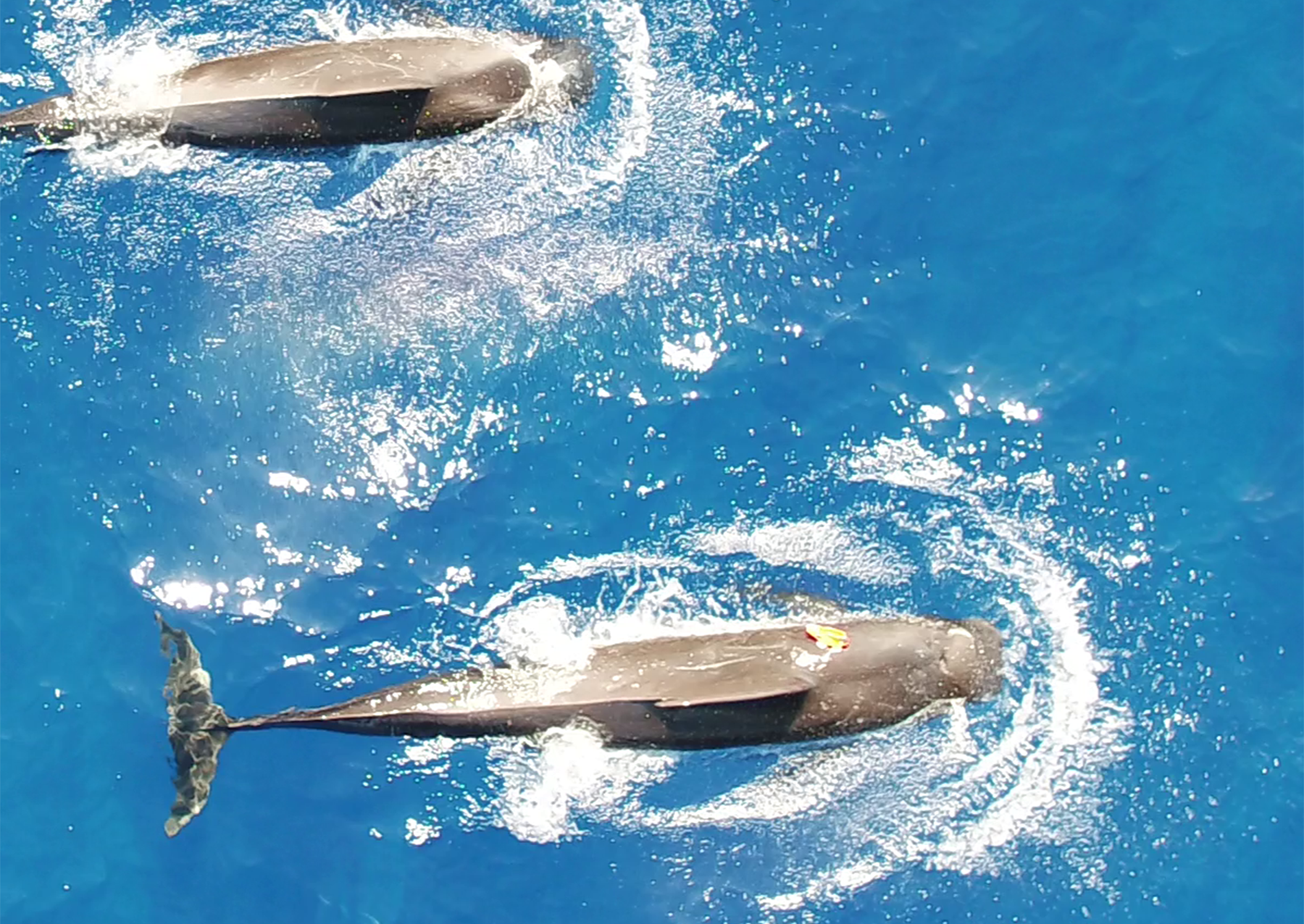
To solve this conundrum about how much squid whales consume, Gough teamed up with colleagues from Spanish, Australian and Danish institutions. They traveled to the Pacific Ocean and attached data collection tags with a removable suction cup to eight short-finned pilot whales. Each tag was equipped with motion sensors, a camera with a light, hydrophones to pick up echolocation clicks, and GPS.
“Short-finned pilot whales are quite small and fast, so we really have to choose our timing,” Gough said. “Ideally, we attached the tag just behind the vent facing the head, so we can see any food in depth.”
The team also flew a drone 82 feet above each whale, filming them from above so the team could determine the size of each animal.

A short-finned pilot whale “films” the other whales in its group. CREDIT: HIMB Marine Mammal Research Program
The team then recovered the tags, some of which were floating 50 miles away in rough waters. The whales made 118 deep dives, reaching depths of up to 2,836 meters. Each of the eight whales studied dove about 39 times per day.
The team then analyzed the whales’ tail beats as they went below the surface to see how much energy they were using. Short-finned pilot whales consume about 73.8 kilojoules per minute (about 17.6 calories) while diving, compared to just 44.4 kilojoules per minute (about 10.6 calories) when at the surface. So how much squid should they eat to meet the caloric needs of diving and foraging?
By listening to the echolocation clicks recorded on the hydrophone when the whales intercepted a squid, the team estimated that the mammals ate about four squid per dive. Each squid provides them with approximately 560,000 kilojoules of energy (over 133,000 calories) once digested.

Film from a camera attached to a diving pilot whale swimming at depth. The whale was recorded producing hunting echolocation clicks just before the light flash. The echolocation clicks suggest that the whale had detected a squid and that the glowing object is a cloud of squid ink illuminated by the tag’s lights as the whale swims through it. CREDIT: HIMB Marine Mammal Research Program.
Gough then calculated that each whale must have eaten between 82 and 202 squid each day, or up to 73,730 squid per whale per year. With approximately 8,000 individuals of short-finned pilot whales in the waters around Hawaii, that amounts to up to 88,000 tons of squid each year. Hawaii is home to several species of squid, including the Hawaiian bobtail squid. Keeping squid stocks healthy will ensure that whales have enough to eat in the future.
“These results show that short-finned pilot whales are in relatively good shape in Hawaii, having found an abundant and reliable food source,” said Gough, optimistic about the future of this whale species.

Holiday Gift Guide 2025


