New Species of Triassic Armor-Plated Reptile Unearthed in Brazil


A new genus and species of pseudosuchian archosaur have been identified from fossil remains found in southern Brazil.
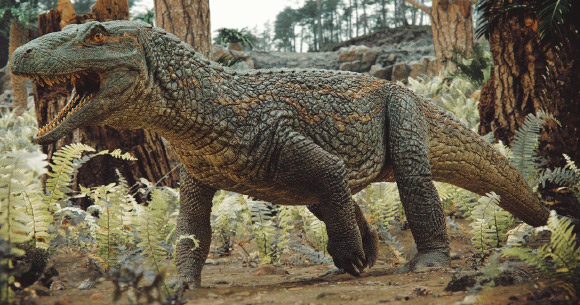
Bellator Tainrakuasuchus. Image credit: Caio Fantini.
Bellator Tainrakuasuchus lived in what is now Brazil during the Triassic period, approximately 240 million years ago.
This ancient predator was approximately 8 feet (2.4 m) long and weighed 60 kg.
The species had a back covered in bony plates called osteoderms, structures also found in modern crocodiles.
It used its long neck and agile mobility to attack its victims using quick, precise movements, before seizing its prey using its slender jaw full of sharp, curved teeth to restrain the target, preventing it from escaping.
“This animal was an active predator, but despite its relatively large size, it was far from being the largest hunter of its time, with the same ecosystem supporting giants up to 7 m long,” said Dr. Rodrigo Temp Müller, a paleontologist at the Federal University of Santa Maria.
Bellator Tainrakuasuchus was a member of Pseudosuchia – precursors of modern crocodiles and alligators.
“Pseudosuchia were a diverse group of animals capable of preying on robust prey, as well as small hunters specialized in capturing fast-moving animals,” said Dr. Temp Müller.
“Although its appearance superficially resembles that of a dinosaur, Bellator Tainrakuasuchus does not belong to this group.
“One of the clearest ways for us to distinguish it from dinosaurs is in the structure of the pelvis where the characteristics of the hip and femur joints are very different.”
“Bellator TainrakuasuchusThe discovery represents the complexity of the ecosystem at the time, with different species of pseudosuchia – varying in size and hunting strategies – occupying specific ecological niches.
“Its discovery sheds light on a key moment in the history of life, the period which preceded the rise of the dinosaurs.”
A partial skeleton of Bellator Tainrakuasuchuspreserving parts of the lower jaw, spine and pelvic girdle, was discovered in May 2025 in the municipality of Dona Francisca, southern Brazil.
Although the animal’s limbs were not preserved, the expert team believes that, like its close relatives, it moved on all four limbs.
“Bellator Tainrakuasuchus“The discovery of is further evidence of the ancient connection between Brazil and Africa during the Triassic period, when the world’s continents were united into a single supercontinent, Pangea,” said Dr Temp Müller.
“Despite the diversity of pseudosuchians, they remain poorly understood, as fossils of some of their lineages are extremely rare in the fossil record.”
“The fossils we found underwent a careful preparation process in the laboratory, during which the surrounding rock was carefully removed.”
“Once the anatomical details were revealed, we were delighted and really excited to reveal that the specimen represented a species previously unknown to science.”
“What we discovered is a species that belongs to a predator closely related to another… Mandasuchus tanyauchen – found in Tanzania.
“This connection between the animals of South America and Africa can be understood in light of the paleogeography of the Triassic period.”
“At that time, the continents were still united, allowing the free dispersal of organisms in regions now separated by oceans. »
“As a result, the faunas of Brazil and Africa shared several common elements, reflecting an intertwined evolutionary and ecological history.”
“Bellator Tainrakuasuchus would have lived in a region bordering a vast arid desert – the same setting where the first dinosaurs appeared.
“This shows that, in what is now southern Brazil, reptiles had already formed diverse communities adapted to various survival strategies.”
“Moreover, this discovery reveals that such diversity was not an isolated phenomenon. »
The discovery is reported in an article in Journal of Systematic Paleontology.
_____
Rodrigo Temp Muller and others. Osteology, taxonomy and phylogenetic affinities of a new pseudosuchian archosaur from the Middle Triassic of southern Brazil. Journal of Systematic Paleontologypublished online November 12, 2025; doi: 10.1080/14772019.2025.2573750


