This Huge Lizard Stalked the Earth Before Dinos



Explore
Tit’s not a dinosaur: this large carnivorous lizard arrived before dinosaurs dominated. The second half of the name of this newly designated species, Bellator Tainrakuasuchustranslates from Latin as “warrior”. It is an appropriate name, given that T. bellator turned out to be a ferocious predator around 240 million years ago.
This creature belonged to a branch of the tree of life that included other ancient precursors to today’s crocodiles and alligators. His remains were discovered in southern Brazil last May. Scientists have discovered a partial skeleton including parts of the lower jaw, spine and pelvic girdle, as reported this week by Journal of Systematic Paleontology.
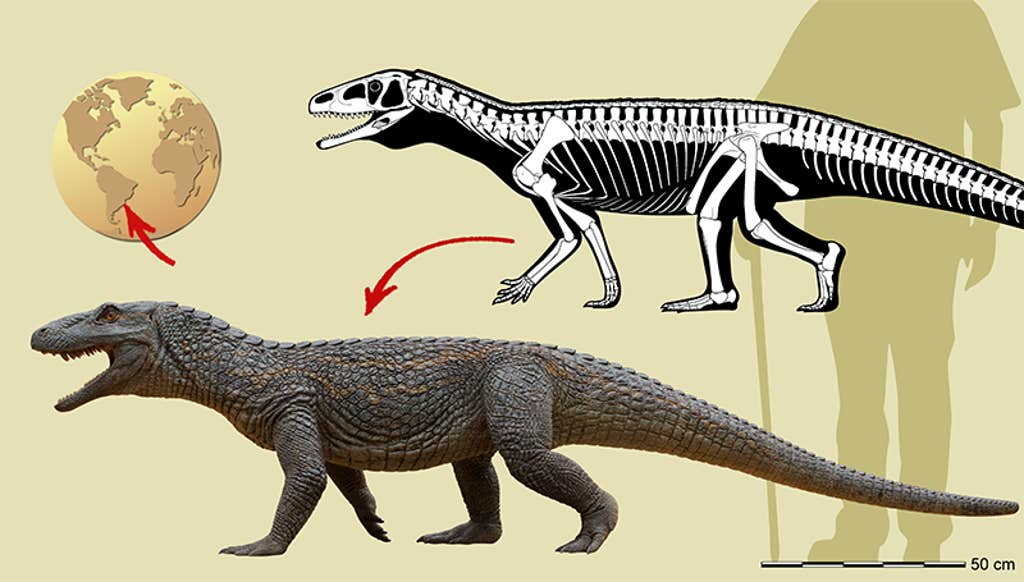
Ancient bones offer tantalizing clues about the life of this giant lizard. Researchers from the Federal University of Santa Maria estimated that T. bellator measured nearly 8 feet long and weighed about 130 pounds, and probably lived near a large expanse of desert. The remains suggest that T. bellatorThe back of was covered in bony places called osteoderms, ornaments shared by modern crocodiles.
ADVERTISEMENT
Nautilus members enjoy an ad-free experience. Log in or register now.
Mobile and long-necked, T. bellator may have caught prey with a jaw filled with sharp teeth that curved inward. Around the Middle Triassic period, crocodilian ancestors like T. bellator ran the show and developed all sorts of unique traits and lifestyles. Pseudosuchia, the group of animals to which it belonged, also included, for example, small predatory species capable of catching even the fastest prey. Overall, certain types of pseudosuchian fossils “have been discovered across much of the world,” according to the journal.
Read more: “How American tycoons created the dinosaur”
This new discovery “shows that, in what is now southern Brazil, reptiles had already formed diverse communities adapted to various survival strategies,” study co-author Rodrigo Temp Müller, a paleontologist at the Federal University of Santa Maria, said in a statement. “Moreover, this discovery reveals that such diversity was not an isolated phenomenon. » But there is still much to learn about pseudosuchians. THE T. bellator the remains were relatively rare finds, as researchers have rarely encountered fossils from some of their lineages.
Yet these old bones also added evidence of an intriguing evolutionary relationship that linked wildlife inhabiting distant lands. Based on analysis of his Pseudosuchia family tree, T. bellator appears to be closely related to Mandasuchus tanyauchena crocodilian ancestor whose remains were found in Tanzania. When both species roamed Earth, around 240 million years ago, the planet consisted of a single supercontinent called Pangea, so these animals had plenty of space to move around. The two sites, before being separated by the Atlantic Ocean, shared other similar types of species.
ADVERTISEMENT
Nautilus members enjoy an ad-free experience. Log in or register now.
Many pseudosuchians perished during the Triassic and Jurassic extinctions around 200 million years ago, but we still have plenty of ferocious crocodiles to remind us of these extinct predators that once dominated their ecosystems.
Enjoy Nautilus? Subscribe for free to our newsletter.
Main image: Caio Fantini


