House poised to pass a bill to force the release of the Epstein files in a bipartisan vote


WASHINGTON — The House is set to overwhelmingly vote Tuesday on legislation requiring the Justice Department to release all of its records relating to the late sex offender Jeffrey Epstein, a major victory for lawmakers from both parties who have led the campaign for months.
The measure, which last week gained enough bipartisan support to pass directly in the House, received new momentum over the weekend, when President Donald Trump reversed his position and urged Republicans to support it.
The bipartisan duo who co-wrote the legislation — Reps. Thomas Massie, R-Ky., and Ro Khanna, D-Calif. — are striving for a veto-proof majority in the House and predicting up to 100 Republicans could vote for it. That number could rise further now that Trump has given his blessing.
“Almost everyone” will vote for it, House Majority Whip Tom Emmer, R-Minn., told NBC News, adding that leaders don’t tell members how to vote.
Such a lopsided vote would put enormous pressure on the Republican-controlled Senate to act on the measure.
“I just think politically, [Republicans] “We have to look beyond 2028 and ask ourselves if they want this on their record for the rest of their political career,” Massie told reporters recently.
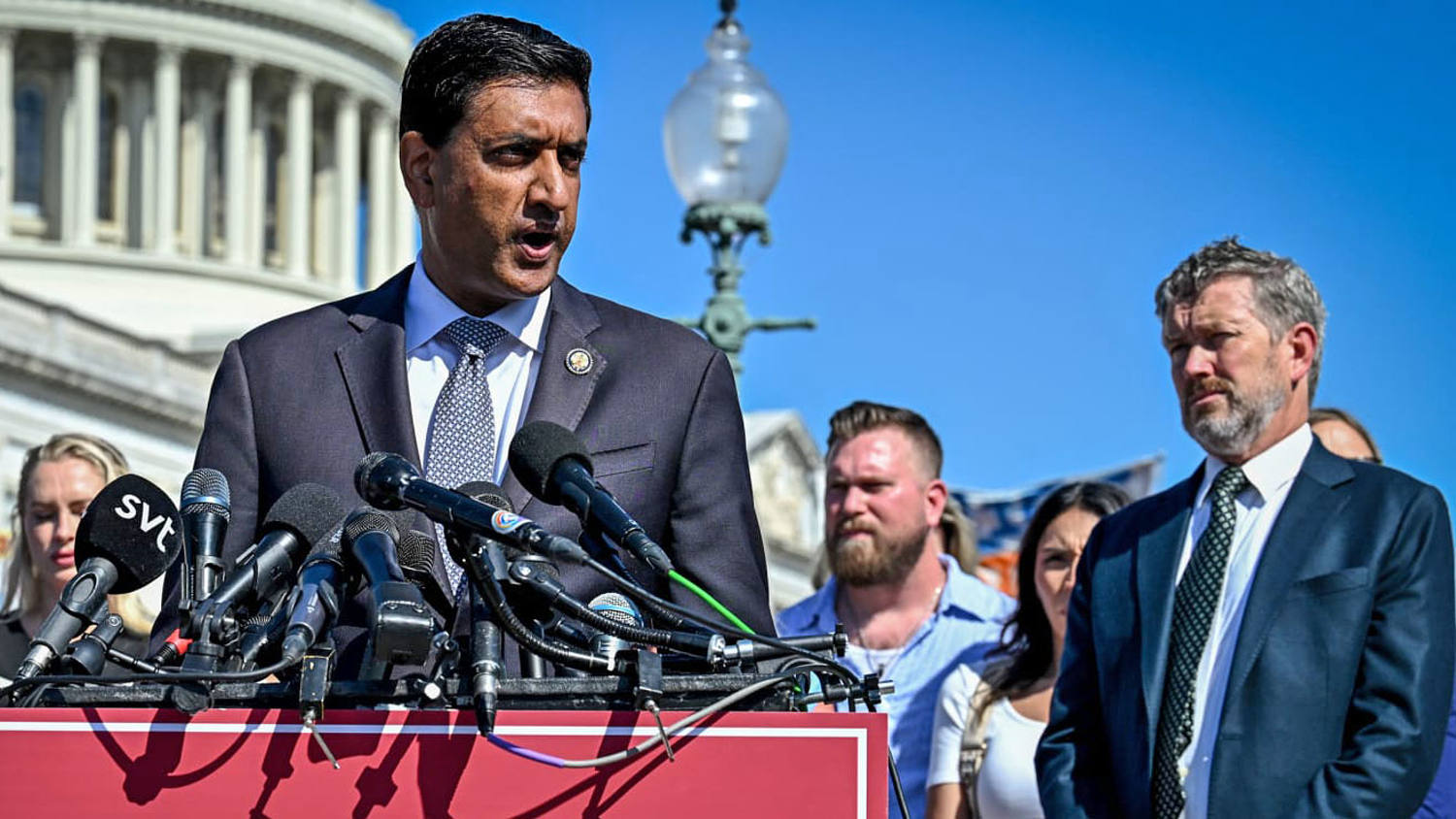
Khanna said he and Massie would hold a news conference with Epstein survivors Tuesday morning, during which they would ask Trump to meet with the survivors.
GOP leaders in the Senate say they all support transparency when it comes to Epstein, but they have not revealed whether they will introduce the bill.
“We’ll see if they send anything to the Senate. And if they do, we’ll look at that,” Majority Whip John Barrasso, R-Wyo., said Sunday on NBC News’ “Meet the Press.” “But we want transparency and accountability.”
Momentum around Epstein’s impeachment petition was building in the House, allowing rank-and-file members to bypass leadership and force a vote.
Every House Democrat was on board, and after Rep. Adelita Grijalva, Democrat of Arizona, was sworn in and became the 218th lawmaker to sign the discharge petition to force a vote, a flood of Republicans began announcing they would vote in favor once it came up.
Trump and the White House had been working behind the scenes to shut down those efforts, trying to pressure a handful of Republican women into dropping the petition. On Friday, Trump ordered Attorney General Pam Bondi to investigate Epstein’s ties to prominent Democrats and financial institutions.
But while the writing was on the wall, Trump abruptly changed course Sunday night, posting on Truth Social that House Republicans should vote for the bill.
Speaking to reporters Monday, Trump, who supported the release of the Epstein files before his re-election last year, pledged to sign the legislation if it reached his desk, which he said would allow the Republican Party to turn the page on the nagging issue and focus on the economy.
“Some of the people we mentioned are being looked at very seriously because of their relationship with Jeffrey Epstein, but they were with him the whole time — I wasn’t. I wasn’t at all,” Trump said in the Oval Office.
“What I just don’t want Epstein to do is damage the great success of the Republican Party, including the fact that Democrats are being blamed entirely for the shutdown,” he continued.
A conservative Trump ally in the House told NBC News that Republicans were largely frustrated by the White House’s dismissive handling of the Epstein saga and had privately encouraged him to change strategy — something that was communicated Friday, days before Trump reversed course on the issue.
The White House was also warned that there would be mass defections from Republicans in the House.
The Justice Department has already turned over tens of thousands of documents from the Epstein investigation to the House Oversight Committee, which is conducting its own investigation and has made many of those documents public.
Additionally, Democrats on the Oversight Committee last week released a series of emails from Epstein to associate Ghislaine Maxwell and journalist Michael Wolff referencing Trump, which Epstein’s estate turned over in response to a subpoena. In a 2019 email, Epstein wrote of Trump, “Of course he knew about the girls when he asked Ghislaine to stop,” but he did not accuse Trump of any wrongdoing.
Trump has always denied any involvement in Epstein’s crimes. The two had socialized in the 1980s and 1990s, including at a 1992 party at Trump’s Mar-a-Lago estate in Florida, where video shows them discussing women. But Trump and Epstein fell out in the 2000s, when Trump accused Epstein of hiring girls and young women from his resort’s spa. Trump said he banned Epstein from Mar-a-Lago.
In 2008, Epstein pleaded guilty to Florida state charges of soliciting prostitution from a minor. In July 2019, the Justice Department charged him with sex trafficking of minors. A month later, authorities said, Epstein killed himself in his jail cell while awaiting trial.
The House Epstein bill would require the Attorney General to release in a searchable and downloadable format “all unclassified records, documents, communications, and investigative materials” related to Epstein and his co-conspirator Maxwell, flight or travel logs, individuals and entities connected to Epstein, and internal emails, memos, and other internal communications of the Department of Justice.
The legislation states that Bondi can withhold or redact any information that identifies victims or that would jeopardize an active federal investigation.
House Speaker Mike Johnson, R-La., has argued for months that the Epstein legislation is unnecessary because the Oversight Committee investigated the matter and made thousands of documents public. He evaded questions Monday about Trump’s about-face and his conversations with the president.
“He never had anything to hide. He and I had the same concern: We wanted to ensure that the victims of these heinous crimes were completely protected from disclosure, those who do not want their names released,” Johnson told reporters. “And I’m not sure the release request does that, and that’s part of the problem.”