Kids get diseases like lupus, too. As researchers hunt better treatments, this camp brings joy

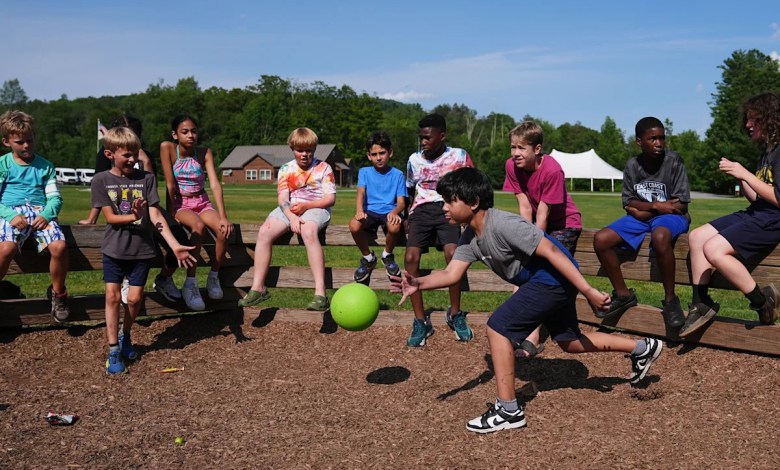
A doctor advising… a night camp? That’s how a 12-year-old with lupus found himself laughing on a ropes course while other campers hoisted him into the air.
“It’s really fun,” said Dylan Aristy Mota, thrilled to have had the chance to participate in the childhood rite — thanks to doctors who reassured his mother that they would be at this camp in upstate New York, too. Dylan felt good knowing that if “something else popped up, they could catch it quicker than if we had to wait until we got home.”
It may seem surprising, but diseases like lupus, myositis and some forms of arthritis, when your immune system attacks your body instead of protecting it, don’t just strike adults. With the exception of type 1 diabetes, these autoimmune diseases are rarer in children, but they do occur.
People often ask: “Can children get arthritis?” Can children have lupus? said Dr. Natalia Vasquez-Canizares, a pediatric rheumatologist at Montefiore Children’s Hospital, who partnered with the Frost Valley YMCA last summer so some of these young people could try a traditional overnight camp despite a strict medicine schedule and nervous parents.
“Imagine for an adult, it’s difficult. If you’ve had this disease since you were young, it’s very difficult, you know, to deal with it,” she said.
Special challenges for children
The younger a person is when certain illnesses strike, especially before puberty, the more severe the symptoms can be. And while genes can make people of any age more vulnerable to autoimmune diseases, it usually takes other factors that stress the immune system, like infections, to cause the disease to develop.
But genes are more to blame when the disease strikes early in life, said Dr. Laura Lewandowski of the National Institutes of Health, who helps lead international research into the genetic changes that fuel childhood lupus.
Symptoms in children can be sneaky and difficult to identify. Rather than expressing joint pain, a very young child might walk with a limp or regress to crawling, Vasquez-Canizares said.
“Before, I looked like everyone else, like usual,” Dylan said. Then, “my face turned bright pink and it started getting redder and redder.”
His family thought it must be allergies, and Dylan recalled numerous doctor’s appointments before being diagnosed with lupus last January.
The treatment also presents unique challenges. Medications that alleviate symptoms do so by suppressing the young immune system, just as it learns to fend off germs. They can also affect the strength of children’s bones.
Research underway to help children
But promising treatments are under development. Seattle Children’s Hospital recently opened the first clinical trial of what’s called CAR-T therapy for pediatric lupus. These “living drugs” are made by reprogramming certain patients’ immune soldiers, T cells, to find and kill another type, B cells, which can go crazy. Tests in adults with lupus and a growing list of other autoimmune diseases are showing promise, putting some people into long-term, drug-free remission.
And sometimes a mother’s autoimmune disease can harm her child, such as a rare fetal heart defect that requires a lifelong pacemaker if the baby survives. Dr. Jill Buyon of NYU Langone Health is studying how to block this defect — and just reported a healthy girl born to a mother with mild lupus.
“This is a rare example where we know the exact time when this is going to happen,” allowing a chance for prevention, said Dr. Philip Carlucci, a rheumatology researcher at New York University and co-author of the study.
What happens: A type of antibody, found in lupus, Sjögren’s disease and some other autoimmune diseases, can impair the heart’s ability to beat properly if enough crosses the placenta during key heart development. Certain treatments can reduce but not eliminate the risk. Buyon’s team is testing whether a drug used to treat another autoimmune disease might better protect the fetus.
Kelsey Kim jumped on the experimental treatment during her last pregnancy, “partly hoping to save my own baby and partly hoping to save other people’s babies and spare them the pain I had felt.”
Her first daughter was born healthy, although doctors did not mention that the baby’s temporary lupus rash was a warning of risk for future pregnancies. Kim then lost a son to congenital heart block at 22 weeks pregnant. Her second daughter’s heart suffered less damage, and she is now a healthy 2-year-old thanks to a pacemaker.
A third daughter was born healthy in June after Kim received the experimental drug during weekly visits, spanning about three months, to NYU from her home in northern Virginia. A single case does not constitute proof, and Buyon has NIH funding to soon launch a clinical trial in other high-risk pregnancies.
Helping children to be children
Back at the New York overnight camp, the goal was some normalcy for children governed by strict medication schedules that can make it difficult to be away from family.
“I can kind of forget about it,” Ethan Blanchfield-Killeen, 11, said of the form of juvenile idiopathic arthritis — similar to rheumatoid arthritis in adults — that can leave his joints stiff and painful.
One day, a doctor examined his hands at the camp. Another day, he ran across the splattered lawn in a fierce paint game.
“Just seeing them from a different perspective” than the sterile doctor’s office “almost brings tears to my eyes,” said Vasquez-Canizares, a Montefiore rheumatologist.
___
The Associated Press Health and Science Department receives support from the Howard Hughes Medical Institute’s Department of Science Education and the Robert Wood Johnson Foundation. The AP is solely responsible for all content.