Texas appeals ruling that Trump-urged voting map is racial gerrymandering : NPR

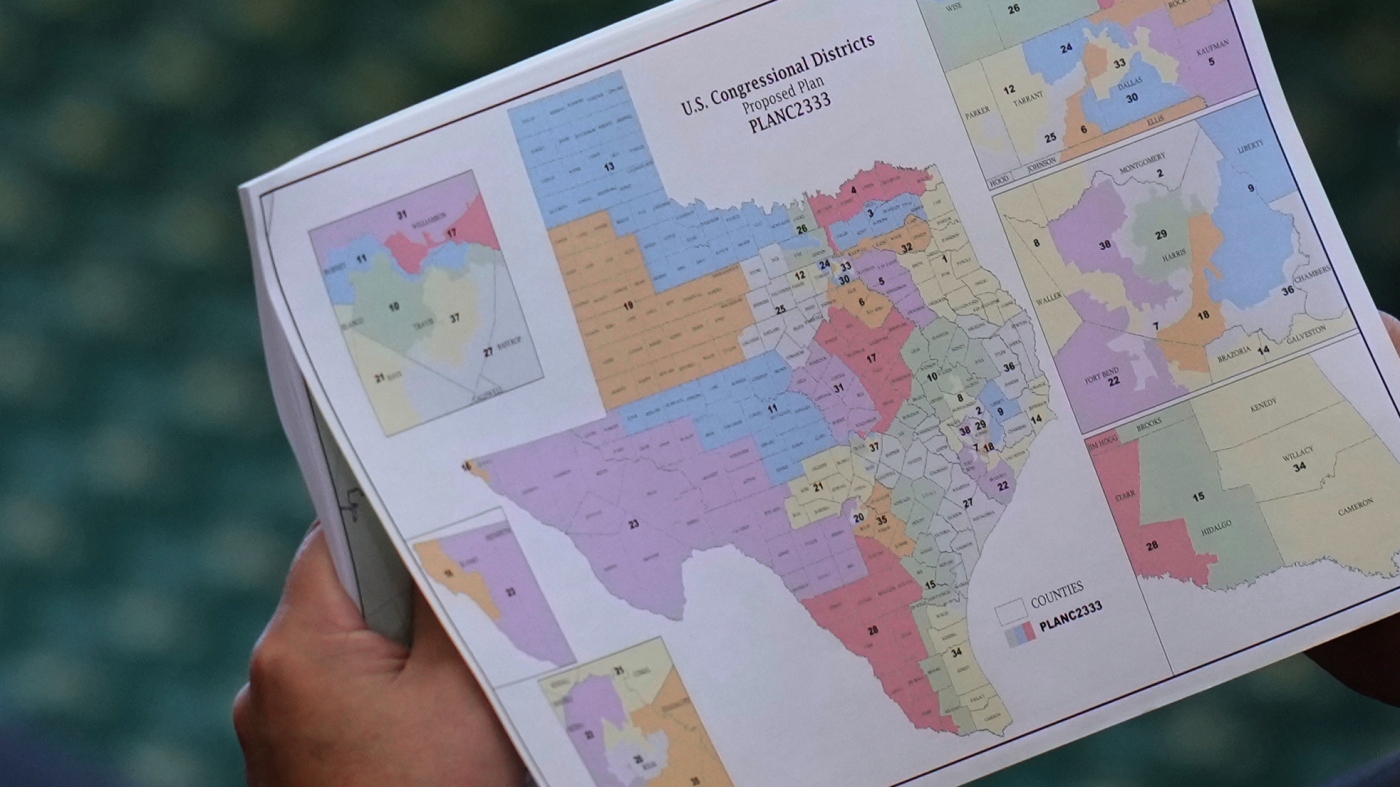

A Texas lawmaker examines a redistricting map during debate in the state Senate in August.
Eric Gay/AP
hide caption
toggle caption
Eric Gay/AP
Texas Gov. Greg Abbott quickly appealed to the Supreme Court a ruling that said redistricting passed by lawmakers at President Trump’s request was based on racial gerrymandering.
“Any claim that these maps are discriminatory is absurd and unsupported by the testimony presented during the ten days of hearings,” Republican Abbott said in a statement. “This decision is clearly erroneous and undermines the authority that the U.S. Constitution vests in the Texas Legislature to impose a different map by judicial fiat.”
A three-judge panel earlier Tuesday placed a temporary hold on the map that Republican lawmakers passed this summer and ordered the state to use district maps from the last two elections.
The map that was overturned was designed to give Republicans an advantage by flipping up to five House seats held by Democrats.
“Certainly, politics played a role in crafting the 2025 map. But it was much more than politics. Substantial evidence shows that Texas racially truncated the 2025 map,” the majority of a three-judge panel wrote.
The panel heard a trial on the case in October. The plaintiffs included several civil rights groups and individuals.
This decision is a blow to Trump and the Republicans. national redistricting race that started in Texas this summer.
Texas Attorney General Ken Paxton, who announced his candidacy for the U.S. Senate, also said he would appeal the decision regarding the “Big Beautiful Map,” which he called “completely legal” in a statement.
Democrats welcomed the court’s decision. “Race has always been a driving factor and a driving factor in making it harder for minority Texans,” Texas Congresswoman Lizzie Fletcher said in an interview. “This map was drawn to make it more difficult for them to impact the election.”

The court’s 2-1 decision comes at a pivotal moment. Across the country, Trump is pressuring Republican state lawmakers to reshape voting maps in Congress to hold the party’s slim majority in the House and support his agenda.
Using their strong Republican majority in the Legislature, Texas lawmakers in August passed a map intended to help their party grow its ranks in the 2026 elections to the U.S. House of Representatives.
The process gained national attention when Democrats in the Legislature fled the state for more than two weeks to delay a vote and Republican leaders threatened to stop them. Democrats argued that the new map weakened the voting power of Latino and Black communities.
Texas redistricting also spurred California Democrats to act. This month California voters succeeded a move allowing redistricting that could help Democrats win five seats in the state.
Was it partisan gerrymandering or racial gerrymandering?
Republicans in the Texas Legislature I passed the card saying it was designed to improve their party’s chances of winning five congressional seats. They noted that, unlike some states, Texas law does not prohibit redistricting for partisan purposes and that the U.S. Supreme Court ruled in 2019 that federal courts cannot intervene once it’s done.
But partisan gerrymandering can often overlap with racial gerrymandering, which is illegal. Card opponents argue in court that he intentionally decreased the voting power of minority communities.

Texas State Sen. Sarah Eckhardt, a right-wing Democrat, questions Republican Sen. Phil King during the August debate over the Republican-backed district map that a federal court blocked and called a racial gerrymander Tuesday.
Eric Gay/AP/AP
hide caption
toggle caption
Eric Gay/AP/AP
The 160-page opinion was written by District Judge Jeffrey V. Brown, a Trump appointee during his first term as president. His decision is based on statements and contradictions in what Republican lawmakers said when passing the maps.
A letter written by the Justice Department to encourage redistricting ended up being grounds used by the court to block the effort.
The justices noted that when Governor Abbott initially called lawmakers into session to draw the map, he cited a letter from the Department of Justice officials criticized districts with majority nonwhite populations as “racial gerrymanders.” In other words, the letter implied that the districts as they existed gave an advantage to non-white voters and that this needed to be reversed.
Ultimately, Texas Republicans said the map was not intended to correct a racial bias but for partisan gain.
That letter put lawmakers, who had for years denied the use of race when creating maps, in “a difficult situation,” according to political scientist Josh Blank of the University of Texas at Austin, because they were “ultimately saying opposite things.”
Brown’s ruling criticized the construction of the letter itself, which was sent by Harmeet Dhillon, head of the Justice Department’s civil rights division. “It is difficult to unpack the DOJ letter because it contains numerous factual, legal, and typographical errors,” Brown wrote.
“This decision is a rebuke to Donald Trump and, to some extent, a rebuke to Texas lawmakers,” said Brandon Rottinghaus, a political scientist at the University of Houston. “They believe the process was flawed and that the Justice Department was not credible in its legal arguments.”
Rep. Gene Wu, the Democratic leader in the Texas House, said Tuesday’s ruling shows the courts are staying true to American principles.
“The nullification of the maps is basically a sign that the courts still believe in the fundamental principles of this country: the idea of one man, one vote is something absolute and must be upheld,” Wu said.
Throughout the country, Republicans have more options for redistricting the seats are their way than Democrats, in part because the GOP controls more state legislatures. Usually, states conduct redistricting at the beginning of the decade following the national census.
At Trump’s urging, lawmakers in Missouri and North Carolina passed new maps that could help the Republican Party win a seat in each state. Ohio drew a map that analysts say gives Republicans a slight advantage in a few seats.
For Democrats, in addition to the five seats that could be gained in California, court-ordered redistricting in Utah could help Democrats win a seat there. And Virginia Democrats have begun a process that could yield two seats in that state.
Blaise Gainey covers state politics for The Texas Newsroom. Andre Schneider covers politics and government for Houston Public Media.
Larry Kaplow with NPR contributed to this story.


