Neanderthals also kissed: A gesture of love that is 21 million years old | Science


The kiss is a great evolutionary mystery. This gesture, which consists of pressing one’s lips against those of another individual, does not appear to offer any advantage in terms of reproduction or survival of species, and can even cause problems, such as the transmission of diseases. However, the vast majority of humans (and many other animal species) enjoy it immensely, so much so that kissing has inspired poems, songs, paintings, and films for centuries.
However, a study carried out by the University of Oxford dates the beginning of this gesture, which can express love, desire, affection or reconciliation: researchers estimate that it is around 21 million years old. The study found that this behavior evolved in the common ancestors of humans and other great apes, and that Neanderthals probably kissed too, with a probability of almost 84 percent. The results, published Wednesday in the journal Evolution and human behaviorreveal that, far from being a recent human cultural invention, kissing is an ancient trait deeply rooted in our biology.
“This is the first time anyone has taken a broad evolutionary perspective to examine kissing. Our findings add to a growing body of work highlighting the remarkable diversity of sexual behaviors exhibited by our primate cousins,” Matilda Brindle, lead author of the study and an evolutionary biologist in the Department of Biology at Oxford, said in a statement.
The Oxford team attempted for the first time to reconstruct the evolutionary history of kissing using a cross-species approach, based on the primate family tree. The first challenge was defining exactly what constitutes a kiss, something much more complex than it seems.
“A lot of mouth-to-mouth behavior looks like kissing, but it’s not,” Brindle pointed out. Since researchers were studying kissing in different species, they needed a definition that applied to a wide range of animals. Finally, the one they proposed is rather prosaic: “Non-aggressive contact, mouth to mouth, without transfer of food”.
From bonobo to Neanderthal
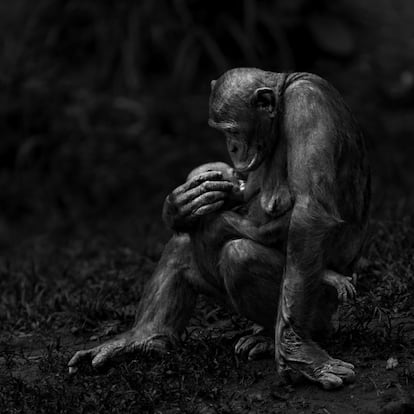
Using this definition, the researchers compiled data from the scientific literature on which modern primate species have been observed kissing. The results show that kissing is present in most great apes: chimpanzees, bonobos and orangutans. Outside of primates, kissing has been documented in animals as diverse as polar bears, wolves, prairie dogs, and even some birds. There are, however, significant differences between species: the bonobo’s kiss is “surprisingly sensual,” according to research, while the chimpanzee’s is “brief and tense.”
To reconstruct the evolutionary history of kissing, the researchers used a statistical approach (called Bayesian modeling) to simulate different evolutionary scenarios along the branches of the tree, and thus estimate the probability that different ancestors also kissed. The model was run 10 million times to provide robust statistical estimates, they explain.
The results indicate that kissing evolved in the ancestors of great apes between 21.5 and 16.9 million years ago, after they diverged from smaller apes such as gibbons. This behavior has persisted throughout evolution and is still present in most modern great apes.
“By integrating evolutionary biology with behavioral data, we are able to draw informed conclusions about traits that do not fossilize, such as kissing. This allows us to study the social behavior of modern and extinct species,” explained Professor Stuart West, co-author of the study and professor of evolutionary biology at Oxford, in a statement.
One of the study’s most surprising findings is that Neanderthals, our extinct human relatives, very likely kissed, too. Phylogenetic analysis estimates the probability that this species practices kissing at 84.3%.
This finding adds to previous studies showing that modern humans and Neanderthals shared oral microbes, particularly bacteria. Methanobrevibacter oralisby saliva transfer. Although modern humans and Neanderthals diverged between 450,000 and 750,000 years ago, this oral microbe did not separate into distinct strains until between 112,000 and 143,000 years ago. This suggests that the species exchanged microbes for an extended period after their separation. “We suspected that Neanderthals probably kissed,” Brindle explained via video conference, “but it was great that we were able to confirm it. A probability of 84% is a pretty strong result,” he added.
Paleoanthropologist Antonio Rosas, who was not involved in the study, believes that this relationship is “a little weak”, since the transfer of bacteria could be done by a kiss, “but it could also be a bacteria inherited from common ancestors”.
The study also explains that although it has been around for millions of years, the act of kissing is not universal among humans. “This is only documented in 46% of human cultures,” Catherine Talbot, co-author and assistant professor in the College of Psychology at the Florida Institute of Technology, said in a statement. “Social norms and context vary greatly between societies, raising the question of whether kissing is an evolved behavior or a cultural invention.”
If kissing carries risks of disease transmission, there must be compensating adaptive benefits. The researchers explored several hypotheses. In a sexual context, kissing could help assess the quality of a potential partner using olfactory signals. It could also serve to increase pre-copulatory arousal, thereby increasing the chances of fertilization. Additionally, data from this study suggest that pre-chewing (parents feeding their offspring pre-chewed food) is present in all kissing species, suggesting that kissing may have evolved from this parental protective behavior.
Boundaries
The authors of the study themselves recognize its limitations. Data are scarce, particularly outside of great apes, and most sightings come from captive animals rather than wild populations. “It is important to view our analysis as a proof of concept for future work,” cautions Brindle. The experts hope their study will establish a framework for future research and help systematize the recording of kissing behaviors in non-human animals.
“This is an interesting study that opens up a new way of thinking about a behavior that appears to be universal among great apes. This means that the likelihood of observing kissing among Neanderthals is high,” says Clive Finlayson, director of the Gibraltar Museum, who was not involved in the study. It also highlights several life history variables that correlate “reasonably, but not perfectly,” he says, with the presence of kissing in monkeys: multi-male mating systems and pre-chewing. “Of course, we don’t know if these variables would apply to Neanderthals,” he admits.
Brintle concludes her study with a quote widely attributed to actress Ingrid Bergman: “A kiss is a beautiful trick designed by nature to stop speech when words become superfluous.” » A tip which, according to this new study, is 21 million years old.
Register for our weekly newsletter to get more English media coverage from EL PAÍS USA Edition


