Family caregiving can be a gift, but it takes support : NPR

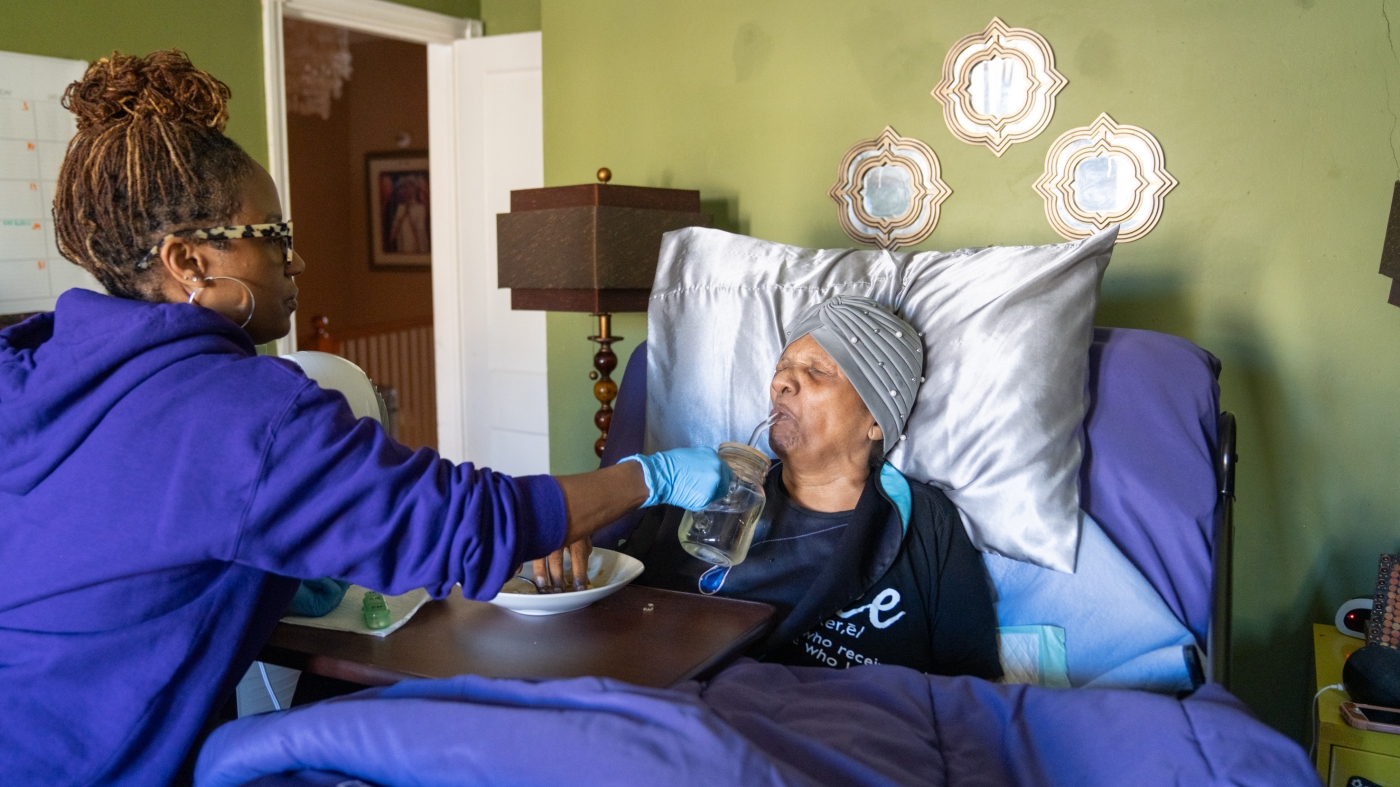

Dawnita Brown gives her mother, Joan Cain, water to help her swallow pills after breakfast. Brown is the primary caregiver for her mother and father, who live with her in Baltimore.
Claire Harbage/NPR
hide caption
toggle caption
Claire Harbage/NPR
At 43, Dawnita Brown changed her life.
She took leave from her secure government job, cleared out her assets, sorted out her financial responsibilities and, in 2016, enrolled in the Peace Corps. Volunteering in Eswatini was “amazing,” she said — so much so that she planned to extend her time overseas in a paid position with the Peace Corps after her service ended.
Little did she know she was about to make another pivot.
In 2018, his mother, Joan Cain, had a brainstem stroke. Brown rushed home to Baltimore, preparing to say goodbye. Instead, her mother recovered, but with a difficult prognosis.
“So, I became his proxy,” Brown says, and she stayed by Cain’s side in rehabilitation and nursing centers. Eventually, concerns about the quality of her mother’s care led Brown to quit her job, bring her mother home and care for her herself, full time.

Family photos adorn Joan Cain’s bedroom wall. The central image is from his 70th birthday, five years ago.
Claire Harbage/NPR
hide caption
toggle caption
Claire Harbage/NPR
Many of today’s 65-year-olds — more than two-thirds — will likely need long-term care as they age, whether it’s in-home care, an assisted living facility or a nursing home. These services can easily cost more each year than the average American earns.
And health insurers – public and private – may not provide the necessary coverage.
This forces many people to rely on unpaid family caregivers whose care is valued at $600 billion in 2021. That’s more than half a trillion dollars of work done by people like Dawnita Brown.
As a family, Brown makes caregiving financially feasible through a patchwork of coverage, including Medicare, supplemental insurance and her mother’s pension. And she’s debt-free thanks to the work she’s done to prepare to join the Peace Corps. “I haven’t had a steady income in almost 10 years,” Brown says. “I haven’t contributed to my retirement. But I don’t lack anything.”

High: Brown walks up the stairs to his mother’s room. With his mother upstairs and his father in the basement, Brown is constantly running up and down the stairs to care for both of them. LEFT: Brown cuts pancakes into bite-sized pieces for his mother. RIGHT: Brown organizes his mother’s medications for the coming week.
Claire Harbage/NPR
hide caption
toggle caption
Claire Harbage/NPR
“It’s a gift”
Brown the house is warm and welcoming, just like her. The brick rowhouse is tastefully appointed with meaningful family artifacts and photographs, meticulously clean without appearing sterile.
On the day of our visit, Brown had just returned from taking his father, Bill Lee Brown, to physical therapy. She cares about him too. Although Bill and Joan are not a couple, he moved into the house in 2024 after complications from his multiple myeloma diagnosis made it difficult for him to live alone.
So while his mother is upstairs, his father is downstairs. Between the two of them, climbing countless stairs a day, Dawnita Brown holds it all together. Fill prescriptions, prepare meals, schedule appointments, and call for help when this cannot be handled by one person. Caregiving is a role she didn’t expect, but one she has fully embraced.
In 2021, Brown founded a community for fellow caregivers called Binti Circle. The name comes from the Swahili word girl.

Brown stands in her garden, which she calls her oasis.
Claire Harbage/NPR
hide caption
toggle caption
Claire Harbage/NPR
“I created Binti because it was the community I needed and didn’t have,” she says. They meet monthly, organize outings and events, all with the goal of making a difference in the lives of caregivers, reducing stress and keeping the community safe.
This way, Brown says, “you have more of the skills and tools that you need for this gift of care, because it’s a gift to be able to take care of your parents, even if it’s difficult.”
She says it was especially important for her to focus on Black girls who play caregiver roles. “The girl holds on,” Brown says, even in tough situations. “Watching the fragility of your parent, dealing with the grief of losing the parent you knew…that your mother doesn’t know you.”
She adds: “And you know, what’s even harder is girls taking care of parents who didn’t raise them.” In the Binti Circle, she brought together “a community of girls who understand and can empathize, without judgment.”
One of Binti’s — and Brown’s — core values is the importance of respite for caregivers.

Brown helps his father, Bill Lee Brown, use a compression machine on his legs. His father lives in the basement of the house.
Claire Harbage/NPR
hide caption
toggle caption
Claire Harbage/NPR
“You know, most people think of self-care as nails, hair and massage,” she says. Brown does these things, but taking care of herself also includes regular doctor appointments and therapy, as well as simpler things. “It’s breathing, just sometimes lying in bed and breathing. And my devotions, I always set the tone before I get out of bed.”
And as positive and driven as Brown is, she sometimes feels depressed.
“Yesterday I felt a little gross,” she said. “And so I got up and found a yoga session to improve your mood.” She also built her own little getaway at home: an outdoor deck furnished with thrifted and upcycled finds, succulents and a fire pit. She calls it her oasis.
“You’re responsible for people,” Brown says, so “if you’re not good, they’re not good. And that’s why I work very hard to take care of myself.”