Students ‘anxious but hopeful’ at mock COP30 talks


Hugh CasswellEast Midlands Environment Correspondent

 BBC
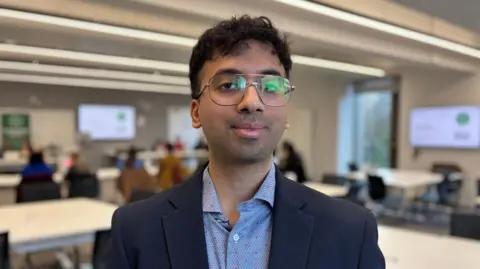
BBCAs COP30 in Brazil draws to a close, students at the University of Leicester have organized their own climate talks.
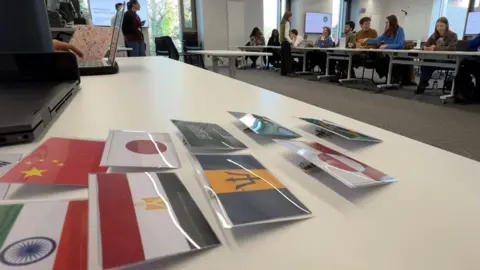
Students played the role of different countries, gave speeches and “negotiated” with each other to reach international agreements during the “Mock COP” conference held on Wednesday.
Mohammed Siddiqui, an engineering doctoral student and chair of the student union’s sustainability council, said it allowed participants to put themselves in the shoes of world leaders.
“As our generation inherits the next era of decision-making, of governance… we want to make sure that we have a planet that we can sustain, but that future generations can also maintain,” he said.
Human geography student Andrew Alvedro, who chose to represent Spain, said there was an “air of anxiety” among the young people, but also “a feeling of disillusionment”.
“When I told some of my friends I was going to an event like this, they asked me ‘what is COP?’ – it’s a bit worrying,” he said.
“I think this kind of evidence shows that some of us are just putting our heads underground.”
He added that he was “cautiously optimistic” about progress in tackling climate change.
“We know the science, we have the technology to deal with this crisis and yet instead of managing it, we are going around in circles,” he said.
“We have to solve the political problem because the science has already proven itself.”
This year marks the tenth anniversary of the historic climate agreement reached at COP21 in Paris, during which countries committed to trying to limit the rise in global temperatures to 1.5°C.
However, UN Secretary-General António Guterres warned that “exceeding” 1.5°C was now inevitable and the limit was exceeded for the first time in 2024 for a full year.
Nour El Imane Boubekeur, who studies French and English law, represented her home country, France, at the “Mock COP”.
“I feel quite anxious, but I also have some hope in humanity,” she said.
“We have managed to reach big deals like the 2015 Paris Agreement, so I still hope we are not completely lost.”
“We can still make some changes, but we need to make them now if we don’t want to live in a nightmare.”
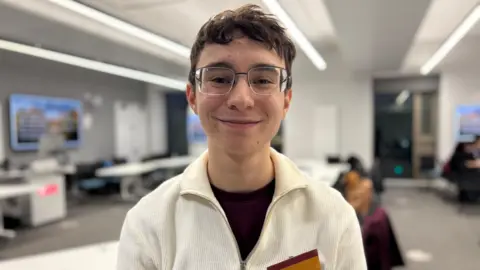
Political science and international relations student and “Australian delegate” James Charlton echoed feelings of anxiety mixed with hope.
“When we talk about what’s going to happen in 20, 30, 50 years, I end up thinking: This is my life, this is the world I have to live in,” he said.
“There are so, so many people, my age and younger, who are very willing to jump in and try to do better.”
Patrizia Szewernoha, a German exchange student studying media and communications, said she chose to represent the UK because she wanted to learn more about UK politics.
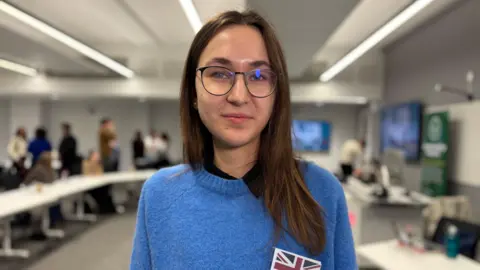
She said she felt “sad and disappointed” by the actions of some world leaders.
Before COP30, most countries did not submit updated plans on how they would reduce their greenhouse gas emissions.
“Sometimes it feels like they’re blaming these problems on our generation, that it won’t be a problem for them,” Ms. Szewernoha said.
Donald Trump did not attend COP30 and the US government said it would not send any high-level officials.
In a speech to the UN in September, the US president called climate change “the greatest scam ever perpetrated on the world”.
He also attacked the scientific evidence for rising temperatures.
The overwhelming majority of scientists and experts agree that climate change is man-made and real.
COP30 officially ends on Friday November 21.