UK did ‘too little, too late’, leading to thousands more deaths


Nick TrigleHealth correspondent
The UK’s Covid response was “too little, too late” and led to thousands more deaths in the first wave, an investigation into government decision-making has found.
The report also states that the lockdown could have been avoided if voluntary measures such as social distancing and isolation of people with symptoms as well as household members had been put in place before March 16, 2020.
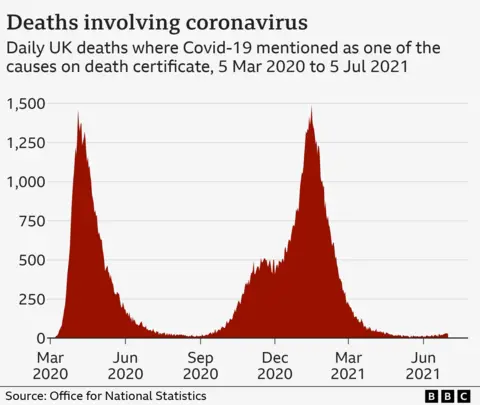
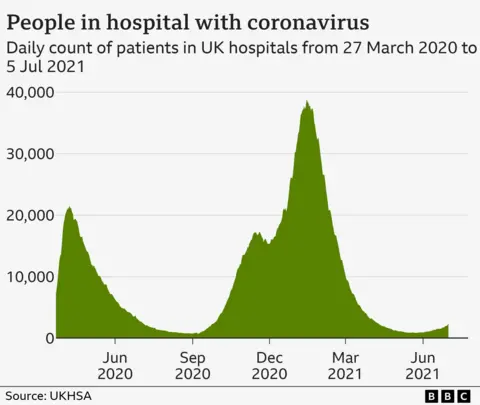
By the time ministers acted it was too late and the lockdown was inevitable, the report said, and then a week’s delay in its introduction led to 23,000 more deaths in England in the first wave than would otherwise have been the case.
The report criticized the governments of all four countries and described a “chaotic culture” in Downing Street.

 Getty Images
Inquiry chair Baroness Hallett said that although the government was faced with unenviable choices under extreme pressure, “all four governments failed to understand the scale of the threat or the urgency of the response it demanded at the start of 2020”.
Ministers were partly relying on “misleading assurances” that the UK was ready, she said.
Government scientists underestimated how quickly the virus was spreading and initially advised not to introduce restrictions until the spread of the virus was near its peak to help build herd immunity, Lady Hallett added.
At nearly 800 pages, the report – which is the second of ten planned by the investigation – also notes a number of other shortcomings:
- He called it “inexcusable” that the same mistakes of spring 2020 were repeated in the autumn as the second wave began to build and Prime Minister Boris Johnson repeatedly changed his mind on the need for tougher restrictions, meaning England’s second lockdown was only introduced in November when control had been lost.
- Failure to follow the rules by politicians and their advisers – Dominic Cummings’ trip to Durham and Barnard Castle in March 2020 was documented – has undermined public confidence in the decision-making process and significantly increased the risk of people not complying with the measures.
- The report described a “toxic and chaotic” culture within government during its response to the pandemic, which it said affected the quality of advice and decision-making.
- The four countries were criticized for their planning and decision-making, which the report said was hampered by a lack of trust between Boris Johnson and the prime ministers.
- The Eat Out to Help Out scheme, suggested by Chancellor Rishi Sunak and agreed to by Johnson to support hospitality venues in August 2020, was “designed in the absence of any scientific advice” and “undermined public health messaging”.
- The impact on vulnerable groups – the elderly, the disabled and some ethnic minorities – was not sufficiently taken into account when deciding how to respond to the virus, even though the harm they might suffer was foreseeable.
- Children have not been prioritized sufficiently, with ministers failing to properly consider the consequences of school closures.
The report says lockdowns, while helping to save lives, have left lasting scars on society, ending ordinary childhood, delaying treatment for non-Covid health problems and worsening inequalities.
Modeling which shows that 23,000 deaths could have been avoided in confinement one week before March 23, 2020 was carried out in 2021. This figure would have been equivalent to 48% fewer deaths during the first wave until July 1, 2020.
But the report does not suggest that the total number of deaths from the pandemic – 227,000 in the UK by the time it was declared over in 2023 – would have been reduced.
This is very difficult to say, as it depends on various other factors that could have reduced or increased the number of deaths as the pandemic progressed.
The survey, however, praised the government for the “remarkable” rollout of the vaccination program and the manner in which it emerged from lockdown in early 2021, allowing time for vulnerable groups to be vaccinated. The report describes this as a turning point for the UK.
The report makes a series of different recommendations, including:
- Better consider the impact that decisions could have on those most at risk – both from the disease and the measures taken to respond to it
- Broaden participation in the Sage Scientists Advisory Group – including with representatives from the devolved governments – alongside the establishment of other expert groups to advise on economic and social implications
- Reform and clarify emergency decision-making structures within each nation
- Improving communication between the four nations in the event of an emergency
Deborah Doyle, of Covid-19 charity Bereaved Families for Justice, said it was “devastating to think of the lives that could have been saved” under different leadership.
“We now know that many of our family would still be alive today without the leadership of Boris Johnson and his colleagues.
“Throughout the pandemic, Boris Johnson put his political reputation ahead of public safety. He bowed to his critics when the UK needed decisive action.”
Johnson has not yet responded to the findings.
But Cummings, who was a senior adviser to Boris Johnson at the start of the pandemic, accused the investigation of a mix of “cover-up and rewriting history”.
In a social media post, he said he was offered the chance to respond to the investigation’s findings before the report was released but declined, calling it “internal corruption.”
He said experts “advised us to do almost nothing” and “advised against any serious restrictions” because the country would reach “natural herd immunity” by September.
Prime Minister Sir Keir Starmer said the government would “carefully consider” the findings and recommendations.
He said improvements had been made to how the government would respond to a major crisis, but added: “It is clear that local government and our public services, including the NHS, are under immense pressure and, in many cases, have not fully recovered from the pandemic. »
“The cost of the pandemic still weighs heavily on public finances.”
Liberal Democrat leader Sir Ed Davey has called on Conservative Party leader Kemi Badenoch to apologize on behalf of her party, saying the news that the lockdown could have been avoided was “upsetting”.
“This tragedy must never happen again,” he added.
Additional reporting by Cachella Smith


