This moss survived 9 months outside the International Space Station and could still grow on Earth

When you purchase through links on our articles, Future and its syndication partners may earn a commission.

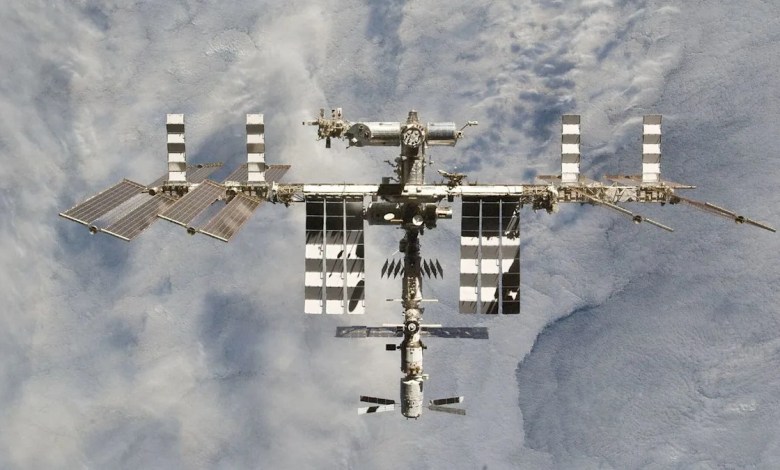
The International Space Station is home to various experiments. . | Credit: NASA
This little plant is much tougher than it seems.
The researchers exposed the moss spores to hostile space environment for nine months recently, and the results were surprising, a new study reports.
“Most living organisms, including humans, cannot survive, even briefly, in the vacuum of space,” study lead author Tomomichi Fujita of Hokkaido University in Japan said in a statement. statement. “However, moss spores retained their vitality after nine months of direct exposure. This provides striking evidence that life that evolved on Earth has, at the cellular level, intrinsic mechanisms to withstand the conditions of space.”

Germinated moss spores after spatial exposure. | Credit: Dr Chang-hyun Maeng and Maika Kobayashi
Mosses are one of the oldest plants Earth. They evolved over 400 million years ago and lack some of the characteristic traits of more “advanced” flora: for example, they do not have a vascular system that transports water and nutrients throughout their bodies. But many moss are quite resilient and thrive in extreme environments around the world, from the Arctic tundra to the sands of the Sahara.
Fujita and his team wanted to see if this resilience extended beyond Earth. So, they carried spores of a widespread species known as “widespread earthmoss” aboard Northrop Grumman’s 17th ship. Swan cargo spacecraft, which launched towards the International Space Station (ISS) in March 2022.
Scientists selected the spores – or more precisely the sporophytes, the reproductive structures that produce the spores – after conducting a few experiments here on Earth. These experiments involved exposing sporophytes, as well as juvenile moss and moss stem cells, to space-like conditions in the laboratory: a vacuum environment, microgravityhigh levels of ultraviolet (UV) radiation and large temperature variations.

The spatial exposure unit used for the experiment, alongside a 100 yen coin for scale. | Credit: Tomomichi Fujita
The researchers determined that UV radiation was the main stressor for the moss and that the sporophytes handled it – and other challenges – much better than the juvenile moss and its stem cells.
So they sent sporophytes to the ISS. The astronauts affixed the samples outside the station, where they remained for 283 days before returning to Earth on a plane. Dragon cargo capsule in January 2023. (Cygnus was not designed to survive the return trip to Earth, but the Dragon crew and cargo ship are reusable.)
Fujita and his colleagues were surprised when they examined the spores carried into space.
“We expected almost zero survival, but the result was the opposite: most of the spores survived,” he said. “We were truly amazed by the extraordinary durability of these tiny plant cells.”

A reddish-brown sporophyte can be seen at the top center of a leafy gametophore. This capsule contains many spores inside. Mature sporophytes like these were collected individually and used as samples for the space display experiment conducted on the International Space Station Display Facility. | Credit: Tomomichi Fujita
In fact, more than 80% of the sporophytes were still alive and 89% of these survivors were able to germinate in the laboratory. Spaceflight caused a 20 percent reduction in chlorophyll a, the main pigment involved in photosynthesis, but the spores appeared healthy despite the drop, the team found.
Indeed, the sporophytes likely could have survived much longer in the final frontier – around 5,600 days, according to a mathematical model developed by the researchers.
“This study demonstrates the astonishing resilience of life native to Earth,” Fujita said. (We have already had a glimpse of this resilience, which manifests itself in a variety of organisms, such as bacteria And tardigrades.)
The new research could also have implications for travel beyond our home planet, Fujita added.
“Ultimately, we hope this work will open a new frontier toward building ecosystems in extraterrestrial environments such as the moon And March“, he said. “I hope our research on moss will serve as a starting point.”
THE new study was published Thursday, November 20 in the journal iScience.


