Why Trump’s claim of falling food stamp use might not mean the economy is improving


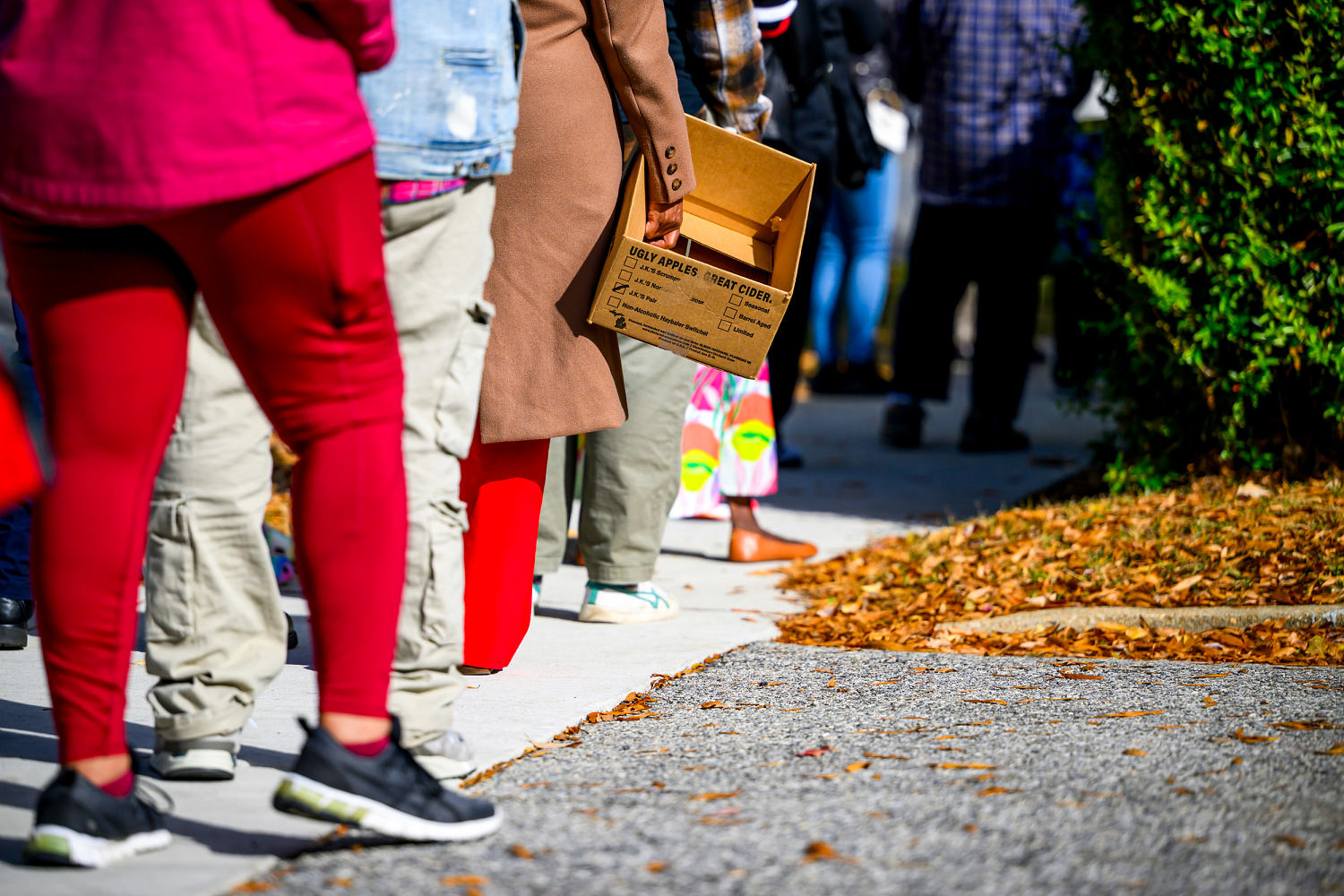
President Donald Trump recently turned to a new economic metric to try to convince Americans that his policies are boosting the economy: the number of people receiving federal food aid.
“In nine months, we have freed more than 600,000 Americans from food stamps,” he said Tuesday at the U.S.-Saudi Investment Forum in Washington.
Days earlier, Trump cited that number at the McDonald’s Impact Summit, saying, “It’s really because we have a really strong economy.” And last month, he also highlighted this figure at a gathering of business leaders in South Korea.
But a deeper analysis of the data paints a more complex picture. Even as fewer people receive federal food assistance, low-wage workers continue to face a slowing job market and persistent inflation that is holding back their wage growth, researchers and economists said. At the same time, food banks say they have seen growing demand, suggesting an ongoing struggle among people to be able to put food on the table.
Data on the number of people receiving food benefits under the Supplemental Nutrition Assistance Program, often called food stamps, is only available through June, and that month’s figures are still subject to revision, according to the U.S. Department of Agriculture. But comparing the number of people receiving food assistance in January — when Trump took office — with June, there was a drop of 800,000 enrollees, or about 2 percent, which the White House attributed to his policies.
“President Trump’s proven economic formula of cutting taxes, deregulating and unleashing American energy has cooled inflation, raised real wages and promoted growth,” White House spokeswoman Anna Kelly said in a statement. “As a result, more than 800,000 Americans have been removed from SNAP thanks to this president’s successful policies.”
Seasonal variations in SNAP enrollment
Over the long term, the number of people receiving SNAP benefits tends to follow the level of poverty in the country, as fewer people qualify for these benefits as their incomes increase, researchers and economists said.
But, they caution, comparing monthly changes in the number of SNAP recipients over a relatively short period of time can be misleading. For example, there was a similar decline in the number of SNAP recipients during the first six months of 2023 — a period when Trump was attacking then-President Joe Biden’s handling of the economy.
There are often monthly fluctuations in the number of people receiving SNAP benefits based on a number of factors outside the path of the economy, such as seasonal hiring, eligibility changes, and natural disasters. Hurricane Helene, for example, caused a surge in SNAP enrollment in North Carolina and Georgia last fall, and SNAP enrollment in those states remained above their pre-Helene levels early this year.
“The number of people participating has tracked the number of people living in poverty, and that tracks, in general, economic conditions,” said Dottie Rosenbaum, federal SNAP policy director at the Center on Budget and Policy Priorities. “But there are other factors, like how many eligible people participate, how well states are doing at enrolling people, changes in eligibility rules, and whether there has been a recent natural disaster.”
When comparing the average number of SNAP recipients during the first six months of this year to the same period last year, there is a slight increase. On a year-over-month monthly basis, SNAP enrollment in May was relatively unchanged from the previous year and declined by about 300,000 in June to about 41.6 million, according to USDA figures.
Slowdown in the labor market
U.S. economic growth actually recovered in the spring compared to the start of the year, driven by a surge in consumer spending and a rush of companies importing goods in anticipation of Trump’s new tariffs. But the job market has slowed in recent months and unemployment has increased.
Employers added jobs at a relatively healthy pace in September, but there were job losses in sectors that lower-paid workers rely on, such as manufacturing, transportation and warehousing, according to data released Thursday. The unemployment rate reached 4.4% in September, its highest level in almost four years.
Low-wage workers have also experienced a slowdown in their wage growth; Wages for the bottom quarter of earners rose 3.7% in July, compared with a 4.7% increase for the highest earners, according to data from the Federal Reserve Bank of Atlanta.
“The economy is running on mud trying to gain ground,” said Ismael Cid-Martinez, an economist at the Economic Policy Institute whose research focuses on income inequality. “I would be hard-pressed to find any signs that might indicate that this is a stronger labor market than we’ve had over the last five years.”
Recent polls have shown that voters are increasingly concerned about the economy and how Trump is handling it. In an NBC News poll earlier this month, 63% of respondents said Trump had failed to meet expectations on the economy. In a Fox News poll released this week, 76% of voters said they had a negative view of the economy — worse than the 70% who said the same about Biden at the end of his term.
Food banks reported seeing few signs of food insecurity decreasing. Feeding America, the nation’s largest hunger-relief organization, said that in the first six months of the year, up to 80% of the food banks it serves reported seeing an increase in demand.
Even as more Americans see their incomes rise and are no longer eligible for SNAP benefits, that doesn’t necessarily mean they no longer have difficulty putting food on the table, said Linda Nageotte, president and chief operating officer of Feeding America. About 37% of people served by Feeding America earn too much to qualify for SNAP benefits but still have to rely on a local food pantry, she said.
A family of four must earn less than $3,483 per month to qualify for assistance. If a recipient’s income exceeds the limit by even a small amount — because their hours increased slightly or they got a small raise — they can lose hundreds of dollars in benefits.
“You might be making $10 more than what qualifies, so you’re really not able to cover all of your basic needs, but you also can’t get the help you need from our nation’s leading support service for people facing food insecurity,” Nageotte said. “We call it profit collapse, and it’s a significant challenge facing many, many people who are food insecure. »
Stricter SNAP eligibility
In the coming months, fewer people are expected to be eligible for SNAP benefits, which could reduce enrollees by the millions, even if they don’t see an increase in income.
Starting this month, the Trump administration began implementing sweeping new work requirements, which were passed as part of the tax bill passed over the summer and which Republicans dubbed the One Big Beautiful Bill Act. Under the legislation, all adults under the age of 65 must now work, volunteer or attend school at least 20 hours per week to qualify for benefits for more than three months, unless they have a child under 14 or qualify for a disability exemption.
Under these provisions, 2.4 million people could lose their SNAP benefits in an average month over the next decade, according to Congressional Budget Office estimates.
“Just be frank, this feels like a very scary time to know where we are and what’s coming next versus the narrative of an economy doing well,” said Sara Bleich, a professor of public health policy at Harvard University. “There’s basically a tidal wave of losses coming because millions of people are going to be kicked off SNAP, and the charitable food network and the states can’t make up the shortfall. So people are just going to be lost, and they’re going to have no way to make ends meet.”


