The U.S. relies on immigrant physicians. What if they no longer want to come? : Shots


Michael Liu grew up in Toronto, Canada and then moved to the United States to study college and medicine because, for him, America was the first destination to fulfill his aspirations of becoming a doctor and researcher.
“You know, chasing the American dream and understanding all the opportunities, that was such a draw for me,” said Liu, who attended Harvard University. He is now 28 years old and has deep personal and professional roots in Boston, where he is a resident in internal medicine at Mass General Brigham.

But this spring, it was reeling from the Trump administration’s cuts to scientific research at the National Institutes of Health and to staff at the Department of Health and Human Services. “It was a really defining moment for me,” Liu says. “It made me question where, professionally, it made the most sense for me. I still have strong ties to Toronto and my mentors.”
Then, in September, Liu was touring with two doctors from Mexico and Costa Rica, when the administration increased fees for H1B visas, intended for highly skilled professionals, nearly 30-fold to $100,000. He watched his colleagues’ tearful reactions to the sudden uncertainty over their careers, knowing that employers like hospital systems are unlikely to be able to afford to pay such dramatic raises.
“It was terrible to see,” Liu said. He has a green card, having married a US citizen earlier this year. But, he said, the Trump administration’s actions are affecting him.

“I feel like my contribution is less valued, simply because I wasn’t born in this country,” Liu says. “I hadn’t really thought that deeply about coming home before, but it’s definitely a much bigger priority.”
A rural workforce
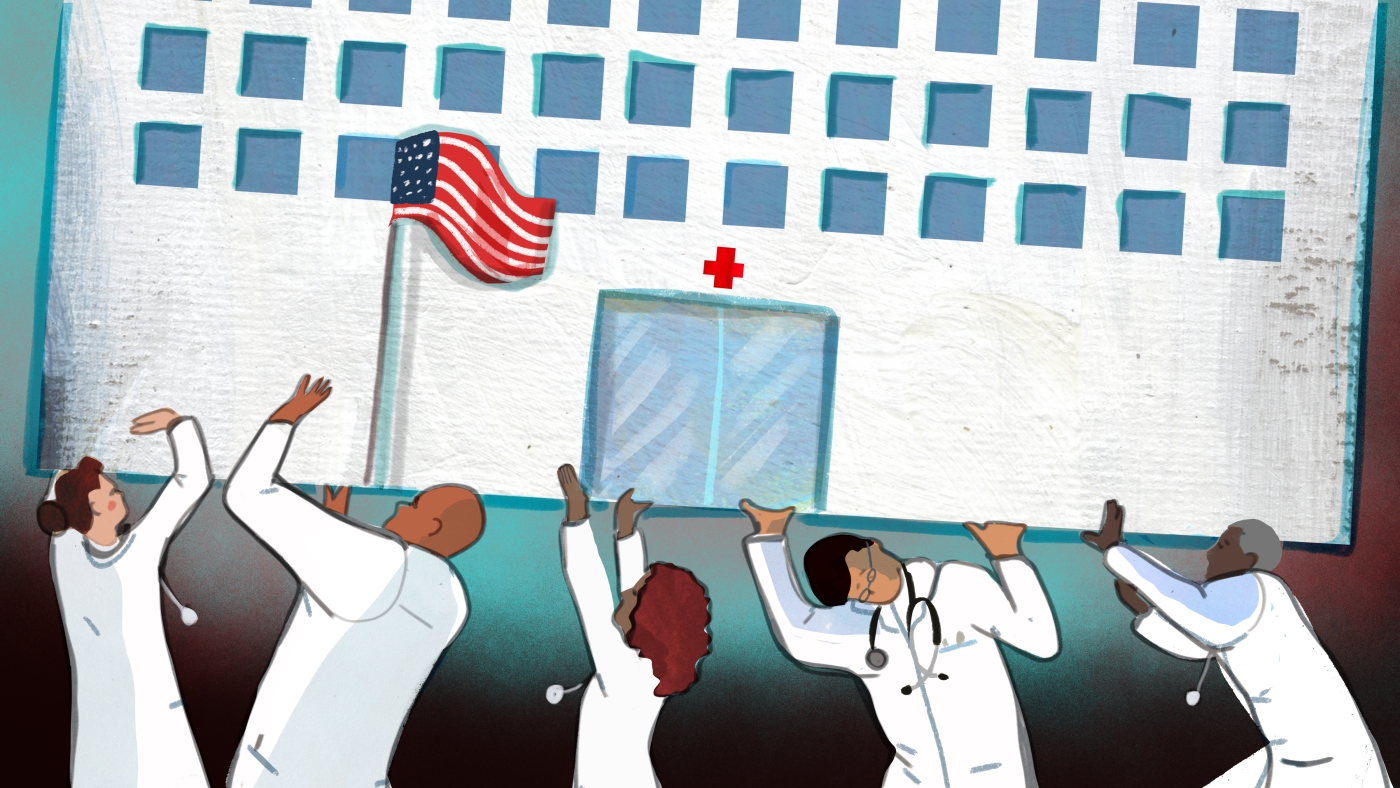
Immigrants make up about a quarter of all doctors in the country, and the U.S. health care system depends heavily on them. There are approximately 325,000 doctors… not including nurses or other essential healthcare workers – living and working in the United States, born and trained elsewhere.
In rural communities and in certain subspecialties of medicine, the use of immigrant doctors is much greater. In primary care and specialties like oncology, for example, foreign-born doctors make up about half the workforce.
Meanwhile, health care is already burdened by retirements and burnout. Many experts say recent immigration and health care policies only make it more difficult — and less attractive — for foreign-born talent to bolster the understaffed U.S. health care system.
“This is a truly pivotal moment where decades of progress could be at risk,” says Dr. Julie Gralow, chief medical officer of the American Society of Clinical Oncology.
She says policies to defund everything from scientific research to public health have damaged America’s reputation to the point where she’s hearing from hospitals and universities that top international talent is no longer interested in coming to America. “Until this year, it was a dream – a wish! – to be able to find a job and come to the United States. And now, no one wants to come.”
Gralow says that, at the same time, other countries like China, Denmark, Germany and Australia are taking advantage of recruiting international talent from outside the United States — including U.S.-born doctors and medical researchers — by promising stable grants and state-of-the-art facilities abroad.
American patients will feel the repercussions, Gralow says, for generations.
Immigrant doctors have historically found work in U.S. communities facing severe health care worker shortages, so those places are also likely to see more impact from reduced international hiring, says Boston resident physician Michael Liu.
He points to his own recent co-authored research in JAMA, estimating that 11,000 doctors, or about 1 percent of the country’s doctors, currently have H1B visas. “That may seem like a small number, but that percentage varies widely across geographic areas,” he said, and they tend to congregate in the least resourced areas, reaching as many as 40 percent of doctors in some communities.
“High-poverty counties had a four times higher prevalence of H1B doctors; we also saw the same trend in rural communities,” he says. (Many doctors and medical residents may have different types of visas, such as J1B and others.)
Groups like the American Medical Association have called on the administration to exempt doctors from the new H1B fees. HHS did not respond to requests for comment on recent visa policies and health care workers., even if some opposition seems to have softened the president’s position.
A story of immigration
Over the past six decades, immigrants have contributed significantly to the United States’ reputation as an undisputed global leader in health research and practice. In terms of pay and prestige, the United States has been unprecedented in helping attract the world’s best talent – at the expense of its home country.
It began in 1965, during a period of growing federal investment in public health and scientific research, spurred by international competition and fueled by Cold War rivalries over events such as the Soviet launch of Sputnik. That year, Medicare and Medicaid were created, and with them, a sudden demand for doctors, says Eram Alam, a professor of the history of science at Harvard.

“Overnight, around 25 million people can now access health services,” says Alam. That year’s passage of the Hart-Celler Immigration and Nationality Act opened U.S. borders to doctors and others with in-demand skills, says Alam, who recently published a book: Care of strangerson the history of immigrant doctors in the United States.
Over the next decade, the United States granted visas to 75,000 doctors, and by 1975, about 45 percent of all U.S. doctors were immigrants, Alam says. The U.S.’s top-notch reputation allowed it to attract more talented doctors than America could train and train: “There were more immigrant doctors entering the workforce each year than U.S.-trained doctors joining it,” she says.
Today, Alam says, the United States is undoing much of that, dismantling its role as a global leader in medicine and science and shrinking its borders.


