Snapchat is nearing 1 billion monthly users. Why can’t it turn a profit?

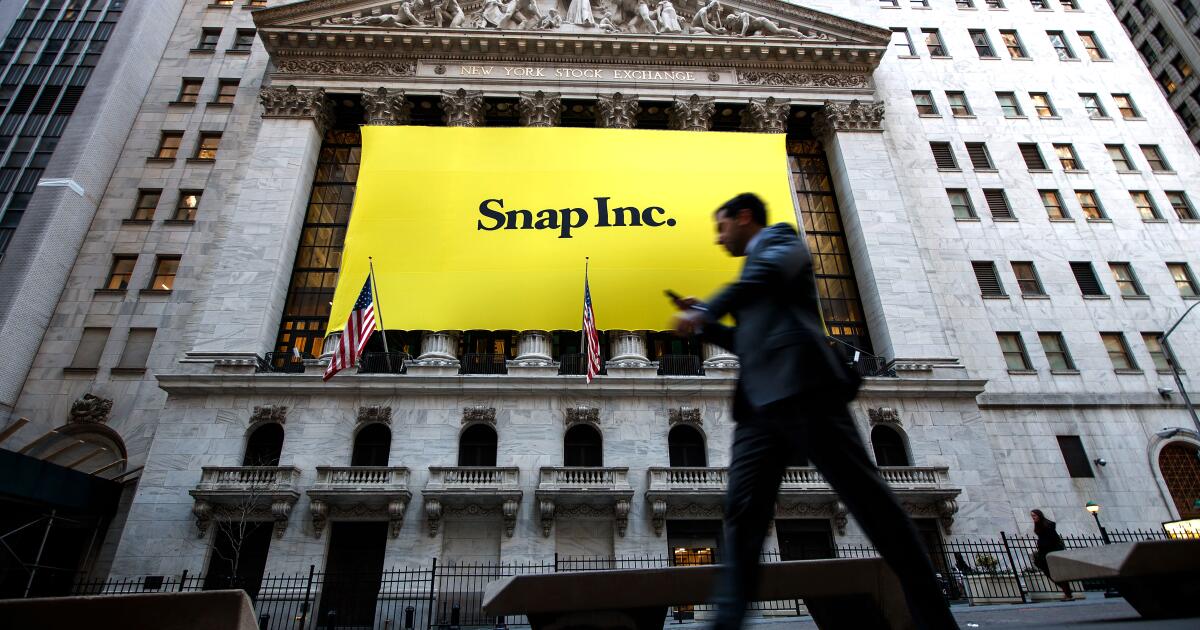
Snapchat, an app whose disappearing messages and silly face filters made chats with loved ones more informal, is close to a milestone few social media platforms reach: reaching 1 billion monthly users.
But Snap, the Santa Monica company behind the app, faces a crucial test. The 14-year-old tech company is still losing money and has seen its stock price fall as it prepares to popularize augmented reality glasses next year.
And even though more people in developing countries are using the app, Snapchat’s usage in markets where the company generates more revenue per user, including the United States and Europe, has fallen.
Snapchat has 943 million monthly active users worldwide, according to the company.
Growth in India, where TikTok is banned, and Pakistan have fueled global growth in Snapchat users, according to data from market intelligence firm Sensor Tower. In India, Snapchat’s monthly users have surpassed 250 million, or more than a quarter of its user base, according to figures released by Snap in July.
Meanwhile, in the third quarter, Snapchat’s monthly active users declined by 4% in the United States and by double digits in France, Italy, Germany and the United Kingdom, Sensor Tower said.
Snap Chief Executive Evan Spiegel wrote in a memo to employees in September that the company was in a “critical moment,” likening it to a “middle child” stuck between big tech giants and its smaller rivals.
“This moment is not just about survival,” Spiegel wrote in the note. “It’s about proving that a different way of building technology, one that deepens friendships and inspires creativity, can succeed in a world that often rewards the opposite.”
The 35-year-old tech executive co-founded Snapchat – initially known as Picaboo – in 2011 with friends as a class project while studying at Stanford University. At the time, texts and photos posted on social networks like Facebook and Instagram were more permanent.
Snapchat’s logo is a ghost, and the app set itself apart from its competitors by giving people a way to share photos and messages that would disappear once someone viewed it. Instead of a social media app that opens to a content feed, Snapchat opens to a camera.
Rather than worrying about whether they looked perfect, people turned to original and creative ways to express themselves. They superimposed effects on their selfies, turning their faces into cute dogs and even vomiting rainbows. The app encouraged people to continue sending these missing messages called “Snaps” to their loved ones at least once a day, keeping what’s called a “streak” alive.
As Snapchat’s popularity skyrocketed, fueling the rise of vertical videos, social media’s biggest rivals took notice. Snapchat’s co-founders have turned down Facebook’s multibillion-dollar offer to buy the company.
Facebook and its photo-sharing app Instagram copied Snapchat’s features, including Stories, which allowed users to post images and videos that disappeared after 24 hours. This has prompted some Snapchat users to flock to rival Instagram. Spiegel jokingly introduced himself as vice president of product at Meta, Facebook’s parent company, on LinkedIn, a nod to the social media giant’s cloning of Snapchat features.
While Snapchat stands out from other social media, it also faces similar concerns that tech platforms face, such as child safety and mental health. The app is popular among teens, making some users wonder if they’re too old for Snapchat and should leave.
Investor confidence in the company has plummeted. In 2021, Snap’s stock peaked at over $83 per share. Snap’s stock price closed Tuesday at $7.64.
Competing with larger competitors such as Instagram, Facebook, YouTube and TikTok, for advertising dollars has been a challenge for Snapchat and it has struggled to consistently generate profits. Apple’s privacy feature has made it harder for advertisers to track users across apps and websites, posing an additional hurdle for social networks.
Research firm eMarketer estimates that in 2025, Snapchat will account for 2.1% of U.S. social media ad spending, but said that share is declining.
Snapchat’s initial focus on disappearing messages made it harder for the company to recruit advertisers, because people generally don’t want to see ads in the middle of a private conversation. But the company has updated its advertising tools and expanded where ads appear, including between short videos.
Although Snapchat is popular among Gen Z and millennials, its audience can limit what companies want to advertise on its platform.
“He’s definitely a lot younger and that naturally limits advertisers’ interests in his audience,” said Max Willens, principal analyst at eMarketer. If a company wants to advertise retirement planning, for example, it will likely go to Facebook rather than Snapchat.
On Snapchat, advertisers have also used augmented reality effects to promote their brands in an offbeat way to a young audience. Snapchat users can transform themselves into a dancing McDonald’s McRib sandwich or take selfies with digital animals from the Disney movie “Zootopia 2.”
Snap has been exploring other ways to make money. The company offers subscription plans that allow users to personalize the app’s wallpaper, personalize their digital avatars called Bitmojis, and see how often their friends view their content. It has started limiting the amount of free storage it offers to 5 gigabytes. AI company Perplexity said it would pay Snap $400 million over a year so users could find answers from its “AI-powered answer engine.”
In the third quarter, Snap’s revenue reached $1.5 billion, up 10% from the same period last year. The company narrowed its net loss to $104 million, compared to a net loss of $153 million in the same period a year earlier.
This month, JP Morgan analysts raised Snap’s price target to $8 after the Perplexity deal, but maintained an underweight on the stock, meaning they expect the stock to underperform.
The company said Snap had “a significant market opportunity, an engaged user base and a strong history of innovation” but was also looking for “more consistent execution, improved user and revenue trends and greater profitability.”
Snap made bold and expensive bets on the future of computing by launching a drone and glasses to capture photos and videos – although those products failed. Snap now plans to launch augmented reality glasses in 2026 that will allow people to interact with digital images overlaid on the physical world. Instead of pulling out your phone, people will be able to view documents, stream movies, play chess and more with glasses.
For now, analysts say it’s too early to tell whether Snap’s bets will pay off or whether the company will end up in the graveyard of social media like Myspace or Vine.
“There’s nothing written that says you can exist forever if you’re a social media platform,” Willens said. “Although almost all of them are still plodding along in one state or another.”


