Mysterious Fossil Foot Belonged to Ancient Human that Lived Alongside ‘Lucy’


November 26, 2025
3 min reading
Mysterious Fossil Foot Belonged to Ancient Human Who Lived Alongside ‘Lucy’
Newly Identified Bones Link Mysterious Burtele Foot to New Australopithecus species that lived alongside Lucy more than three million years ago
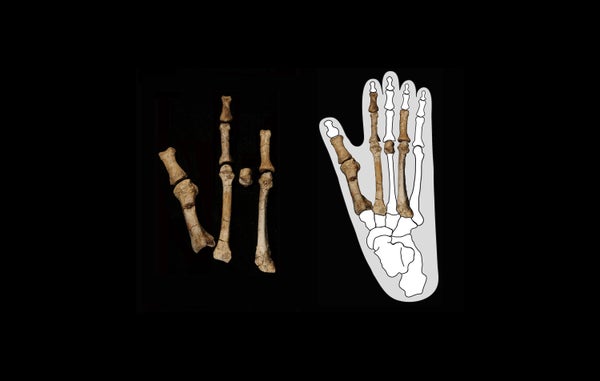
Burtele’s foot (left) and the foot integrated into the outline of a gorilla foot.
Sixteen years ago, a group of anthropologists discovered fossilized foot bones dating back 3.4 million years in Ethiopia. While they suspected the foot belonged to an ancient human who likely lived alongside the species we know as “Lucy”, Australopithecus afarensiswithout a skull or teeth to analyze, they couldn’t be sure.
What they did know was that unlike Lucy, who walked upright on arched feet like ours, the mystery foot had a gripping toe adapted for climbing trees.
Now, the same team that discovered the strange foot has finally solved the mystery. In an article published Wednesday in NatureThe researchers describe other hominid fossils found in the same area as the appendix, which they dubbed Burtele’s foot. The results confirm that Lucy lived alongside another hominid species called Australopithecus deyiremedawho behaved quite differently from his A. afarensis peers.
On supporting science journalism
If you enjoy this article, please consider supporting our award-winning journalism by subscription. By purchasing a subscription, you are helping to ensure the future of impactful stories about the discoveries and ideas shaping our world today.
“This is a really exciting and long-awaited discovery for all of us who were wondering what this crazy foot was,” said Carol Ward, an anthropologist at the University of Missouri who was not involved in the new study.
“Not only do we have different species living at fairly similar times in a similar area, but they navigate the world in different ways from each other,” she says.

Burtele’s foot with its elements in anatomical position.
Anthropologists suspected that Burtele’s foot belonged to A. deyiremeda for years: in 2015, they reported the existence of the species in the region based on jaws 3.5 million to 3.3 million years old. But to establish a conclusive link A. deyiremeda At the foot of Burtele, the team had to return to their discovery site to find more fossils.
“We have been visiting the site every year for 20 years now, and the Burtele locality is revisited every year, like all localities on the site,” explains Yohannes Haile-Selassie, a paleobiologist at Arizona State University and co-author of the study.
During the latest visit to the Ethiopian paleoanthropological site of Woranso-Mille, the team made several crucial discoveries: fragments of pelvic bones and, above all, a skull and a jaw with 12 teeth. Identified as belonging to A. deyiremeda based on the shape of the canines and molars, the jaw had more primitive features than its A. afarensis cousins.
After analyzing the teeth, the team discovered that their owner had a different diet than Lucy’s, preferring to eat trees, shrubs, fruits and leaves – a diet more similar to that of older hominids, according to the team. In contrast, Lucy’s species typically ate vegetation from mixed woodlands and grassland plants.
Burtele’s foot gives clues to how A. deyiremeda managed to deftly climb trees to feed: its long, curved toes and flexible bones suggest a foot well adapted for climbing and clinging to trees. Even the bones of the big toe are thin and curved, suggesting it could wrap around branches.
Combining their findings – the teeth, food analysis and the foot – and taking into account the absence of other hominid fossils at the site, the scientists concluded that the mysterious Burtele foot belonged to A. deyiremeda.
This discovery gives researchers more opportunities to learn more about how ancient humans adapted to walk upright, Haile-Selassie says. And, he says, this shows that not all human ancestors walked on two feet.
“It is a unique mode of locomotion which has been the subject of various experiments throughout human evolution until the emergence of Homo“, he said.
It could also help settle another debate once and for all: the 2015 discovery of A. deyiremeda has been disputed, with some scientists claiming that the specimens actually belonged to A. afarensisexplains paleoanthropologist Donald Carl Johanson, who discovered Lucy in 1974.
The new study suggests instead that A. deyiremeda inherited its foot traits from a different ancestral species than the one that gave rise to Lucy’s species, Johanson says. “Acceptance of a new hominid species always attracts criticism,” he says. “Let the new evidence convince a wider audience than A. deyiremeda is a valid species remains to be seen.
Knowing that another hominid lived alongside Lucy’s species also challenges the idea that human evolution was relatively linear, Ward says. The new findings also raise questions about how ancient hominids walked.
Haile-Selassie’s team will continue to return to the Burtele site each year to learn more about the biology and geographic distribution of A. deyiremeda. “There are many questions we can ask about this species,” says Haile-Selassie.
It’s time to defend science
If you enjoyed this article, I would like to ask for your support. Scientific American has been defending science and industry for 180 years, and we are currently experiencing perhaps the most critical moment in these two centuries of history.
I was a Scientific American subscriber since the age of 12, and it helped shape the way I see the world. SciAm always educates and delights me, and inspires a sense of respect for our vast and beautiful universe. I hope this is the case for you too.
If you subscribe to Scientific Americanyou help ensure our coverage centers on meaningful research and discoveries; that we have the resources to account for decisions that threaten laboratories across the United States; and that we support budding and working scientists at a time when the value of science itself too often goes unrecognized.
In exchange, you receive essential information, captivating podcasts, brilliant infographics, newsletters not to be missed, unmissable videos, stimulating games and the best writings and reports from the scientific world. You can even offer a subscription to someone.
There has never been a more important time for us to stand up and show why science matters. I hope you will support us in this mission.


