Scientists Sequence Genome of Vampire Squid


The vampire squid genome (Vampyroteuthis sp.) is one of the largest animal genomes, exceeding 10 billion base pairs.
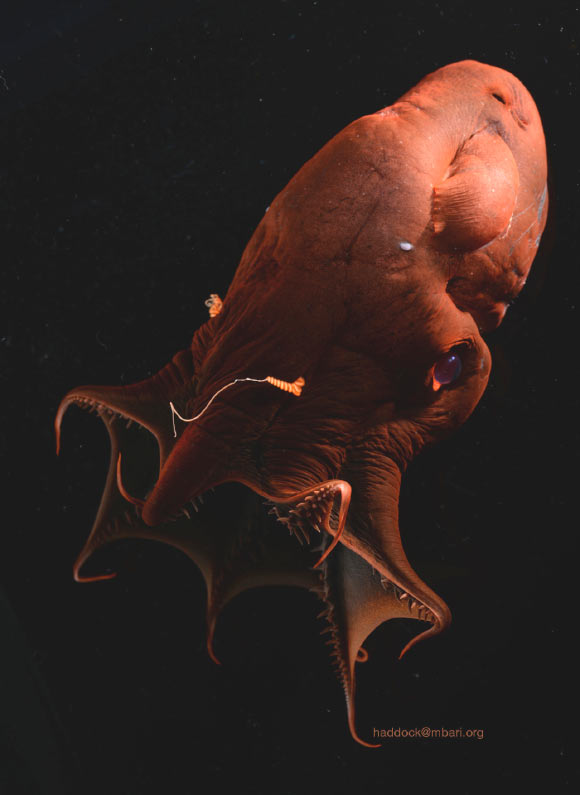
The vampire squid (Vampyroteuthis sp.) is one of the most enigmatic animals of the deep sea. Image credit: Steven Haddock / MBARI.
A “living fossil”, the vampire squid inhabits the deep waters of all ocean basins in the world, between 500 and 3,000 m deep.
The species is a passive, soft-bodied creature the size, shape, and color of a football.
It has a dark red body, huge blue eyes, and a cape-like web that extends between its eight arms.
When threatened, the squid turns around, exposing rows of nasty-looking “cirri.”
While other squid reproduce all at once at the end of their lives, the vampire squid shows signs of multiple reproductive cycles.
“Modern cephalopods (coleoids) – including squid, octopuses and cuttlefish – split more than 300 million years ago into two main lineages: the ten-armed decapodiforms (squid and cuttlefish) and the eight-armed octopodiforms (octopuses and vampire squid),” said Masa-aki Yoshida, a biologist at Shimane University, and colleagues.
“Despite its name, the vampire squid has eight arms like an octopus but shares key genomic features with squid and cuttlefish.”
“It occupies an intermediate position between these two lineages – a connection that its genome reveals for the first time at the chromosomal level. »
“Although it belongs to the octopus lineage, it retains elements of a more ancestral, squid-like chromosome organization, providing new insight into early cephalopod evolution.”
In new research, the authors sequenced the vampire squid genome from an individual collected in the western Pacific Ocean.
“At more than 11 billion base pairs, the vampire squid genome is approximately four times larger than the human genome, making it the largest cephalopod genome ever analyzed,” they said.
“Despite this size, its chromosomes have a surprisingly conserved structure.”
“Because of this, Vampyroteuthis is considered a “living genomic fossil” – a modern representative of an ancient lineage that preserves key features of its evolutionary past.
The researchers found that it had retained parts of a decapodiform-like karyotype, while modern octopuses had undergone significant chromosomal fusions and rearrangements during evolution.
This conserved genomic architecture provides new clues about how cephalopod lineages diverged.
“The vampire squid sits right at the interface between octopuses and squid,” said Dr. Oleg Simakov, a researcher at the University of Vienna.
“Its genome reveals deep evolutionary secrets about how two strikingly different lineages could emerge from a common ancestor.”
Comparing the vampire squid with other sequenced species, including the pelagic octopus Argonaut hiansscientists were able to trace the direction of chromosomal changes during evolution.
“The genome sequence of Argonaut hians (paper nautilus), a “strange” pelagic octopus whose females secondarily obtained a calcified shell-like structure, was also presented for the first time in our study,” they said.
“The analysis suggests that early coleoids had a squid-like chromosomal organization, which then merged and compacted into the modern octopus genome – a process known as fusion with admixture.”
“These irreversible rearrangements likely led to key morphological innovations such as weapon specialization and loss of outer shells.”
“Despite being classified as an octopus, the vampire squid retains a genetic heritage that predates both lineages,” added Dr. Emese Tóth, a researcher at the University of Vienna.
“This gives us direct insight into the early stages of cephalopod evolution.”
“Our study provides the clearest genetic evidence to date that the common ancestor of octopuses and squid was more squid-like than previously thought.”
“This highlights that large-scale chromosomal reorganization, rather than the emergence of new genes, has been the main driver of the remarkable diversity of modern cephalopods.”
The results were published on November 21, 2025 in the journal iScience.
_____
Masa-aki Yoshida and others. 2025. Giant vampire squid genome reveals state derived from modern octopod karyotypes. iScience 28(11):113832; doi: 10.1016/j.isci.2025.113832


