New Study Reveals How Pterosaurs Evolved Flight-Ready Brain


In new research, an international team of researchers used high-resolution 3D imaging techniques, including microCT scanning, to reconstruct the brain shapes of more than three dozen species. These included pterosaurs, their close relatives, early dinosaurs and bird precursors, modern crocodiles and birds, as well as a wide range of Triassic archosaurs.
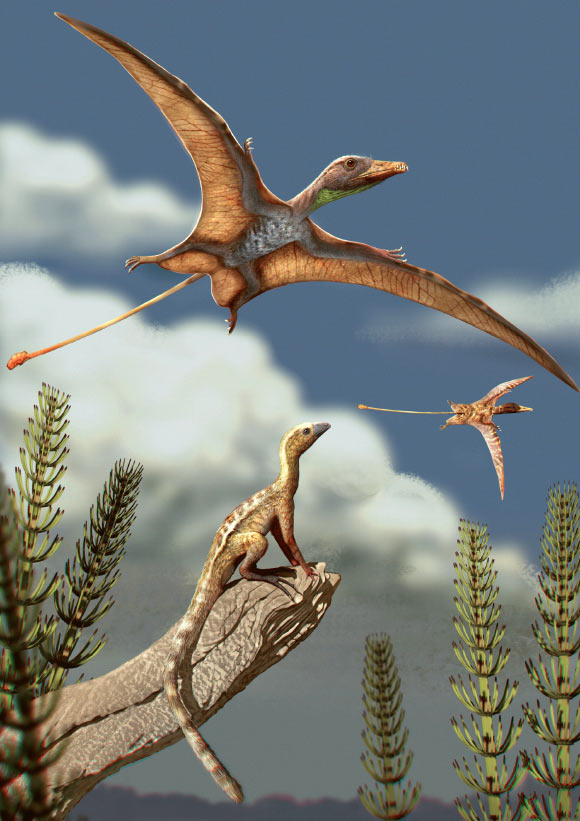
Reconstruction of a landscape from the Upper Triassic, approximately 215 million years ago; A lagerpetid, a close relative of pterosaurs, perches on a rock and watches pterosaurs fly overhead. Image credit: Matheus Fernandes.
The oldest known pterosaurs lived about 220 million years ago and were already animals capable of powered flight, an ability that later evolved independently among paravian dinosaurs, the group that includes living birds and their closest non-avian relatives.
Flight is a complex locomotor mode that requires physiological adaptations and a radical transformation of the body plan, including changes in body proportions, a specialized integument and the acquisition of new neurosensory abilities.
Although pterosaurs and birds evolved distinct skeletal and integumentary adaptations for flight, they are hypothesized to share neuroanatomical traits related to aerial locomotion.
“Our results confirm that the enlarged brains observed in modern birds and likely in their prehistoric ancestors were not the driving force behind pterosaurs’ ability to fly,” said Dr. Matteo Fabbri, a researcher at Johns Hopkins University School of Medicine.
“Our study shows that pterosaurs evolved flight early in their existence and did so with smaller brains, similar to those of true non-flying dinosaurs.”
To find out whether pterosaurs acquired flight differently from birds and bats, scientists studied the reptile’s evolutionary tree to determine the evolution of pterosaur brain shape and size, looking for clues that may have led to the development of flight.
They particularly focused on the area involved in vision, the optic lobe, whose growth is believed to be associated with flight capabilities.
Using CT scans and imaging software that allowed the authors to extract information about the fossils’ nervous systems, the researchers focused on the pterosaur’s closest relative: Ixalerpetona species of flightless arboreal lagerpetid that lived in Brazil during the Triassic period approximately 233 million years ago.
“The brains of lagerpetids already exhibited features linked to enhanced vision, including an enlarged optic lobe, an adaptation that may later have helped their pterosaur relatives take flight,” said Dr. Mario Bronzati, a researcher at the University of Tübingen.
“A larger optic lobe was also present in pterosaurs,” Dr Fabbri said.
However, there were otherwise very few similarities in the shape and size of the brains of pterosaurs and that of the flying reptile’s closest relative, the lagerpetid.
“The few similarities suggest that flying pterosaurs, which appeared very soon after the lagerpetid, probably acquired flight in a flash in their origin,” Dr Fabbri said.
“Essentially, pterosaur brains rapidly evolved, acquiring everything they needed to take flight early on.”
“In contrast, modern birds are thought to have acquired flight step by step, a more gradual process, inheriting certain features, such as an enlarged brain, cerebellum, and optic lobes, from their prehistoric parents, and later adapting them to enable flight.”
This theory is supported by a 2024 study which highlighted that the expansion of the brain’s cerebellum was key to bird flight.
The cerebellum, located at the back of the brain, regulates and controls muscle movements, among other activities.
In other studies, researchers analyzed the brain cavities of fossils of crococdylians and extinct ancient birds, and compared them to the brain cavities of pterosaurs.
They determined that the pterosaur brain had moderately enlarged hemispheres, similar in size to other dinosaurs, compared to the brain cavities of modern birds.
“The discoveries in southern Brazil have given us remarkable new information about the origins of major animal groups like dinosaurs and pterosaurs,” said Dr. Rodrigo Temp Müller, a paleontologist at the Federal University of Santa Maria.
“With each new fossil and each new study, we get a clearer picture of what the earliest relatives of these groups were, which would have been almost unimaginable just a few years ago.”
“In the future, better understanding how the structure of the pterosaur brain, in addition to its size and shape, enables flight will be the most important step to better deduce the fundamental biological laws of flight,” said Dr. Fabbri.
The results appear in the newspaper Current biology.
_____
Mario Bronzati and others. Neuroanatomical convergence between pterosaurs and non-avian paravians in the evolution of flight. Current biologypublished online November 26, 2025; doi: 10.1016/j.cub.2025.10.086


