6,000-Year-Old Rock Murals in Texas and Mexico Reveal Ancient Beliefs on the Cosmos


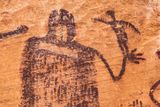
In the rock shelters of the southwest United States, ancient paintings weave a grand story that has been built over thousands of years. Each mural – depicting humans, animals and various forms – constitutes a colorful chapter in the Mesoamerican view of the world.
A new study published in Scientific advances established a more complete timeline for a particular style of rock art known as the Pecos River style, seen in southwest Texas and northern Mexico. This style, first painted almost 6,000 years ago, has survived for 4,000 years. Overall, the murals offer insight into how indigenous communities interpreted the universe through sacred spaces.
Learn more: Close echoes of Stone Age cave art suggest rituals were a common practice
Tell a story with rock art
Rock art in the Americas encompasses a range of distinctive styles based on different regions, and each incorporates pictographs (paintings) or petroglyphs (engravings). The Pecos River Style (PRS) is the iconic variety of rock art in the Lower Pecos Canyonlands, a 3,000-square-mile region believed to have been inhabited by hunter-gatherers for more than 12,500 years.
In this region, limestone rock shelters contain evidence of big game hunting and earth ovens used to cook plant foods in pits. The inhabitants of these sites painted on the walls and ceilings using red, orange, yellow, black and white pigments to draw visual stories. The largest of the PRS murals spans 100 feet long and 20 feet high, requiring ladders or makeshift scaffolding to create.
Those who painted the murals included humanoid figures and animals like deer, felines, birds and snakes. Figures were also usually drawn with additional details, including headdresses or ornaments attached to other body parts. They were sometimes even depicted with tools or weapons. Some figures, for example, hold atlatls, a device that allowed hunter-gatherers to throw spears or darts with increased precision and speed, according to the Shumla Archaeological Research and Education Center.
A centuries-old story
To find out when exactly the Pecos River style was made, researchers involved in the new study obtained 57 direct radiocarbon dates and 25 indirect oxalate dates from 12 sites. Using this information, they estimated that the Pecos River Style began between 5,760 and 5,385 years ago and likely ended between 1,370 and 1,035 years ago.
The dates of the murals also suggest that these were planned projects, calling into question archaeologists’ previous assumptions.
“Another huge shock is that the dates in many of the murals clustered so closely that they are statistically indistinguishable, suggesting that they were produced during a single painting event as a visual narrative,” study author Carolyn Boyd, an archaeologist at Texas State University, said in a statement. “This contradicts the widespread belief that the murals were a random collection of images accumulated over hundreds or thousands of years.”
A cosmovision that comes to life
Researchers also determined that eight of the murals had an established iconographic vocabulary and were deliberately created to feature layers of multiple intertwined figures. As a result, the wall paintings told an overarching story about Mesoamerican beliefs.
Geological features of the Lower Pecos Canyonlands, including canyons, sinkholes, caves, rock shelters and rivers, had sacred meaning to ancient indigenous communities and were linked to ritual activities, researchers say. The rock art of the shelters was therefore an expression of “cosmovision”, a term used to describe the worldview shared by Mesoamerican societies.
Although climate and land use have changed in the Lower Pecos Canyonlands, the hunter-gatherers who live there have passed down the Pecos River style from generation to generation for several millennia.
“But perhaps most exciting of all, today indigenous communities in the United States and Mexico can connect the stories communicated through imagery to their own cosmologies, demonstrating the antiquity and persistence of a pan-New World belief system at least 6,000 years old,” Boyd said.
Learn more: Ancient murals at Teotihuacan could reveal 2,000-year-old written language
Article sources
Our writers at Discovermagazine.com use peer-reviewed studies and high-quality sources for our articles, and our editors review them for scientific accuracy and editorial standards. See the sources used below for this article:


