White House justifies strikes on boat survivors, but it’s unclear where buck stops : NPR

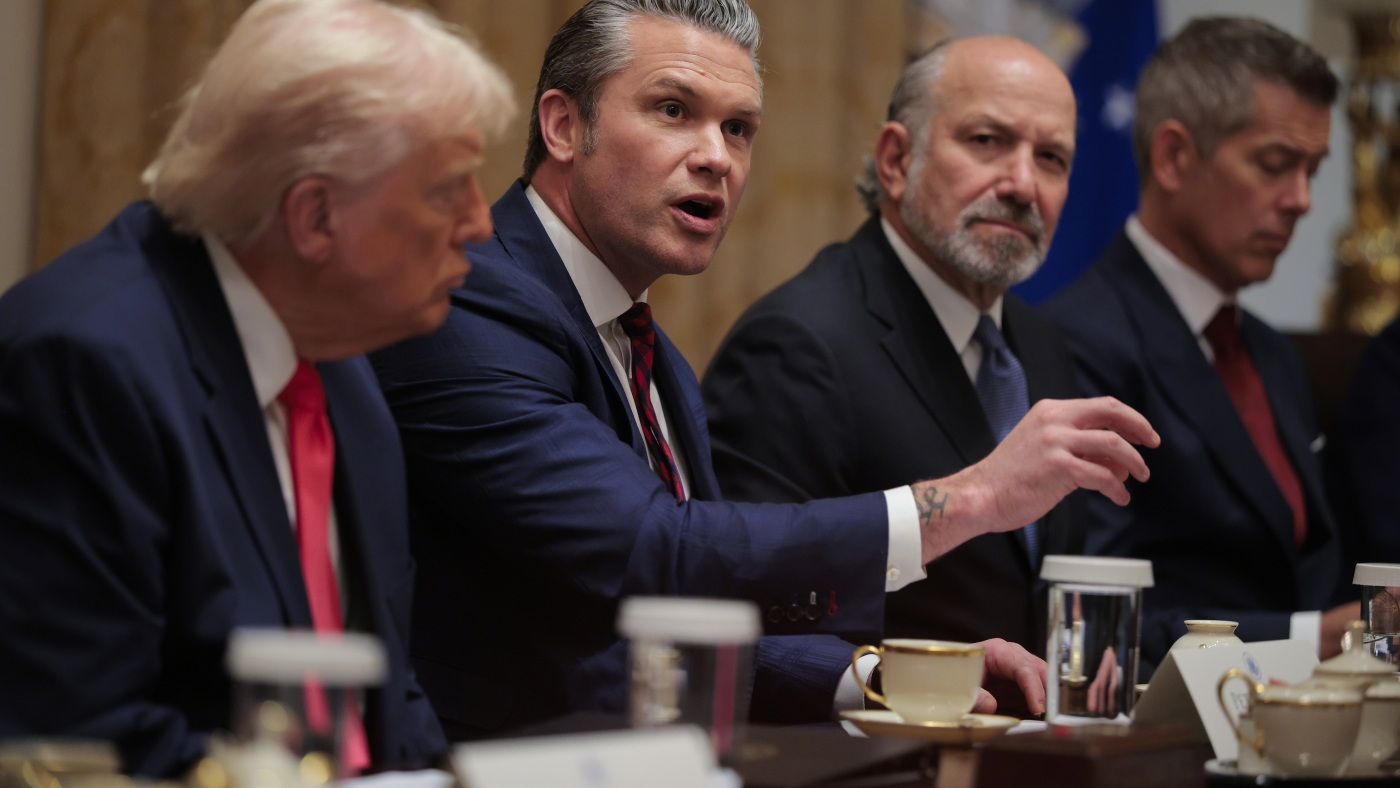

Secretary of Defense Pete Hegseth speaks during a Cabinet meeting in the Cabinet Room of the White House, December 2.
Puce Somodevilla/Getty Images
hide caption
toggle caption
Puce Somodevilla/Getty Images
The Trump administration is continuing its controversial campaign to target and kill small boat crews suspected of smuggling drugs from South America to the United States. But amid accusations that the strikes amounted to executions without trial, the White House is sending a confusing message about who exactly gave the order to use deadly force.
The details are important because some members of Congress suggest the orders are illegal and could expose the military to possible prosecution.
In response to reports that the first of those incidents included a second round of strikes that killed two survivors on a burning boat, Defense Secretary Pete Hegseth said Tuesday that he authorized and observed the initial attacks but did not witness the second round.
“I watched that first strike live,” Hegseth said during a Cabinet meeting at the White House. “As you can imagine, at the War Department we have a lot to do. So I moved on to my next meeting.”
Hegseth said he did not see any survivors of that September 2 attack on the video and that subsequent strikes aimed at sinking the boat, which killed the survivors, were ordered by Admiral Frank M. Bradley.

“A few hours later, I learned that this commander had made the [decision]which he had full authority to do,” Hegseth said. “And by the way, Admiral Bradley made the right decision ultimately, to sink the boat and eliminate the threat.”
Hegseth’s analysis of the order’s responsibility has drawn criticism, including from Rep. Adam Smith, the ranking Democrat on the House Armed Services Committee.
“Yeah. It was a CYA moment for Hegseth,” Smith said, speaking on NPR. Morning edition“It’s the Secretary of Defense. You know, he puts them in a terrible situation by giving them these very questionable orders. And then after that, to come out and say, hey, it was that guy, not me. That’s not leadership, and it’s not honest either. It seems to me that Secretary Hegseth is the one responsible for what happened here.”
Since the first U.S. military strike against a small boat in the Caribbean three months ago, debate has raged within the military because the use of lethal force against civilian crew and passengers appeared illegal. Trump’s Justice Department provided Congress with a memo stating that the United States is engaged in a non-international armed conflict with drug cartels and that the strikes are consistent with the laws of war. But Smith says even that note was ambiguous.
“This memo that explains the legal rationale for this is fascinating because half says, this is why this is an armed conflict, why these narcoterrorist groups pose such a threat. They’re doing all these horrible things. And the other half says, no, this is not a war, so we don’t need to get permission from Congress,” Smith said. “They say it’s legal, and yet they’ve gone to great lengths to make sure it wasn’t Hegseth who gave the order. So obviously they’re a little nervous about that.”
Now the questions are getting more pointed, after Washington’s positiont reported that the September 2 incident included two rounds of strikes on a boat and that survivors of the initial attack were visible when they were struck and killed again. Hegseth initially denied the story and called it fake news, but he confirmed the basic facts on Tuesday.
If the United States is at war, killing enemies who surrender or are helpless would constitute a war crime according to military experts, including a group of former JAG officers who have criticized the Trump administration. Questions along these lines are expected when Admiral Bradley appears before Congress on Thursday.
But talking about war crimes accepts the idea that the United States may even be at war with the entire criminal world of drug trafficking, in the legal sense, said Sarah Yager, director of Human Rights Watch in Washington. “It’s not a war crime because there’s no war, there’s no armed conflict, so it can’t be a war crime. It’s literally murder,” she said.
“This sets a dangerous pattern for the United States that believes it can strike anywhere on the planet without rules, limits or consequences.”
She also noted that when a country acts as if it is at war when it is not, “it undermines the rules that keep civilians safe and gives governments the right to kill without the safeguards required by international law.”
President Trump and Hegseth again justified their strikes on Tuesday. Hegseth said the evidence was strong that each of the strikes targeted what he called a “narcoterrorist,” but declined to provide proof. Trump claimed his efforts saved hundreds of thousands of lives — more than double the estimated annual death toll from all drug overdoses in the United States, most of which are actually caused by fentanyl that doesn’t enter the country by ship.
Meanwhile, Republican Sen. Rand Paul released a letter he received after a request for information showing that 21 percent of Coast Guard interdictions turn up no drugs, suggesting at least one in five deadly strikes could be a mistake.
During the council of ministers On Tuesday, Trump suggested, without presenting evidence, that drug trafficking had declined since the boat strikes began, but he also claimed to know nothing of the details.
“As far as the attack, I did, you know, I still haven’t gotten a lot of information, because I’m relying on Pete, but to me it was an attack. It wasn’t one strike, two strikes, three strikes,” Trump said. “Someone asked me about the second strike. I didn’t know about that second strike. I didn’t know anything about the people, I wasn’t involved in it.”
But speaking at the Pentagon earlier Tuesday, Press Secretary Kingsley Wilson said: “Ultimately, it’s the secretary and the president who direct these strikes.”


