Icy Volcanic Action on Comet 3I/ATLAS Has Produced an Unusual Combo of Chemicals


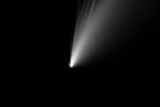
Rapidly approaching the sun with an unusual aura of gas and dust, Comet 3I/ATLAS has been attracting the attention of astronomers and the general public for months now. This interstellar visitor to our solar system – only the third ever observed – has raised eyebrows for several reasons, including its carbon-rich composition and intense brightness as it approaches the sun.
An article recently published on the preprint server arXiv introduced what could be another defining feature of 3I/ATLAS: ice volcanoes. The paper, which has not yet been peer-reviewed, suggests that the comet shows signs of cryovolcanism, a process often observed in trans-Neptunian objects – faint celestial bodies that orbit the sun beyond the orbit of Neptune.
Learn more: New images of comet 3I/ATLAS reveal ‘how magical the universe could be’
The cold journey of 3I/ATLAS
Comet 3I/ATLAS entered the solar system at a remarkably high speed of 130,000 miles per hour, but its exact origins in the Milky Way are still debated. Previous research based on star details compiled in the Gaia DR3 catalog (collected by the European Space Agency’s Gaia mission) indicated that the comet had not passed near other stars in the past 10 million years.
The authors of the recent preprint paper note that comet 3I/ATLAS may have a unique composition because it spent a very long time passing through the cold regions of the interstellar medium (the gas and dust that fill the space between stars).
Before entering the solar system, it may have accumulated ice and organic compounds on its surface. This material could then have been processed by cosmic rays when the comet crossed the interstellar medium, thus creating a crust on its surface.
“The implantation of foreign materials and their processing by cosmic rays during its long journey through our galaxy could have hidden the true nature of 3I,” the authors write in the article.
Comparison with chondrites
As comet 3I/ATLAS approached the sun in late October 2025, the cloud of gas and dust surrounding it – its so-called “coma” – became unusually bright. Most comets do not become as bright because of the dust coat they gain, which insulates subsurface ice and prevents abrupt brightening.
Comet 3I/ATLAS, on the other hand, probably does not have a dust coat because it has not passed stars in 10 million years. For this reason, the comet is considered “pristine”, never heat-treated like other comets.
The preprint authors report that the pristine quality of Comet 3I/ATLAS is comparable to that of carbonaceous chondrites, a class of carbon-rich meteorites. To confirm the similarities, they used spectroscopic observations to compare how light would reflect off the comet and several carbonaceous chondrites collected in Antarctica.
One of the chondrites in the collection contains what may be a remnant of a trans-Neptunian object (TNO). Based on their comparisons, the authors hypothesize that comet 3I/ATLAS is a primordial TNO object that contains metallic grains and was launched from its ancient planetary system after a close encounter with a giant planet or star.
Icy eruptions on an interstellar visitor
TNOs undergo cryovolcanism, a process characterized by the eruption of liquid or gaseous volatile substances, such as water, ammonia or methane.
According to the authors of the preprint, comet 3I/ATLAS could experience something similar; as it passed close to the sun, the water ice sublimated and its icy surface was heated enough to reveal a more porous subsoil. The heated liquid water would then have passed through the porous surface, coming into contact with metallic grains similar to those found in certain groups of carbonaceous chondrites.
These minerals would have been corroded by water, producing reactions leading to the projection of cryovolcanic jets out of the comet. This, the authors suggest, appears to make the comet’s comet extremely rich in carbon monoxide (CO) and carbon dioxide (CO2).
Although there is still much to explore about the composition and potential cryovolcanism of Comet 3I/ATLAS, it is exciting to think that an interstellar visitor might share something in common with objects from our own solar system.
Learn more: Radio signals detected by comet 3I/ATLAS — What its interstellar origins reveal
Article sources
Our writers at Discovermagazine.com use peer-reviewed studies and high-quality sources for our articles, and our editors review them for scientific accuracy and editorial standards. See the sources used below for this article:


