Climate change threatens Asia’s water and power systems, reports warn

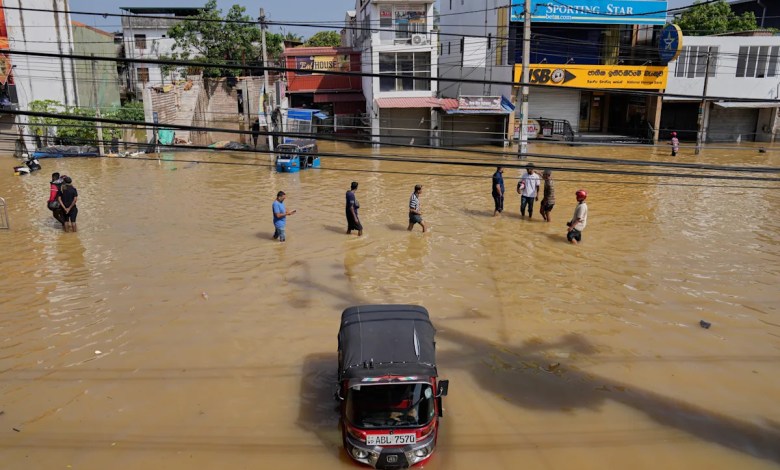
BENGALURU, India (AP) — Climate change is straining Asia’s water and electricity systems and putting millions of people at risk, forcing countries to spend billions of dollars to strengthen basic services, according to two recent reports.
Water-related disasters are increasing in the region, even though spending to protect communities is insufficient. Asian countries will need $4 trillion for water and sanitation between 2025 and 2040, or about $250 billion a year, the Asian Development Bank said in a report released Monday.
Governments are under increasing pressure to protect the electricity systems that people depend on every day. By 2050, extreme weather could leave publicly traded power companies in the Asia-Pacific region with about $8.4 billion in damages and lost revenue per year, a third more than today, according to a recent study by the Asia Investor Group on Climate Change, a Hong Kong-based nonprofit, and the MSCI Institute in New York, a sustainability think tank.
These risks have manifested themselves this year across Asia, hit by late storms, incessant rains and severe flooding.
In Quy Nhon, central Vietnam, power lines snapped when Typhoon Kalmaegi hit the coastal town with heavy rain and strong winds. Flooding from incessant downpours left streets submerged days later under chest-deep water, turning entire neighborhoods into islands. The day after the storm hit, Hai Duong, 29, rushed to a shopping center that still had power to charge her phone.
“I can’t go back because my house is underwater. I just want to see if my loved ones are safe,” she said.
Asia’s water resources must be climate-proofed
The ADB report says 2.7 billion people, or about 60% of the Asia-Pacific region’s population, have access to water for most of their basic needs, but more than 4 billion remain exposed to unsafe water, degraded ecosystems and growing climate risks.
Much of the progress made since 2013 comes from major advances in access to water in rural areas, he says. Around 800 million more people in rural areas now have running water, helping many countries escape the lowest level of water security. India has played a big role in this change.
But Asia faces a triple threat: environmental pressures, weak investment and climate change, said Vivek Raman, senior urban development specialist at the ADB and lead author of the report.
“It’s a tale of two realities,” Raman said.
The report said aquatic ecosystems were rapidly deteriorating or stagnating in 30 of the 50 Asian countries surveyed, plagued by uncontrolled development, pollution and conversion of land to other uses. Asia is also responsible for 41% of global flooding and its coastal megacities and Pacific islands face growing threats from storm surges, rising sea levels and the pushing of salt water inland. From 2013 to 2023, Asia and the Pacific experienced 244 major floods, 104 droughts and 101 severe storms – events that undermined development gains and caused widespread damage.
Governments are currently funding only 40% of the estimated $4 trillion in investment, or about $250 billion per year, in financing needed for water and sanitation from 2025 to 2040. This leaves an annual deficit of more than $150 billion.
Asia’s rapid growth is both an opportunity and a challenge, said Amit Prothi, executive director of the New Delhi-based Coalition for Disaster Resilient Infrastructure, who was not involved in the report. “The amount of infrastructure we will build in Asia over the next three decades will be as large as that built in the last two centuries. So this is an opportunity to rethink and build in a new way,” he said.
The coalition found that $800 billion of infrastructure, about a third of which is in Asia, is exposed to disasters globally each year.
Asia’s power utilities are losing billions to climate change
Extreme heat, flooding and water shortages already cost Asia’s power utilities $6.3 billion a year, a figure expected to exceed $8.4 billion by 2050 if companies fail to step up climate adaptation measures, according to a study by the Asia Investor Group on Climate Change and the MSCI Institute.
Asia accounts for 60% of global electricity generation capacity and remains heavily dependent on coal. The report warns that climate change threatens both energy security and economic growth in a region where more than 4 billion people need reliable electricity.
“Overall, if you look at the types of impacts and the degree of preparedness of companies, most of them are in their very early stages,” said Anjali Viswamohanan, policy director at the Asia Investor Group on Climate Change.
Its study of 2,422 power plants in China, Hong Kong, India, Indonesia, Japan, Malaysia and South Korea found that extreme heat is the costliest risk, responsible for more than half of all losses by 2050. Heat waves reduce the efficiency of power plants and strain transmission networks. India’s main power company NTPC, Indonesia’s PLN and Malaysia’s Tenaga Nasional all face a high risk of disruptions from rising heat.
Water disturbances are an important factor
Another major threat comes from declining river flows in Asia’s major basins, which provide water for coal and gas power plants and power hydroelectric dams.
At the same time, heavy rains and flooding also pose risks, especially in coastal and riverine regions. Malaysia’s Tenaga Nasional region faces one of the most flood-prone coastal areas due to power plants built in low-lying areas, the report said.
Despite the growing dangers, most utilities lacked detailed and funded plans to adapt to climate impacts. The report reveals that while nine of the 11 companies studied assessed the impact of climate change on them, only seven looked at risks at the level of their individual factories. Only five of them have calculated and disclosed how future climate impacts could increase costs or hurt their profits.
Rapidly changing climate risks make it difficult to predict the costs and insurance needed to protect energy infrastructure, said Jakob Steiner, a geoscientist affiliated with the University of Graz who was not involved in either report.
Funding gaps in the electricity sector may be easier to fill than in water and sanitation, as energy projects can attract strong interest and investment from industry, he said. But some countries, intimidated by international investors’ demands for environmental protection, may turn to regional financiers who are less scrupulous about these concerns.
“For energy infrastructure, I see more hope that the funding gap can be closed,” he said. “But it can also come at a cost.”
___
Ghosal reported from Hanoi, Vietnam. Follow Sibi Arasu on @sibi123 ___
Associated Press climate and environmental coverage receives financial support from several private foundations. AP is solely responsible for all content. Find AP’s standards for working with philanthropic organizations, a list of supporters, and funded coverage areas at AP.org.


