Astronomers Discover 50-Million-Light-Year-Long Spinning Cosmic Web Filament


The newly discovered galactic filament spans at least 50 million light years and resides 140 million light years away. The galaxies orbit the filament’s spine, making it one of the largest rotating structures discovered so far.
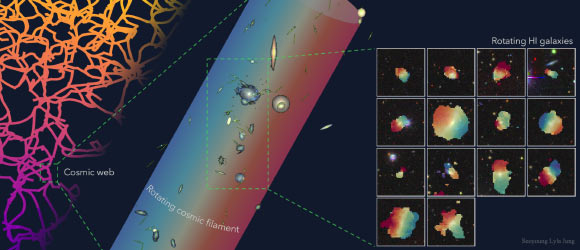
A figure illustrating the rotation of neutral hydrogen (right) in galaxies residing in an extended filament (middle), where the galaxies exhibit a coherent overall rotational motion tracing the large-scale cosmic web (left). Image credit: Lyla Jung.
Cosmic filaments are the largest known structures in the Universe: vast, threadlike formations of galaxies and dark matter that form a cosmic scaffolding.
They also act as “highways” along which matter and momentum enter galaxies.
Nearby filaments containing many galaxies rotating in the same direction – and where the entire structure appears to be rotating – are ideal systems for exploring how galaxies acquired the rotation and gas they have today.
They can also help test theories about how cosmic rotation accumulates over tens of millions of light years.
In a new study, astronomer Lyla Jung of the University of Oxford and colleagues discovered 14 nearby galaxies rich in hydrogen gas, arranged in a thin, elongated line about 5.5 million light-years long and 117,000 light-years wide.
This structure lies inside a much larger cosmic filament containing more than 280 other galaxies and measuring approximately 50 million light years.
Remarkably, many of these galaxies appear to rotate in the same direction as the filament itself, much more so than if the galaxy rotation pattern was random.
This challenges current models and suggests that cosmic structures may influence the rotation of galaxies more strongly or for longer than previously thought.
Astronomers found that galaxies on either side of the filament’s spine move in opposite directions, suggesting that the entire structure is rotating.
Using models of filament dynamics, they inferred a rotational speed of 110 km/s and estimated the radius of the dense central region of the filament to be around 163,000 light years.
“What makes this structure exceptional is not only its size, but also the combination of spin alignment and rotational motion,” Dr. Jung said.
“You can compare it to the teacup ride at a theme park. Each galaxy is like a rotating teacup, but the entire platform – the cosmic filament – also rotates.”
“This double motion gives us a rare insight into how galaxies derive their rotation from the larger structures in which they live.”
The filament appears to be a young and relatively undisturbed structure.
Its large number of gas-rich galaxies and low internal motion – a so-called dynamically cold state – suggest that it is still in an early stage of development.
Since hydrogen is the raw material needed to form stars, galaxies that contain a lot of hydrogen gas actively collect or hold fuel to form stars.
The study of these galaxies can therefore open a window on the early or ongoing stages of galaxy evolution.
Hydrogen-rich galaxies are also excellent tracers of the flow of gas along cosmic filaments.
Because atomic hydrogen is more easily disrupted by motion, its presence helps reveal how gas is channeled through filaments into galaxies, offering clues about how angular momentum flows through the cosmic web to influence galaxies’ morphology, rotation, and star formation.
“This filament is a fossil record of cosmic flows,” said Dr Madalina Tudorache, an astronomer at the University of Cambridge and the University of Oxford.
“This helps us understand how galaxies acquire their rotation and grow over time.”
The researchers used data from South Africa’s MeerKAT radio telescope, one of the most powerful telescopes in the world, comprising an array of 64 interconnected parabolic antennas.
This rotating filament was discovered thanks to an in-depth study of the sky called MIGHTEE.
This was combined with optical observations from the DESI and SDSS surveys to reveal a cosmic filament exhibiting both coherent galaxy spin alignment and global rotation.
“This really demonstrates the power of combining data from different observatories to get better information about how large structures and galaxies form in the Universe,” said Professor Matt Jarvis of the University of Oxford.
The discovery is reported in an article in Monthly Notices of the Royal Astronomical Society.
_____
Madalina N. Tudorache and others. 2025. A 15 Mpc rotating galaxy filament at redshift z = 0.032 available for purchase. MRNRA 544 (4): 4306-4316; doi: 10.1093/mnras/staf2005


