TRAPPIST-1e Likely Doesn’t Have What It Takes To Be a Habitable Planet — Here’s Why


Are we alone in the universe? It’s a question that has piqued the curiosity of astronomers for generations. There are at least 6,000 known planets outside our solar system (also called exoplanets), but only a handful of them are thought to provide conditions suitable for life, according to NASA.
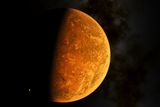
One of them is TRAPPIST-1e – the fourth of seven exoplanets orbiting TRAPPIST-1, a red dwarf star in the constellation Aquarius, 39 light-years from Earth.
Indeed, TRAPPIST-1e is a rocky planet that exists in the “Goldilocks zone,” where its distance from its star means it is possible, at least in theory, for there to be water on the surface. But this is only true if the planet has an atmosphere – and this is where some caution is needed, say researchers writing in a study published in the Astrophysical Journal of Letters.
“The basic thesis of TRAPPIST-1e is: If it has an atmosphere, it is habitable,” Sukrit Ranjan, an assistant professor at the University of Arizona’s Lunar and Planetary Laboratory, said in a statement. “But for now, the first-order question must be: ‘Does an atmosphere really exist?’”
Learn more: An exoplanet the size of Earth discovered 55 million light years from our planet
Atmosphere of TRAPPIST-1e
Publish their results in twin studies in the Journal of Astrophysical Lettersthe team collected data using the James Webb Space Telescope (JWST), pointing it toward TRAPPIST-1e as it passed TRAPPIST-1 four times.
The results suggest evidence of methane, which could indicate the existence of an atmosphere. Only subsequent research suggests that the source of the methane is unlikely to be TRAPPIST-1e itself. In fact, “the previously reported tentative hint of atmosphere is more likely to be ‘noise’ from the host star,” Ranjan said.
Ranjan and his fellow researchers came to this conclusion after simulating various scenarios in which the planet TRAPPIST-1e would have a methane-rich atmosphere, calculating the probability of each.
With this, the team was able to rule out the possibility of a cloudy atmosphere dominated by H2. While this is still possible, the research also “disfavors” both a thin, carbon dioxide-rich atmosphere (like Mars) and a thick, carbon dioxide-rich atmosphere (like Venus).
According to the results, the most likely scenario is that TRAPPIST-1e has a methane-rich atmosphere similar to that of Titan, Saturn’s largest moon, and the only satellite of all the planets to have a thick atmosphere, according to NASA. Even that, the researchers conclude, seems unlikely. Therefore, the likelihood of methane being present is just “noise.”
As the temperature of TRAPPIST-1 is significantly cooler than that of our sun (a yellow dwarf), gas molecules can be found in its atmosphere. It is therefore difficult to determine whether the detected methane indices belong to the star or the planet.
While the research puts a damper on the idea that TRAPPIST-1e has a methane-rich atmosphere that can hold water and, therefore, possibly host life, it also shouldn’t rule it out — “we just need more data,” Ranjan said.
In search of a habitable planet
There are billions of planets in the Milky Way, but only a few of them have the ingredients necessary to support life. The TRAPPIST-1 system is of great interest to astronomers because the seven planets orbiting the star are made of rocks, similar in size and mass to Earth, and temperate.
Although the entire system can fit into Mercury’s orbit, it is TRAPPIST-1e that is located in the habitable (or “Goldilocks”) zone and is most likely to have conditions for life to thrive.
The team hopes that future research will confirm whether or not TRAPPIST-1e has an atmosphere.
“With 15 additional JWST transits of TRAPPIST-1 e on the horizon, we are close to revealing an atmosphere, or lack thereof, on one of the most fascinating rocky exoplanets,” the study authors wrote.
Learn more: James Webb Space Telescope captures smallest exoplanet ever seen in historic first
Article sources
Our writers at Discovermagazine.com use peer-reviewed studies and high-quality sources for our articles, and our editors review them for scientific accuracy and editorial standards. See the sources used below for this article:


