Ancient Dirty Dishes May Be Misleading Archaeologists and Rewriting History


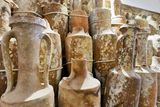
Olive oil has been a highly sought-after product for millennia, and its cultivation dates back to Neolithic times.
Only Cornell University researchers now say its presence in ancient artifacts may be overestimated. Indeed, the degradation process could cause other vegetable oils to be confused with olive oil. The team, writing in the Journal of Archaeological Sciencesnow calls for a re-examination of the criteria generally used to identify residues in excavated pottery.
“Archaeologists certainly want to believe that you found olive oil, because that tells a great story. And because it is an economically important Mediterranean product, there is a default assumption that if you found molecules that match olive oil, then you must have found olive oil,” said Rebecca Gerdes, a Hirsch postdoctoral associate at the Cornell Institute of Archeology and Material Studies, in a press release.
“The problem is that the composition of olive oil overlaps with that of a bunch of other vegetable oils. And if you start degrading it, the situation gets even worse: It starts to resemble animal fat,” Gerdes said.
Learn more: Discovering 7,200-year-old cheeses and other ancient foods and drinks
The problem of alkaline soils
Excavated pottery often contains chemical compounds (or biomarkers) that can be used to determine what the pot once contained. Vegetable oils, for example, can be identified by the presence of certain saturated and unsaturated fatty acids, as well as the oxidation products of unsaturated fatty acids, such as diacids.
“I generally describe my job as follows: I wash old dirty dishes, save the rinse aid, and use the molecules in it to understand how people use their pots and pans,” Gerdes said.
The problem is that Mediterranean soil is not conducive to the preservation of chemical biomarkers. The region’s climate, combined with its alkaline soil rich in calcium carbonate, “catalyzes” the degradation of residue that might be contained in ancient artifacts, the study authors wrote.
To find out how damaging this can be to the environment, the team studied how the amount and composition of olive oil residue changes in calcareous, alkaline soil in Cyprus compared to slightly acidic soil in New York.
Recreating archaeological conditions
First, the researchers made 3-centimeter ceramic pellets from terracotta clay. These were immersed in olive oil overnight before being buried in soil imported from Cyprus or in soil collected from an agricultural field in Ithaca, New York. The samples were then stored at 77 or 122 degrees Fahrenheit (25 or 50 degrees Celsius) for 3, 8, or 12 months. Once the time was up, the team removed the samples from the soil and extracted the residue, ready for analysis.
“We were able to do it in the lab at an accelerated pace, so we didn’t have to wait 3,000 years to complete my doctorate,” Gerdes said.
Results show that olive oil residues in Cypriot soil were less well preserved than those in New York soil, with lower yields and greater losses of dicarboxylic acid vegetable oil biomarkers. The effects were more pronounced in samples incubated at a higher temperature (122 degrees Fahrenheit or 50 degrees Celsius).
The researchers put forward several potential explanations, including the possibility that leaching occurs more quickly in Cypriot soil and that the two soils trigger different oxidation processes.
Rewriting the history of olive oil
This could change what we know about the history of the Eastern Mediterranean during early periods of globalization, such as the Late Bronze Age (1650 to 1100 BCE), the study authors say.
In Cyprus, for example, large-scale olive oil production is believed to have played a vital role in the country’s agricultural economy during this period, helping to secure its role as an important player in the region — a theory known as the “olive oil hypothesis.” Only this theory is based on evidence that may not be as infallible as previously thought, banking on the presence of fatty acids that are “consistent but not unique” to olive oil.
“We therefore suggest caution when extracting and interpreting organic residues from calcareous and alkaline contexts: the set of biomarkers in vegetable oils may not be preserved,” the study authors wrote.
Learn more: Bronze and Iron Age people focused on olive and grape cultivation, making wine and olive oil a priority
Article sources
Our writers at Discovermagazine.com use peer-reviewed studies and high-quality sources for our articles, and our editors review them for scientific accuracy and editorial standards. See the sources used below for this article:


