Don’t underestimate memory bandwidth when buying a graphics card


If you are looking for a new graphics card, you are probably looking at the clock frequencies, how many shaders cores and how many VRAM it packs. But do not underestimate the bandwidth of memory when shopping as it can lead to sly performance impacts.
There is a data bus connection between the GPU and graphic memory that is responsible for data transport, this is known as the GPU memory bandwidth. If the bandwidth is insufficient, a bottleneck occurs: the GPU cannot operate effectively because the data is provided too slowly.
The memory bandwidth is specified in gigabits or gigabytes per second. It depends on the type of memory (such as GDDR6 or GDDR7), the clock frequency and the width of the data bus. A higher bandwidth improves the performance of the card, as the data circulates more quickly between the graphic chip and the memory. A high bandwidth is particularly important for high resolutions such as 4K, which represent four times more pixels than 1080p.
Even in lower resolutions, high -resolution textures or graphic features such as tracing the shelves can always make strong requests on the bandwidth of memory. In addition, the many processors and nuclei on modern GPUs must be supplied permanently with data. A data transfer of data transfer therefore affects the overall performance of the graphics card.
Limited bandwidth is often manifested in stuttering and fluctuation in image frequencies. The transfer of data quickly reaches its limits, in particular at high image frequencies of 120 or 240 images per second. A frame limiter can however help by adapting the frequency of images to the available bandwidth.
Virtual reality applications also require a high memory bandwidth because the GPU must calculate a distinct and high resolution image with at least 90 images per second for each eye. The tracing of the rays further increases the requirement of the bandwidth. In this case, additional brightness data must be transferred for a real -time calculation.
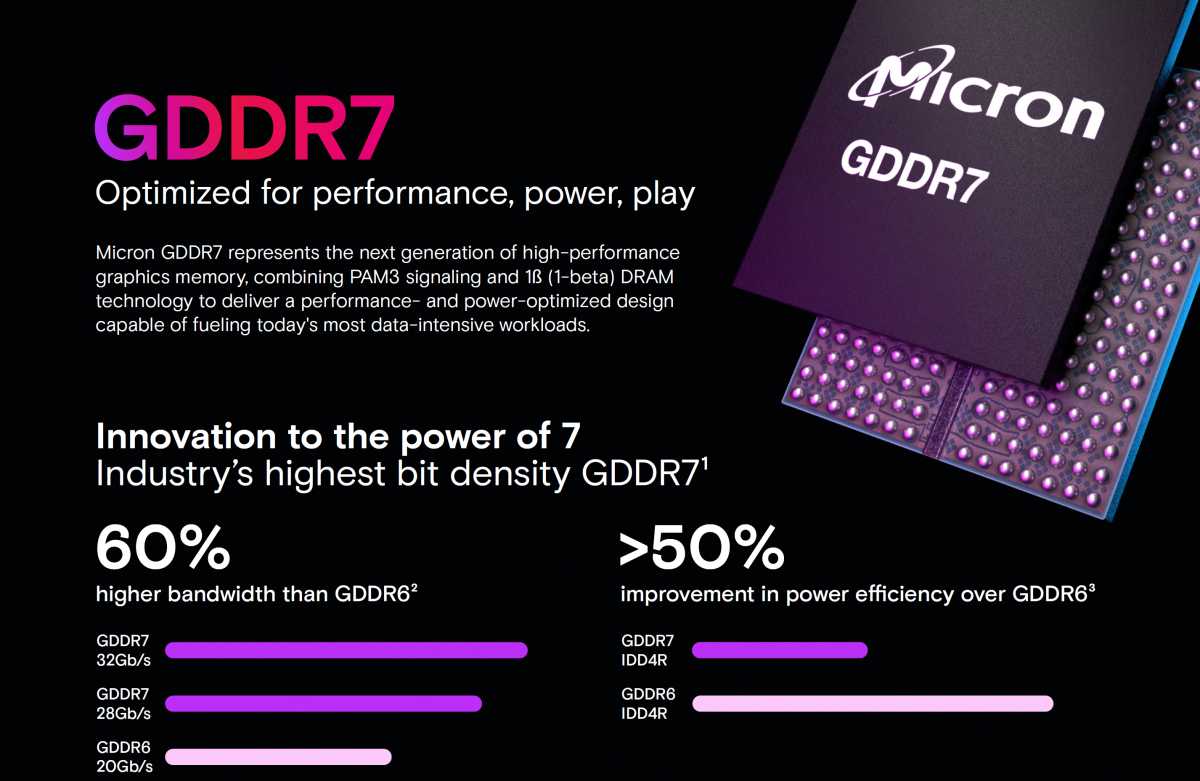
Compared to the graphic memory of the GDDR6 generation, the 7 series – here of Micron – is designed for much higher memory bands.
Micron
Graphics cards are often optimized for specific target resolutions and detail levels. For example, NVIDIA XX60 series models are intended for 1080p players, while upper class cards are designed for 1440p or ultra HD. In a series, the bandwidth available differs mainly from the width of the memory bus.
Entry -level cards often use a 128 -bit bus, while high -end models are equipped with 256 bits or more. If you are targeting higher resolutions or frequencies, you must opt for a graphics card with a high memory bandwidth. The definition of what is considered to be “high” changes with technological progress.
A few years ago, 1080p was still considered the premium standard, while it is now generally considered to be the level of entry. Reference tests provide a precious guide to compare the performance of different graphics cards to different parameters. They help to recognize the potential tape bottles of bandwidth and to select the right card for your needs.
The next time you are looking for a new GPU, be sure to pay particular attention to the memory bandwidth in addition to everything else. This will help you avoid the buyer’s potential remorse to pay attention to this type of technical data when purchasing a graphics card or test it yourself if possible.
This article originally appeared on our PC-Welt sister publication and was translated and located in German.


