December 8, 2025
2 min read
 Add Us On GoogleAdd SciAm
This Weekend’s Geminids Meteor Shower Should Be Spectacular
As far as annual meteor showers are concerned, 2025 has saved the best for last. This year’s Geminids are not to be missed
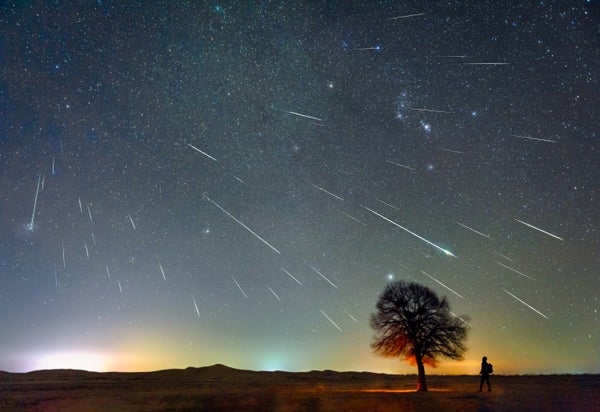
The Geminid meteor shower, as seen in the dark skies of Inner Mongolia on December 13, 2020.
The annual Geminids meteor shower is a favorite celestial sight around the holidays for many. This year’s show is due to peak this weekend with near-ideal viewing conditions for observers in the Northern Hemisphere.
Named for the constellation Gemini from which they appear to radiate, the Geminids—or “Gems” for short—usually offer the best and brightest falling stars for skywatchers to see out of all the major annual meteor showers. And this year’s batch should be no exception, especially because their predicted greatest intensity—late on the night of Saturday, December 13—should happen under relatively dark skies.
The brightness of a full moon can easily obscure most Geminids for observers, but the 2025 Gems will occur when the moon is a waning crescent, which won’t rise until the early-morning hours of Sunday, December 14. Assuming clear skies, these conditions should allow several hours of almost perfect viewing, beginning at 9 or 10 P.M. on Saturday as the Gemini constellation rises in the east, and ending circa 3 or 4 A.M. on Sunday. Running from December 4 through December 17, the Geminids will still be on display for days before and after this peak, albeit with much lower rates of shooting stars.
On supporting science journalism
If you’re enjoying this article, consider supporting our award-winning journalism by subscribing. By purchasing a subscription you are helping to ensure the future of impactful stories about the discoveries and ideas shaping our world today.
For the best chance of seeing a truly spectacular shower—with meteors falling at rates as high as 150 per hour—step outside under a clear, very dark sky sometime between midnight and 2 A.M., when the constellation of Gemini will have reached far above the horizon.
Many smartphone apps can locate Gemini, but as a shortcut simply look to the east-southeast for the eye-catching dot of planet Jupiter, which is now near the constellation as seen from Earth, and settle in for a celestial staring contest. Be sure to bundle up, too, as it’s likely to be quite chilly; a hot drink can help, and warm conversation with a buddy or two will help you pass the time (and monitor more of the sky).
Be on the lookout for bright and colorful shooting stars that gracefully arc overhead—such robust, relatively slow-moving displays are a hallmark of the Gems, which are composed of debris from the six-kilometer-wide asteroid 3200 Phaethon. The shower’s constituents hit Earth’s atmosphere at about 35 km per second—much slower than that of most other annual meteor showers, which instead come from fluffier pieces of cometary debris orbiting the sun at higher speeds.
It’s Time to Stand Up for Science
If you enjoyed this article, I’d like to ask for your support. Scientific American has served as an advocate for science and industry for 180 years, and right now may be the most critical moment in that two-century history.
I’ve been a Scientific American subscriber since I was 12 years old, and it helped shape the way I look at the world. SciAm always educates and delights me, and inspires a sense of awe for our vast, beautiful universe. I hope it does that for you, too.
If you subscribe to Scientific American, you help ensure that our coverage is centered on meaningful research and discovery; that we have the resources to report on the decisions that threaten labs across the U.S.; and that we support both budding and working scientists at a time when the value of science itself too often goes unrecognized.
In return, you get essential news, captivating podcasts, brilliant infographics, can’t-miss newsletters, must-watch videos, challenging games, and the science world’s best writing and reporting. You can even gift someone a subscription.
There has never been a more important time for us to stand up and show why science matters. I hope you’ll support us in that mission.