
Neutrinos are perhaps the most elusive particles in physics. Born in the nuclear reactions that power the sun, trillions pass through us every second, yet they almost never interact with anything at all. Now, scientists working deep beneath Earth’s surface have captured one of these rare encounters — watching a solar neutrino transform a carbon atom into nitrogen inside a massive underground detector.
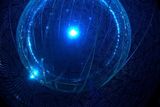
The breakthrough, described in Physical Review Letters, comes from the SNO+ experiment, located two kilometers (~ a half mile) underground at SNOLAB in Sudbury, Canada. There, researchers observed a neutrino striking a carbon-13 nucleus and converting it into radioactive nitrogen-13, a reaction never previously detected. A few minutes later, the nitrogen-13 decayed, producing a second flash of light. That paired signal allowed physicists to confidently identify the interaction.
“Capturing this interaction is an extraordinary achievement. Despite the rarity of the carbon isotope, we were able to observe its interaction with neutrinos, which were born in the sun’s core and travelled vast distances to reach our detector,” said lead author Gulliver Milton, in a press release.
Read More: Tiny Particles Reveal Asteroid Bennu’s Origin Story at the Beginning of the Solar System
Catching a Ghost Particle in the Act
This result builds on the legacy of the original Sudbury Neutrino Observatory (SNO), whose discovery of neutrino oscillations earned the 2015 Nobel Prize in Physics. With the upgraded SNO+ detector, researchers can now probe much rarer processes — including this newly observed interaction involving a neutrino, a particle commonly referred to as a “ghost particle” because it so rarely interacts with matter.
“This discovery uses the natural abundance of carbon-13 within the experiment’s liquid scintillator to measure a specific, rare interaction,” Christine Kraus, a SNOLAB staff scientist, said. “To our knowledge, these results represent the lowest energy observation of neutrino interactions on carbon-13 nuclei to date and provides the first direct cross-section measurement for this specific nuclear reaction to the ground state of the resulting nitrogen-13 nucleus.”
Inside the Double-Flash Signal That Proved the Detection
Between May 4, 2022, and June 29, 2023, the team searched for pairs of linked signals: an initial flash from the neutrino interaction, followed minutes later by the characteristic decay of nitrogen-13. Over 231 days, the detector logged 5.6 such events — statistically consistent with the 4.7 interactions expected from solar neutrinos.
The close match between prediction and observation confirmed that the result was genuine and not background noise. The ability to use solar neutrinos as a “test beam” for inducing and studying rare atomic reactions marks a significant milestone for neutrino physics.
A New Way to Study the Universe’s Most Elusive Particles
This detection marks a significant step forward. It gives scientists a new way to study how neutrinos interact with matter at energies that were previously inaccessible. Because these particles are central to the fusion processes that power stars, more precise measurements of their behavior could sharpen models of stellar evolution and element formation.
The SNO+ team now hopes to extend this work by combining the carbon-13 results with other rare reactions — and potentially pushing to even lower energies — to probe neutrino properties in greater detail.
For now, the achievement is a quiet but striking one: a particle commonly called a “ghost” traveled from the sun’s core to a mine two kilometers underground and left behind a brief flash of light, offering scientists a rare glimpse of its passage.
Read More: Carbon Nanotube Particle Accelerators Could Outmuscle LHC
Article Sources
Our writers at Discovermagazine.com use peer-reviewed studies and high-quality sources for our articles, and our editors review for scientific accuracy and editorial standards. Review the sources used below for this article:


:max_bytes(150000):strip_icc()/HDC-GettyImages-1205638014-729a3a2e30a242caa211295c158bf808.jpg?w=390&resize=390,220&ssl=1 "5 Foods and Supplements To Lower Your Stroke Risk")