NHS orders hospitals to cut back on treating patients


Nick TrigleHealth correspondent

 Getty Images
Access to hospital treatment is restricted in many parts of England as the NHS struggles to balance its books, the BBC has learned.
Regional health boards have ordered some hospitals to reduce the number of patients they see, meaning hundreds of thousands of patients could have to wait longer for treatment.
The rationing measures mainly apply to private companies carrying out work within the NHS, but several NHS hospitals would also be affected.
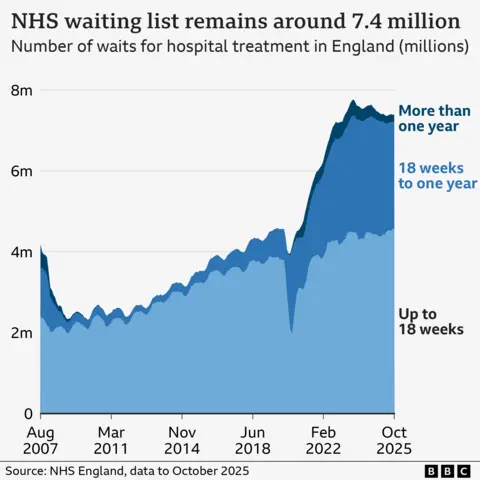
NHS officials have said they find themselves between “a rock and a hard place” trying to juggle balancing the budget and tackling the hospital backlog, which currently stands at 7.4 million.
Reducing wait times for operations like hip and knee surgeries and reaching the 18-week wait time target is the government’s number one health service priority.
But documents seen by the BBC show integrated care boards, responsible for spending on behalf of NHS England, asking hospitals to make patients wait longer and reduce the number of patients they treat until the end of the financial year.
One asked a private provider to reduce its activity by almost 30% and make patients wait eight weeks longer on average, while stopping taking new referrals for a period, in order to reduce treatment volume.
Surgery canceled
A surgeon at a private hospital said he had to cancel all his scheduled NHS operations for the coming weeks, with some patients given only a few days’ notice.
They told the BBC: “I had a full day of joint operations planned for this week and patients were informed a few weeks before that their potentially life-changing operations would not go ahead.
“Many of them have been waiting for treatment for over 40 weeks. It’s devastating for them.”
A letter from Circle, one of the country’s largest private hospital providers, to its doctors says that at some sites they may have to stop seeing NHS patients altogether.
Daniel Elkeles, of NHS Providers, which represents NHS hospitals, said restrictions were also being imposed on some NHS hospitals, calling it a “real concern”.
“If the government really wants it to hit the 18-week target, it will need to go all out and use all available capacity, which will require additional funding.”
Regional health boards use what are called business management plans to push individual hospitals to reduce the number of patients they see.
They are mainly used when hospitals are treating more patients than expected.
They can also be used to push hospitals to treat more when activity levels are lower than expected.
The BBC has seen evidence or received confirmation from a host of health advice that restrictions have been put in place in parts of the North West, North East, South West, Yorkshire, East Midlands and East Anglia.
A number of health boards refused to provide information to the BBC – and senior NHS sources said they expected many of England’s 42 regional councils would now impose restrictions on individual hospitals in their area.
They said they expected the number of affected hospitals to almost certainly increase before the end of the financial year, adding that the strike by resident doctors had not helped, with the NHS estimating that this year’s walkouts had cost hospitals more than £500 million.
It is estimated that the existing orders against private hospitals that have reported so far could lead to 140,000 fewer patients starting treatment by the end of March. But given that some NHS hospitals are affected and not all restrictions on private hospitals have been reported, this could be an underestimate.
David Hare, of the Independent Healthcare Providers Network, said: “Given that it is patient choice that determines demand for treatment in the independent sector – and the scale of the challenge of reducing NHS waiting lists – we were surprised by the scale of the proposed downturn, which will leave significant amounts of available capacity unused in both the independent sector and the NHS.
Rachel Power, chief executive of the Patients’ Association, said: “These reports are deeply alarming and pose a serious risk to patients’ ability to access the treatment they urgently need.
“Calling it ‘business management plans’ distracts from what it really is, another barrier that prevents patients from receiving timely care.”
“This will not only delay treatment, it will worsen conditions, reduce quality of life and cause harm that could have been avoided.”
Sarah Walter, of the NHS Confederation, which represents regional health boards, said its members had to make “difficult decisions”.
“The NHS is facing an unprecedented financial challenge which has forced system leaders to make very difficult decisions about how limited funds and tight budgets should be spent.
“Leaders are caught between a rock and a hard place: they need to balance their books and achieve the goal of elective care.”


