How Dodgers landed Edwin Díaz — and finally found a bona fide closer

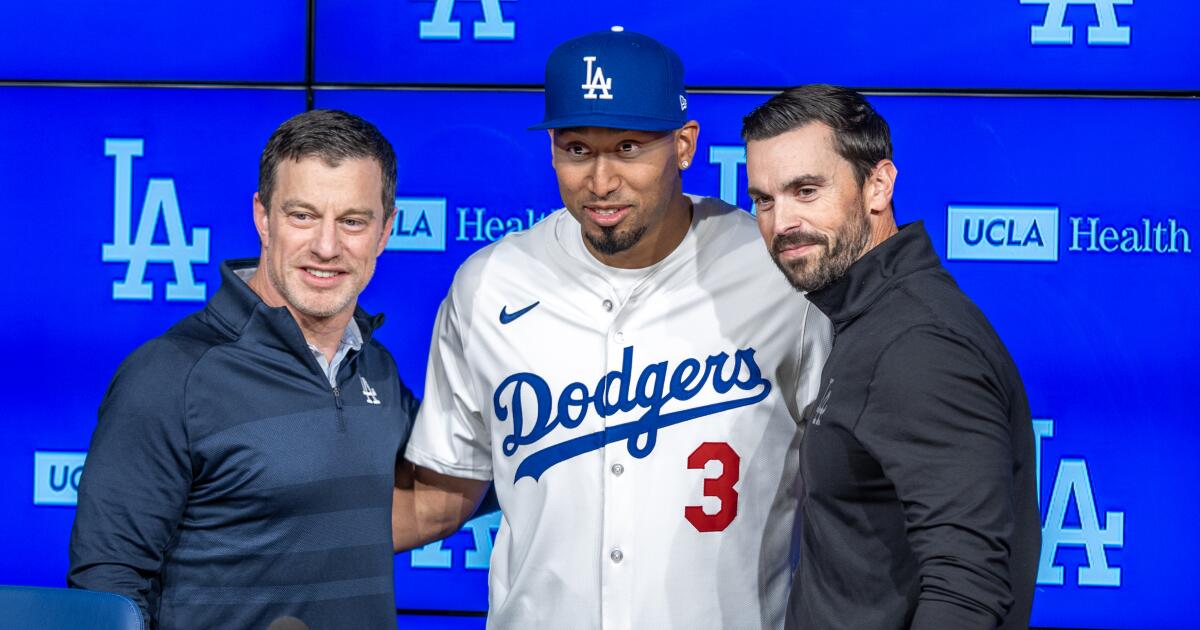
Going into winter, the assumption was that top free agent Edwin Díaz would fall out of the Dodgers’ preferred price range.
Knowing they needed help from the bullpen, the Dodgers decided to reach out with interest anyway.
What followed will go down as one of the most surprising results of this MLB offseason. And, for the Dodgers, their latest in a series of acquisitions of big names and star players.
Although the Dodgers initially had doubts about their chances of landing Díaz — particularly the type of relatively short-term deal they were seeking in their quest for emergency relief — circumstances changed, Díaz’s market evolved, and they went from dark horse to favorite.
It all culminated in a press conference at Dodger Stadium on Friday, the once-unexpected union between the two-time defending champions and the three-time All-Star right-hander being made official as Díaz’s three-year, $69 million contract was finalized.
“It hasn’t been easy,” Díaz said of his free agent process, which ended with him leaving the New York Mets after a decorated seven-year stint. “I spent seven years in New York. They treated me really well. They treated me very well. But I chose the Dodgers because they’re a winning organization. I’m looking to win and I think they have what it takes to win. So choosing the Dodgers was pretty easy.”
That didn’t mean it was any less surprising.
Earlier this winter, the Dodgers signaled hesitance to give another long-term contract to a reliever, after seeing Tanner Scott struggle in the first season of the four-year, $72 million contract he signed last winter.
And although they gradually opened up to the idea, seriously considering Devin Williams before signing a three-year, $51 million contract with the Mets two weeks ago, the idea of landing Díaz seemed far-fetched.
After all, the 31-year-old was widely expected to receive a four- or five-year contract, having already opted out of the remaining two seasons of his record five-year, $102 million contract with the Mets to become a free agent this winter. Additionally, because he had turned down a qualifying offer from the Mets early in the offseason, the Dodgers knew they would lose two draft picks (their second and fifth highest selections) to sign him.
“We checked in from the get-go,” general manager Brandon Gomes said. But, he acknowledged, “the opportunity to add someone of that caliber to what is already a very talented bullpen was something that we weren’t sure could actually come to fruition.” »
It turned out that a few factors worked in the Dodgers’ favor.
First, the Mets weren’t willing to give Díaz a longer-term deal either. Instead, following Williams’ signing, they reportedly only offered three years at a similar salary to the Dodgers. It’s no coincidence that it wasn’t until last week’s winter meetings — just days after Williams’ Dec. 3 deal with the Mets — that Gomes said talks began to intensify.
“Having those conversations and making sure you’re there and [letting him know]’Hey, we really appreciate you, and if things make sense on your end, great, we’re here’ — that was the most important thing,” Gomes said. “Making sure that you explore all avenues, because you don’t know how things are going to play out. “
Another advantage for the Dodgers: They had defenders close to Díaz who vouched for the organization.

New Dodgers star Edwin Díaz speaks during his introductory press conference Friday at Dodger Stadium.
(Allen J. Schaben / Los Angeles Times)
Díaz said he has received rave reviews about the club from his brother Alexis (who spent most of last year with the Dodgers, having acquired it from Cincinnati following an early-season demotion to the minors) and his Puerto Rico teammate Kiké Hernández (a longtime Dodgers fan favorite who is currently a free agent).
“They treat every player the same,” Díaz said of the message he received. “It’s really nice, [especially] knowing they have a lot of great players, future Hall of Fame players. …It’s really good. That’s what a winning clubhouse is like.
Ultimately, it all led to a fairly quick signing process Tuesday morning, in which the Dodgers gave Díaz the highest average annual salary for a reliever in MLB history ($23 million per year), but kept the terms at three years and were able to roll over more than $13 million of the total guarantee.
“I think once Devin left the board, it was like, ‘OK, let’s continue to explore different options,’” Gomes said. “Obviously having no idea of the conversations that had been happening up to that point between Edwin and other clubs, it was more about, ‘Hey, we’re here if there’s something that makes sense. And we’d love for you to join our group.’ And fortunately, everyone’s interests were aligned on that.
“That’s why you shouldn’t play the guess game and just do your due diligence from the start,” Gomes added. “Sometimes things work, sometimes they don’t. But having those conversations and making sure you’re doing the work to really understand the situation is important, especially when you see situations like this happening.”
Now, the Dodgers will trust Díaz to play a leading role in their quest for a World Series trio.
He will be the club’s designated closer – a role they have been reluctant to give to a reliever since the departure of Kenley Jansen (the only MLB reliever with more saves than Díaz since his debut in 2016).
“For us, we have a high bar. To name someone closer, you have to be one of the best. You have to be elite and dominant at what you do,” president of baseball operations Andrew Friedman said.
The team expects Díaz’s presence to also elevate the rest of the bullpen, giving more defined late-game structure to a relief corps that ranked just 21st in the majors in ERA last season.
“It allows Doc and our coaching staff to put guys in positions leading up to that,” Gomes said, “knowing that no matter who’s in the ninth, that we’re going to love the game.”
Perhaps the biggest news from Friday’s intro: Díaz still plans to enter games to his signature exit song, Timmy Trumpet’s “Narco” — which Gomes described as “probably the most electric exit song in the game.”
“I can’t wait for the first game of the season, coming up in the ninth with Timmy Trumpet and getting the W for the Dodgers,” Díaz said.
A few weeks ago, this scene seemed like an improbable vision.
But now, whenever the sounds of trumpets echo around Chavez Ravine in the summers to come, they will serve as reminders of the team’s latest free-agent coup — a move more unexpected than almost any other.


