Astronomers Find Direct Evidence for Supermassive Stars in Early Universe


Astronomers using the NASA/ESA/CSA James Webb Space Telescope have discovered chemical fingerprints of primordial stars weighing between 1,000 and 10,000 times the mass of the Sun in GS 3073, an ancient galaxy with a redshift of 5.55 (one billion years after the Big Bang).
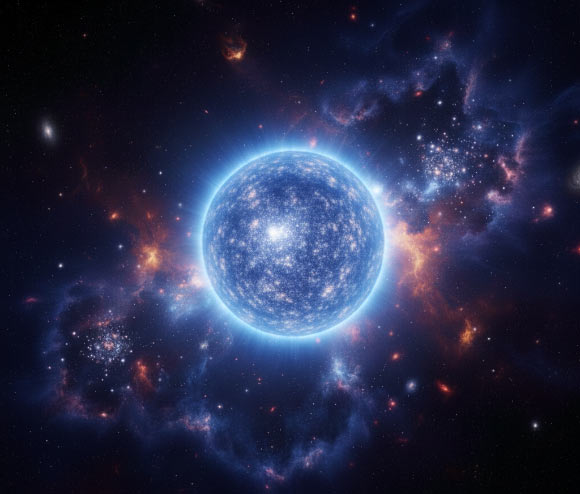
A primordial supermassive star from the beginning of the Universe. Image credit: Gemini AI.
By 2022, astronomers predicted that supermassive stars would form naturally in rare, turbulent streams of cold gas in the early Universe, explaining how quasars could exist less than a billion years after the Big Bang.
“Our latest discovery helps solve a 20-year-old cosmic mystery,” said Dr Daniel Whalen, an astronomer at the University of Portsmouth.
“With GS 3073, we have the first observational evidence for the existence of these monster stars.”
“These cosmic giants would have burned brightly for a brief period before collapsing into massive black holes, leaving behind the chemical signatures that we can detect billions of years later.”
“Much like dinosaurs on Earth, they were huge and primitive. And they were short-lived, living only a quarter of a million years, a cosmic blink of an eye.”
The key to the discovery was measuring the nitrogen/oxygen ratio in the galaxy GS 3073.
The galaxy contains a nitrogen-to-oxygen ratio of 0.46, far higher than can be explained by any known type of star or stellar explosion.
“Chemical abundances act like a cosmic fingerprint, and the pattern of GS 3073 is unlike anything ordinary stars can produce,” said Dr. Devesh Nandal, an astronomer at the University of Virginia and the Harvard and Smithsonian Center for Astrophysics.
“Its extreme nitrogen corresponds to only one type of source that we know of: primordial stars thousands of times more massive than our Sun.”
“This tells us that the first generation of stars included truly supermassive objects that helped shape the first galaxies and may have given rise to today’s supermassive black holes.”
The researchers modeled the evolution of stars between 1,000 and 10,000 solar masses and the elements they produce.
They discovered a specific mechanism that creates massive amounts of nitrogen: (i) these enormous stars burn helium in their cores, producing carbon; (ii) carbon escapes into a surrounding shell where hydrogen burns; (iii) carbon combines with hydrogen to create nitrogen through the carbon/nitrogen/oxygen (CNO) cycle; (iv) convection currents distribute nitrogen throughout the star; and (v) finally, this nitrogen-rich material is released into space, enriching the surrounding gas.
The process continues for millions of years during the helium burning phase of the star, creating the excess nitrogen seen in GS 3073.
The team’s models also predict what will happen when these monster stars die: They won’t explode; instead, they collapse directly into massive black holes weighing thousands of solar masses.
Interestingly, GS 3073 contains an actively feeding black hole at its center, potentially the very remnant of one of these early supermassive stars.
If confirmed, it would solve two mysteries at once: where the nitrogen came from and how the black hole formed.
The study also found that this nitrogen signature only appears in a specific mass range.
“Stars smaller than 1,000 solar masses or larger than 10,000 solar masses do not produce the correct chemical pattern for the signature, suggesting a ‘sweet spot’ for this type of enrichment,” the scientists said.
The study was published in the Astrophysical journal letters.
_____
Devesh Nandal and others. 2025. 1,000 to 10,000 MSun primordial stars created the excess nitrogen in GS 3073 at z = 5.55. ApJL 994, L11; doi: 10.3847/2041-8213/ae1a63