‘Beachy Head Woman’ Originated from Southern England, Ancient DNA Study Shows


The skeletal remains of an individual colloquially known as Beachy Head Woman were rediscovered in the collection of Eastbourne Town Hall in 2012 and have been the subject of significant public interest ever since. Radiocarbon dating gave a date between 129 and 311 CE, indicating that she lived during the period of Roman occupation of Britain, and for over a decade several attempts were made to discover her geographical origins and ancestors. Once theorized to originate in sub-Saharan Africa or perhaps the Mediterranean, the new DNA study indicates that it has a strong genetic affinity with individuals from rural Britain during Roman occupation and modern-day Britons.
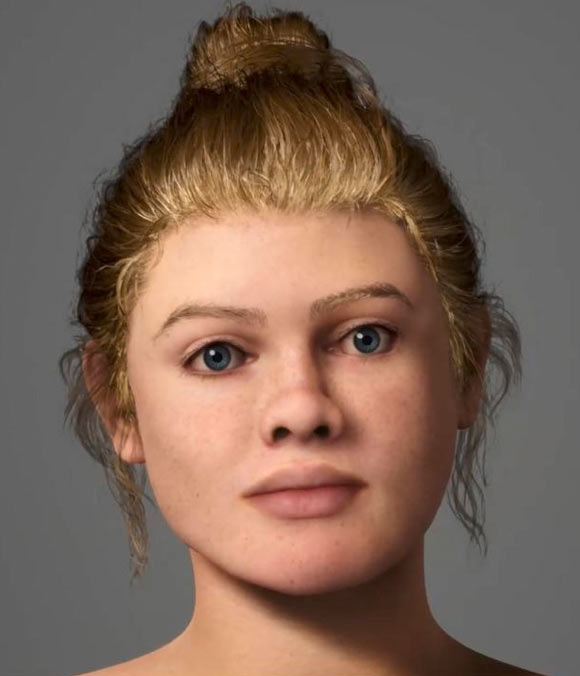
The facial representation of the Beachy Head woman. Image credit: Face Lab, Liverpool John Moores University.
There is little certainty about the Beachy Head Woman from her discovery until today.
Radiocarbon dating showed that she died between 129 and 311 CE, corresponding to the Roman occupation of Britain.
Analysis of her skeletal remains suggests that she was between 18 and 25 years old when she died and was just over 1.5 m (4.9 ft) tall.
A healed leg wound suggests a serious but non-fatal injury at some point in one’s life.
A dietary analysis looking at the carbon and nitrogen values in his bones also revealed that his diet likely included a lot of seafood.
“Using cutting-edge DNA techniques, we were able to determine the origins of this individual,” said Dr William Marsh, a researcher at the Natural History Museum in London.
“We show that she carries genetic ancestry that most closely resembles that of other individuals in the local population of Roman-era Britain.”
The Beachy Head woman came into the spotlight in 2012 when her remains were discovered in the Eastbourne Town Hall collections.
Details on the box it was found in suggest the skeleton had been found on the nearby headland, Beachy Head, in the 1950s, but no details of an excavation have yet been found.
The story of the Beachy Head woman became more intriguing when initial morphometric analysis suggested that she originated in sub-Saharan Africa. This result informed an exhibition at Eastbourne Museum and attracted media attention.
Then, in 2017, unpublished DNA work suggested it was more likely to come from the Mediterranean than Africa, perhaps Cyprus.
However, this discovery was based on limited DNA data, insufficient to draw strong conclusions, leaving many unanswered questions about Beachy Head’s wife.
“Our scientific knowledge and understanding is constantly evolving and, as scientists, it is our duty to continue to search for answers,” said Dr Selina Brace, also from the Natural History Museum, London.
“With technological advances made over the past decade since Beachy Head Woman first appeared, we are excited to present this comprehensive new data and share more about this person and her life.”
The team’s paper was published this month in the Journal of Archaeological Sciences.
_____
Andy Walton and others. Beachy Head Woman: clarifying her origins using a multiproxy anthropological and biomolecular approach. Journal of Archaeological Sciencespublished online December 17, 2025; doi: 10.1016/j.jas.2025.106445


