Before trips to Mars, we need better protection from cosmic rays

When you purchase through links on our articles, Future and its syndication partners may earn a commission.

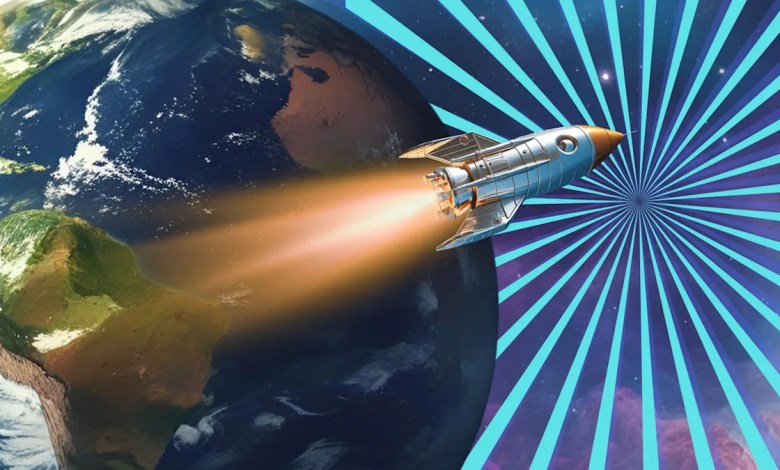
Cosmic rays could pose a major challenge on the road to Mars. . | Credit: Robert Lea (created with Canva)
This article was originally published on The conversation. The publication contributed the article to Space.com Expert voices: opinion pieces and perspectives.
The first step on the Moon was one of humanity’s most exciting achievements. Today, scientists plan round trips – and dream of March beyond.
Next year, NASA Artemis II Mission will send four astronauts to fly around the moon to test the spacecraft before future landings. The following year, two astronauts are expected to explore the surface of the Moon for a week as part of the NASA program. Artemis III Mission.
And finally, the trip to Mars is planned for 2030s. But an invisible threat stands in the way: cosmic rays.
When we look at the night sky, we see nearby stars and planets. If we are lucky enough to live in a place without light pollution, we might catch meteors sliding across the sky. But cosmic rays – made up of protons, helium nuclei, heavy ions and electrons – remain hidden. They come from exploding stars (galactic cosmic rays) and our own sun (solar particle events).
They don’t discriminate. These particles carry so much energy and move so quickly that they can knock electrons out of atoms and disrupt the molecular structures of any material. They can thus damage everything in their path, machines and humans alike.
Earth’s magnetic field and atmosphere protect us from most of this danger. But aside from protecting Earth, space travelers will be regularly exposed. In deep space, cosmic rays can break DNA strands, disrupt proteins and damage other cellular components, increasing the risk of serious diseases like cancer.
The research challenge is simple: measure the impact of cosmic rays on living organisms, then design strategies to reduce their damage.
Ideally, scientists would study these effects by sending tissue, organoids (artificial structures resembling organs) or laboratory animals (like mice) directly into space. It happens, but it’s expensive and difficult. A more practical approach is to simulate cosmic radiation on Earth using particle accelerators.
Cosmic ray simulators in the WE And Germany expose tissues, plants and animals to different components of cosmic rays in sequence. International news accelerator installation being built in Germany will reach even higher energies, matching levels found in space that have never been tested on living organisms.
But these simulations are not completely realistic. Many experiments deliver the entire mission dose in a single treatment. It’s like using a tsunami to study the effects of rain.
In real space, cosmic rays arrive as a mixture of high-energy particles striking simultaneously, not one type at a time. My colleagues and I suggested build a multi-branch accelerator capable of firing multiple tunable particle beams at once, recreating the mixed radiation of deep space under controlled laboratory conditions. But for now, this type of installation only exists as a proposal.
Beyond better testing, we need better protection. Physical shields seem to be the obvious first defense. Hydrogen-rich materials such as polyethylene and absorbing water hydrogels can slow down charged particles. Although they are used or planned to be used as materials for spacecraft, their benefits are limited.
Galactic cosmic rays in particular, those that come from exploding distant stars, are so energetic that they can penetrate through physical shielding. They can even generate secondary radiation which increases exposure. Thus, effective protection using only physical shields remains a major challenge.

Cosmic rays could prevent humanity from traveling to Mars | Credit: NASA
Nature’s armor
This is why scientists are exploring biological strategies. One approach is to use antioxidants. These molecules can protect DNA from harmful chemicals produced when cosmic rays hit living cells.
Supplementation with CDDO-EA, a synthetic antioxidant, reduces cognitive damage caused by simulated cosmic radiation in female mice. In the study, mice exposed to simulated cosmic radiation learned a simple task more slowly than unexposed mice. However, mice given the synthetic antioxidant behaved normally despite being exposed to simulated cosmic radiation.
Another approach is to learn from organisms with extraordinary capabilities. Hibernating organisms become more resistant to radiation during hibernation. The mechanisms by which hibernation protects against radiation are not yet fully understood. It is nevertheless possible to induce hibernation-like conditions in non-hibernating animals and make them more radioresistant.
tardigrades – microscopic creatures also called water bears – are also extremely radioresistant, especially when dehydrated. Although we cannot hibernate or dehydrate astronauts, the strategies these organisms use to protect cellular components could help us preserve other organisms during long space trips.
Microbesseeds, simple food sources, and even animals that might later become our companions could be kept in a protected state for a period of time. In calmer conditions, they could then resume their full activity. Therefore, understanding and exploiting these protection mechanisms could prove crucial for future space travel.
A third strategy aims to support organisms’ own responses to stress. Stressors on Earth, such as famine or heat, have caused organisms to develop cellular defenses that protect DNA and other cellular components. In a recent preprint (a paper that has not yet been peer-reviewed), my colleague and I suggest that activating these mechanisms through specific diets or medications may provide additional protection in space.
Physical shields alone will not be enough. But through biological strategies, more experiments in space and on Earth, and the construction of new dedicated accelerator complexes, humanity is moving closer to achieving routine space travel. At the current rate, it will probably take several decades before we achieve complete protection against cosmic rays. Increased investment in space radiation research could shorten this timeline.
The ultimate goal is to travel beyond Earth’s protective bubble without the constant threat of high-energy invisible particles damaging our bodies and spacecraft.