New Species of Tinamou Discovered in Brazil


Ornithologists have discovered a new species of tinamou living in the mountain forests of the Serra do Divisor in the western Amazon, Brazil.
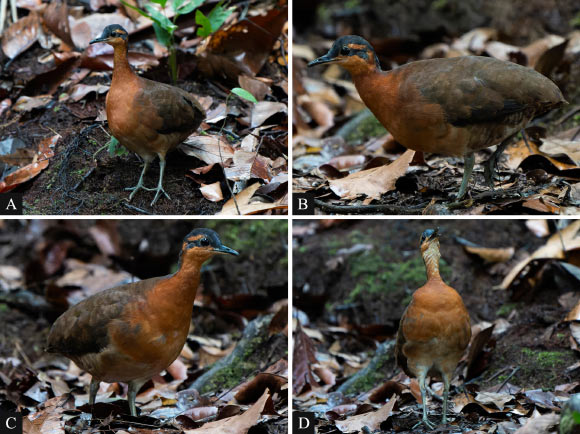
An individual of Tinamus Resonances in Morro Queimado, Serra do Divisor National Park, Mâncio Lima, Acre, Brazil. Image credit: Luis A. Morais.
“The kind Tinamus includes the small Tinamous forest and is the most diverse in the family Tinamidae, with 21 recognized species,” said lead author Dr. Luis Morais of the Universidade Federal do Rio de Janeiro and colleagues.
“Despite its diversity, Tinamus remains one of the least studied avian groups in the Neotropics, largely due to its cryptic habits and the inaccessibility of the dense forest habitats it occupies.
“The western Amazon is home to the greatest diversity of Tinamus coexisting species in the same region.
“However, few studies have addressed tinamous taxonomy in this area, leaving several important questions unanswered.”
Researchers first recorded a distinctive vocalization of the new species in 2021 in the understory of the Serra do Divisor, an isolated mountain complex on the border between Brazil and Peru.
“The song sounded like those of Tinamusyet no species could be positively identified at the time, and no visual confirmation was obtained,” they explained.
“Comparisons with all Tinamus Known vocalizations in the region, as well as consultations with ornithologists experienced in Amazonian avifauna, have failed to produce a conclusive match.
“The song does not resemble any known tinamou vocalizations, raising the hypothesis that it may represent an undescribed form.”
In 2024, scientists managed to attract two individuals using a digitally synthesized playback of previous recordings, obtaining excellent views and photographs of one bird.
“During the field expedition to the Serra do Divisor National Park, five recognized species of Tinamus were detected: Tinamus Bartletti, Tinamus cinereus, Tinamus Soui, Tinamus strigulosusAnd Tinamus variegatus“, they said.
“All of these species have been recorded in lowland forests and along lower mountain slopes.”
“In contrast, the only representatives of the genus encountered in the higher altitudes of the mountains, above 250 m, were the representative specimens of the taxon here assumed to be an undescribed species, exhibiting a unique combination of plumage coloration and vocal structure, which we formally name as: Tinamus Resonances (the common name is the slate-masked tinamou).
During ten independent encounters at eight sites in the Serra do Divisor mountain region, the authors confidently identified at least 15 distinct individuals.
“Considering the total extent of suitable habitat within the defined altitude range (63,302 ha), we estimate a preliminary population size of approximately 2,106 individuals in the Serra do Divisor mountain complex,” they said.
Tinamus Resonances is distinguished by a unique combination of plumage patterns, vocal repertoire, and ecological characteristics, including a conspicuous dark slate facial mask, bright cinnamon-rufous underparts, and a uniform brownish-gray back.
“This species differs from all other Tinamidae by exhibiting, at least in females (all three individuals whose sex could be determined were female), a distinctive dark slate-colored crown, which extends in a prominent band along the back of the neck and into the post-ocular region, forming a conspicuous facial mask,” the ornithologists said.
The vocalizations of Tinamus Resonances are remarkable, composed of long, powerful songs that resonate strikingly on steep mountain slopes, producing a characteristic resonant effect.
“Tinamus Resonances was recorded spontaneously vocalizing in the late afternoon and dusk, between 5:40 p.m. and 6:30 p.m. local time,” the researchers said.
“Its song is strong and carries long distances, but undergoes marked acoustic diffusion along the steep slopes of the Serra, which alters the temporal structure of the song due to echo.”
“When confronted directly, individuals showed no avoidance behavior and appeared remarkably tame, apparently failing to recognize humans as potential predators.”
“Additionally, individuals have been observed crossing open understory areas slowly and without signs of vigilance, a behavior contrasting with the generally wary reactions of other tinamous.”
“In between vocal responses, birds were also observed foraging on the forest floor, probing and knocking over fallen leaves with their beaks in search of food.”
According to scientists, Tinamus Resonances could be very vulnerable to climate change and proposed infrastructure projects in Brazil.
“The discovery of Tinamus Resonances highlights the unique biological character of the Serra do Divisor, reinforces its status as a center of mountain endemism and highlights the crucial importance of maintaining its long-term conservation,” they concluded.
Their article was published on December 2, 2025 in the journal Zootaxa.
_____
Luis A. Morais and others. 2025. A new species of Tinamus (Aves: Tinamiformes) from the western Amazon, Brazil. Zootaxa 5725 (2); doi: 10.11646/zootaxa.5725.2.6


