We have a fossil closer to our split with Neanderthals and Denisovans


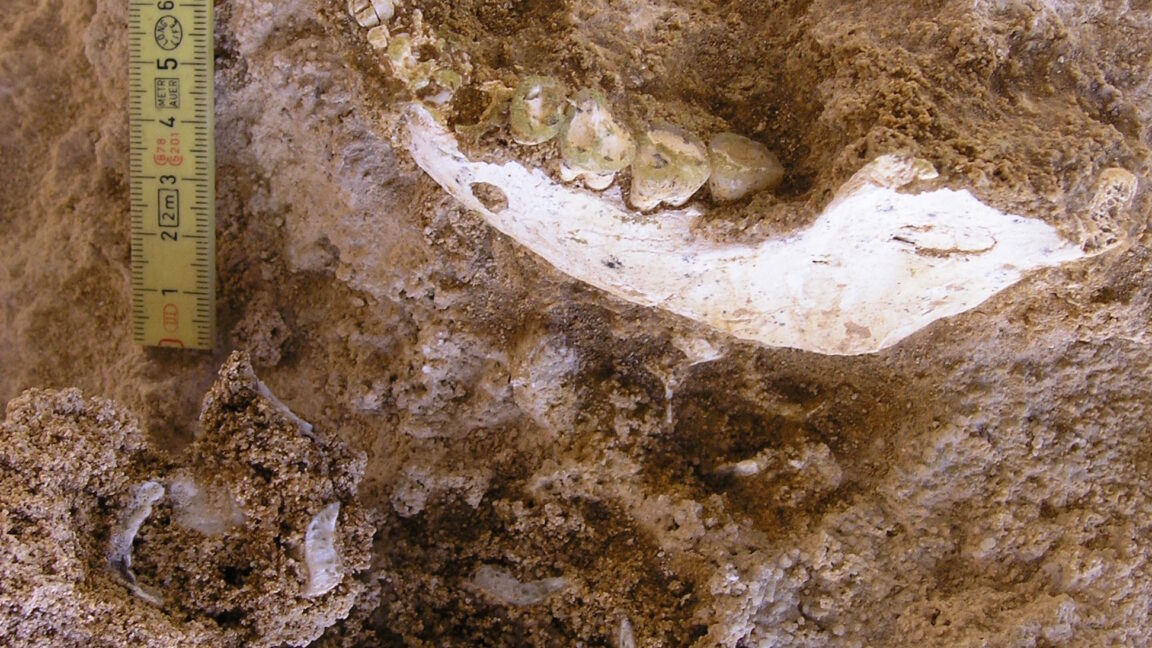
The Casablanca fossils are about the same age as the hominid fossils from Spain, which belong to a species called Homo ancestor. It has been suggested that this species is a likely ancestor of Neanderthals and Denisovans. Overall, it appears that the Casablanca fossils are a North African counterpart Homo ancestorthe Spanish hominids ultimately leading to the Neanderthals and the North African hominids ultimately leading to us.
The two groups share some features of their teeth and lower jaw, but they are also different in some important ways. The teeth and chin in particular share some older features with Homo erectus. But the jaws show more recent features in places where chewing muscles once attached to the bone – features that Neanderthals and our species share. On the other hand, the teeth lack other relatively recent features that would later help define Neanderthals (and which have been is already beginning to appear in Homo ancestor).
Overall it looks like Homo erectus The populations of Neanderthals and Denisovans had been separated for some time by the time the Hominid Cave hominids lived. But not that long. These hominids were probably part of a generation quite close to this great split, near the base of our branch of the hominid family tree.
I’m looking at you, hominin
Based on ancient DNA, it appears that Neanderthals and Denisovans began evolving into two distinct species between 470,000 and 430,000 years ago. During this time, our branch would eventually become recognizable as We about 300,000 years ago, or perhaps earlier. At different times and places, the three species would eventually come together to mix and exchange DNA, leaving traces of these interactions buried deep in each’s genome.
And 773,000 years after a predator dragged the remains of some unfortunate hominids to its lair in North Africa, the distant descendants of those hominids dug up the gnawed and broken bones and began to piece together the story.
Nature, 2025 DOI: 10.1038/s41586-025-09914-y (About DOIs).


