Science news this week: A runaway black hole, a human ancestor discovered in Casablanca cave, and vaccine schedule slashed


This week’s science news was entirely devoted to discoveries made by the world’s best telescopes, such as The James Webb Space Telescope has verified the existence of a runaway supermassive black hole escaping from its host galaxy at 2.2 million miles per hour (3.6 million km/h).
The black hole, which leaves behind an astonishing trail of stars, confirms more than five decades of research. And it’s not the only celestial object offering evidence for long-held astronomical theories this week – there was also Cloud-9, a failed galaxy discovered by the Hubble telescopewhich appears to be held together by dark matter.
An ancestor of humans and Neanderthals found in Casablanca
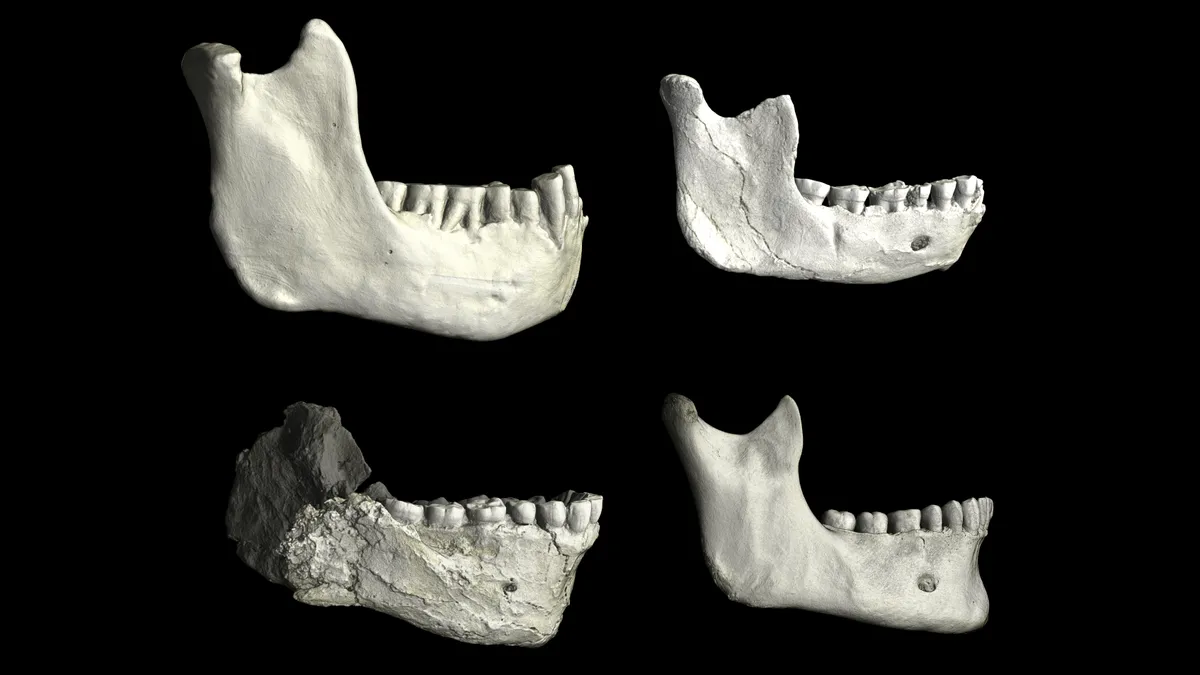
A collection of 773,000-year-old bones discovered in a Moroccan cave this week shifted the potential origins of modern humans from East Africa to West Africa.
There are many fossil hominids in Africa – at least until about a million years ago and again after 500,000 years – but there is a gap between these two times that makes tracking the evolutionary history of humanity difficult.
This makes the discovery of new fossils, found inside the Casablanca Hominid Cave, a very exciting development for paleoanthropologists, with the remains believed to come from the last common ancestor of modern humans, Neanderthals and Denisovans.
Discover more news on archaeology:
—One of the last Siberian shamans was an 18th-century woman whose parents were related, DNA study reveals
—60,000-year-old poison arrows from South Africa are the oldest poisoned weapons ever discovered
—Tiny bump on 7 million-year-old fossil suggests ancient ape walked upright – and could even be a human ancestor
The little mysteries of life

There are over 600 million cats in the world, but are any of the roughly 10% that are purebred? evolve naturally? Or are they all the result of human selection? The answer is more complicated than it seems at first glance.
—If you liked this, sign up for our newsletter Life’s Little Mysteries
The US government reduces the vaccination schedule for children

Federal health officials this week announced an unprecedented change in the childhood immunization schedule, reducing the number of shots universally recommended for children 18 and under from about 17 to 11 years old.
The unilateral decision is a step toward the long-standing goal of Health and Human Services Secretary Robert F. Kennedy Jr. and other vaccine skeptics to reduce the number of vaccines given to children. While officials say the move will bring the United States more closely in line with other developed countries, experts say the decision lacks scientific basis and will lead to more sick children.
Discover more health news:
—The New American Food Pyramid recommends a diet very high in protein, beef tallow as a healthy fat option, and high-fat dairy products.
—Leonardo da Vinci’s DNA may be embedded in his art – and scientists think they’ve managed to extract some of it
—“Mitochondria transfer” into nerves could relieve chronic pain, early studies suggest
Also in science news this week
—Rare 2,000-year-old war trumpet, possibly linked to Celtic queen Boudica, discovered in England
—Orbiting satellites could start crashing into each other in less than 3 days, new theoretical ‘CRASH Clock’ reveals
—Hundreds of iceberg earthquakes shake ruined end of Antarctica’s Doomsday Glacier
Something for the weekend
If you’re looking for something a little longer to read over the weekend, here are some of the best science stories, skywatching guides, and quizzes released this week.
—Jupiter will eclipse all the stars in the sky this weekend – how to see the ‘king of planets’ in opposition [Skywatching]
—What do you really know about T. rexthe king of the dinosaurs? [Quiz]
Science in pictures

The first full moon of 2026, called the Wolf Moon, shone in the northern hemisphere sky earlier this week. It’ll be the biggest and brightest full moon of the year until November, but if you missed the show, we’ve compiled this handy gallery of lunar photos from around the world.
Follow Live Science on social media
Want more science news? Follow our Live Science WhatsApp Channel for the latest discoveries as they happen. It’s the best way to get our expert reports on the go, but if you don’t use WhatsApp, we’re here too Facebook, X (formerly Twitter), Flipchart, Instagram, TikTok, Blue sky And LinkedIn.


