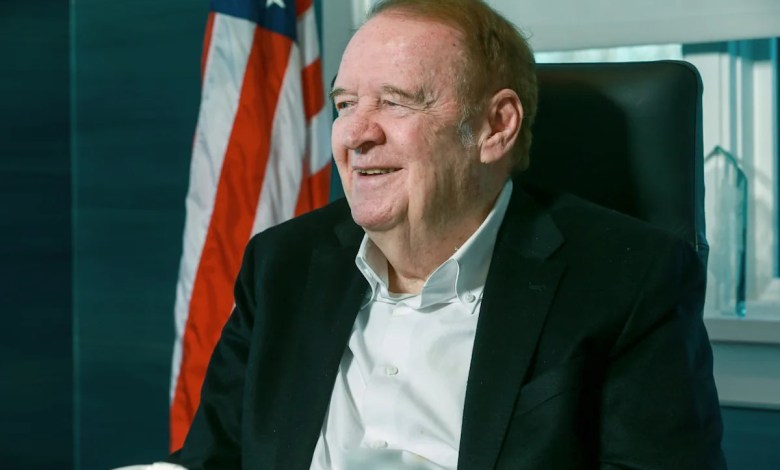
The longest-serving state legislator in New Jersey history, Richard J. Codey became the state’s chief executive quite by chance.
In 2004, Gov. James E. McGreevey abruptly resigned after disclosing an affair with another man he had named as his homeland security adviser. State law at the time provided that McGreevey be succeeded by the state Senate president — the state’s second-most powerful political position, which was then held by Codey, a fellow Democrat.
Recalling the moment when he received the stunning call informing him of the political bombshell about to drop, Codey said he knew it would ultimately define his life.
“It’s either going to be good or it’s going to be bad,” he said of that day in an interview with the Center on the American Governor at the Eagleton Institute of Politics. “And I was not happy.”
Codey, who would hold the dual role of acting governor and Senate president for 14 months and continued to serve in the state Senate for 20 years afterward, died Sunday morning at his Roseland home after a brief illness, his family announced on social media. He was 79.
A funeral director by trade, Codey was a staple of Jersey’s rough-and-tumble politics for decades and a fierce advocate for mental health. In addition to his time as the state’s “accidental governor,” the gregarious and colorful Essex County Democrat spent a record 50 years in the state Legislature. It was stretch that included stints in both the state Assembly and Senate — and spanned the presidencies of Richard Nixon to Joe Biden.
“I’m proud of it,” Codey said of his career during an interview with NJ Advance Media as he prepared to retire in 2024. “Most importantly, I did it the right way, in my opinion.”
The son of an undertaker, Codey — most knew him as Dick; very close friends called him Richie — was born and raised in Orange. He grew up in a large Irish family on the third floor of his father’s stately funeral home on High Street, in a world oddly sandwiched between childhood and death.
The second-oldest of five kids, he and his two brothers and two sisters lived in an apartment with three bedrooms, sharing one bathroom. There was no air conditioning and even in the summer the windows had to remain closed until 10 p.m. so as not to bother bereaved families gathered downstairs.
Sports was their escape. Codey remembered in an interview how they would play basketball in the apartment upstairs by cutting out the bottoms of cardboard shoe boxes, hanging them over the doorway and using rolled-up socks as balls. If it got too noisy, there would be the inevitable call from their father, Donald Codey Sr., from his office downstairs.
The parking lot for the funeral home was their field of dreams. They would play baseball there in the summer. It was tag football in the winter. At night a hook would hang on a light post. Their play would be determined by whether or not a funeral had filled the empty lot with cars.
Still, there was no escaping that death was the family business. Codey spoke of working as a pallbearer at the funeral home. On Saturdays, he was the one in the dark suit while everyone else was in T-shirts and shorts. When his father became coroner for Essex County, Codey began picking up bodies at accident scenes.
“I was 14, taking bodies out of train wrecks. You grow up quick,” he remarked.
Talking about it years later, he said there would be lessons to be learned from those days that did define his life. “A good deal of my success came from watching my parents serve people at a time of need,” he remarked.
A graduate of Fairleigh Dickinson University, Codey was a teacher in East Orange before joining his family’s business. Later he became an insurance broker. But he started in politics early. A product of the Essex County Democratic machine, he often would tell the story of running for the county committee in 1968. He lost by four votes.
“They cheated,” he said. The other side had the machine opened during the voting, saw he was winning, and brought in more people to the polling place. “When I complained, they said: ‘Kid, you’re right. Next year you’ll win.’” The next year, he did.
Four years later in 1973, he ran for state Assembly out of a county then under the firm control of legendary Democratic boss Harry Lerner. George Minish, the son of Democratic congressman Joseph Minish, also wanted the seat. But Lerner gave Codey the organizational line because Orange did not have any officeholders at the time. Codey won easily.
In Trenton, as chairman of the Assembly Committee studying the plan to bring gaming to New Jersey, Codey became one of the architects of the historic move that in 1976 allowed casinos to open in Atlantic City.
Codey, who long represented parts of suburban Essex County, was asked in a 2010 interview if he was a champion of casino gambling.
“I’ve never gambled in a casino in my life, to this day,” he responded.

Richard Codey 1980
By 1981, he had moved on to the state Senate. In Trenton, Codey was a vocal advocate for the care and treatment of those with mental illnesses. He received national attention after he went undercover at a state psychiatric hospital. Assuming the name of a dead convicted criminal, he was hired as a night attendant and found employees sleeping on the job and abusing patients. The exposé led to major reforms for patients in mental health facilities. Later as governor, he established a Task Force on Mental Health to report improving services to the state’s mentally ill.
Sports remained a passion long after the shoebox basketball games in his family’s apartment. He was a die-hard Seton Hall basketball fan, and sported a gold ring with a blue sapphire honoring Seton Hall’s 1989 Final Four appearance — a gift from former Pirates coach P.J. Carlesimo, who said he gave it to Codey to mark his unfailing support for the program.
For a time, he was also a race horse owner. One of them he named “Seat N Haul.”
Codey was a big movie buff. He often quoted from films and would begin conversations with a review of whatever he had most recently seen. He said his favorite film, though, was “The French Connection,” and could recite whole scenes from the movie verbatim.
A genial, mostly soft-spoken man with a self-depreciating manner and an endless stash of one-liners, he hardly said just “yes” to something. His favored phrase instead was “absolutely, positively …” He held tightly onto long-running and sometimes bitter feuds with rivals within the Essex County organization and state party bosses beyond. Yet he was a deal maker and had many friends across the aisle.
His role as governor came through an odd quirk in New Jersey law before the state changed its constitution to elect both a governor and a lieutenant governor. Unlike most other states, the line of succession in New Jersey was through the Senate President, who would step into the role of “acting governor” whenever a governor became incapacitated, resigned, or left the state for travel or any other reason. During a bizarre period in 2001 when the Senate presidency was being shared because of a 50-50 split between Democrats and Republicans, the state had four acting governors in little more than a week.
At the time, Codey himself took a turn for three ceremonial days. Then, it was little more than fun. He used his own money to throw a party for family and friends at the governor’s mansion at Drumthwacket, in what some thought was a bittersweet moment for a man who had once considered running for governor. His parents Donald and Patricia were both there, his father then suffering from Alzheimer’s disease. Guests received commemorative plates and watches he had ordered to mark the celebration.
“It was a lark,” he said of the three-day job.
It was far more serious when McGreevey walked off the stage.
On August 11, 2004, the governor shocked the state when he announced he was a “gay American” and would resign after disclosing an extramarital affair with a man he’d put on the state payroll despite spotty qualifications. With McGreevey’s exit, Codey, as Senate President, became acting governor for the remaining 14 months of his predecessor’s term.
“It was a total absolute shock to me,” he said upon learning of what was about to happen.
Hailed as a steadying influence following the scandal that had ensued over McGreevey, Codey had then-Senate Minority Leader Leonard Lance, a Republican who would later be elected to Congress, to hold the Bible as he took the oath of office. Lance would tell reporters that Codey’s legacy would be that he restored the integrity of office.
Codey did not move into the governor’s mansion. “I was born and raised in Orange,” he told reporters. “There, you’re looking to get out of public housing.” Instead, he commuted from the West Orange home he then shared with his wife, Mary Jo, and his sons Kevin and Christopher, and continued to coach his kid’s youth basketball games, while the State Police watched from the sidelines.
Enjoying widespread popularity during his brief tenure, among the measures Codey signed into law as governor was a ban on political contributions from state contractors — a practice known as “pay to play.” He also pressed to raise the state minimum wage and to require steroid testing for high school athletes. And he helped negotiate a deal to keep the New York Jets and Giants playing in New Jersey.

Codey McGreevey
At the same time, he did not shy away from his “Average Joe” persona. After a radio shock jock ridiculed his wife’s struggle with postpartum depression, Codey, in a heated, face-to-face confrontation, told the talk show host that if he wasn’t governor he would “take him out.”
He was unapologetic about his style. “I think what people like about me is that ‘Hey, this guy isn’t staged,’” he told NJ Monthly when he had been asked if he had “too much fun” as acting governor. “Everything I did, I did from my gut.”
Despite his high approval ratings, he did not seek to run for a full term. In time, though, Codey was given the full title of governor by the Legislature for official and historical purposes, making him New Jersey’s 53rd governor.
In all, Codey spent eight years as Senate president before being ousted in 2010 in a power struggle. He served another 14 years in the Senate after that before retiring.
At the time, his wife, Mary Jo Codey, told NJ Advance Media her husband was “a regular guy who happens to be a politician.”
For all Codey’s time as a lawmaker, there was no mistaking his tenure in the state’s top seat was a role he relished and embraced.
A phone call from him always began with the same introduction.
“It’s the Guv,” Codey would say.

Codey farewell
Read the original article on NJ.com. Add NJ.com as a Preferred Source by clicking here.


:max_bytes(150000):strip_icc()/Health-GettyImages-1194332819-de43dde9d6cf466a99abac996bbeb388.jpg?w=390&resize=390,220&ssl=1 "What Happens to Your Blood Pressure When You Drink Beetroot Juice Regularly")
