Thick-Skulled Troodontid Dinosaur Unearthed in Mexico


A team of paleontologists from Mexico and the United States has identified a new species of bird-like dinosaur with an unusually thick and domed skull, suggesting it may have head-butted during fights with members of its own species.
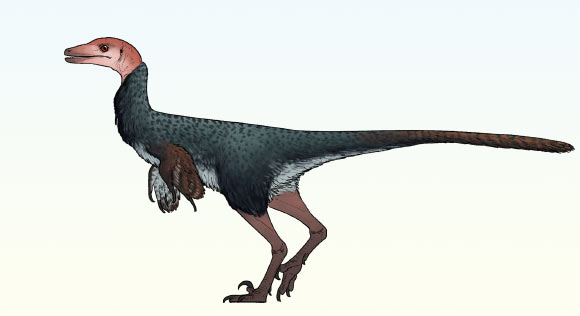
Reconstruction of the life of Xenovenator espinosai. Image credit: Connor Ashbridge / CC BY 4.0.
The newly described dinosaur species lived around 73 million years ago, during the late Cretaceous period.
Appointed Xenovenator espinosaiit belonged to the Troodontidae, a group of agile theropod dinosaurs closely related to birds.
The holotype and paratype specimens were discovered during surface collections in the Cerro del Pueblo Formation of Coahuila, northern Mexico, in the 2000s.
Troodontids are known for their relatively large brains and keen senses, but the new species is distinguished by its remarkably thickened skull roof.
The holotype specimen preserves much of the braincase, including the frontals and parietals, which are heavily domed and can be up to 1.2 cm thick.
CT scans show that the bones of the skull are densely constructed, with tightly interlocking sutures and a rough, ridged outer surface.
This architecture closely resembles the reinforced skulls of domed-headed pachycephalosaurid dinosaurs, although the two groups are only distantly related.
According to paleontologists, these features are consistent with adaptations to intraspecific combat, particularly head-butting behavior.
Although display structures and weapons are common among many dinosaur groups, adaptations specifically related to combat have not yet been documented in non-avian maniraptoran theropods.
The paratype specimens of Xenovenator espinosai show less pronounced thickening and bulging of the skull.
This variation may reflect age or sex differences, with the most extreme cranial enhancement developing later in life or perhaps only in one sex.
“The thick and modified skull of Xenovenator espinosai is unique among maniraptorans, and its function is not immediately obvious,” said lead author Dr. Hector Rivera-Sylva of the Museo del Desierto and colleagues.
“Many traits that have no obvious adaptive value in terms of enhancing the survival of their owners – cranial horns, crests, humps, frills, etc. – are sexually selected for.”
“In modern mammals and birds, these features may function for courtship, for display, or as weapons.”
“Given the evidence found here – the thickening of the skull, the cranial dome, the cranial roughness and the elaborate sutures – it seems likely that the bulging of the skull in Xenovenator espinosai was an adaptation for intraspecific combat,” they added.
“If so, this is the first known example of skull modification for intraspecific combat in a paravian.”
“Curiously, troodontine fronts are sometimes rough, and roughness is also seen on the maxillae and nasals.”
“This suggests that intraspecific fighting may have been widespread among Troodontinae, but that such fighting was particularly intense than among Troodontinae. Xenovenator espinosai.”
Location of the team’s phylogenetic analyzes Xenovenator espinosai within a clade of large North American troodontids, but its thickened, domed skull represents a unique specialization within the group.
The repeated evolution of elaborate weapons and exhibits during the Cretaceous suggests that sexual selection played an increasingly important role in dinosaur evolution.
The discovery expands the known diversity of troodontid dinosaurs in southern Laramidia and provides rare evidence that even small, lightly built theropods evolved specialized structures for physical combat.
“The presence of related people Xenovenator Robustus in New Mexico suggests that they represent a distinct clade of thick-skulled troodontids endemic to the southwest, highlighting the endemicity and diversity of southern laramide faunas,” the researchers concluded.
“Sexual selection, including adaptations for display and combat, was a widespread phenomenon among Late Cretaceous dinosaurs.”
The discovery is described in an article in the journal Diversity.
_____
Hector E. Rivera-Sylva and others. 2026. A thick-skulled troodontid theropod from the Upper Cretaceous of Mexico. Diversity 18 (1): 38; doi: 10.3390/d18010038


