T. rex Bones Reveal These Dinosaurs May Have Lived Far Longer Than We Thought


January 13, 2026
3 min reading
 Add us on GoogleAdd SciAm
T. rex Bones Reveal These Dinosaurs May Have Lived Much Longer Than We Thought
New clues hidden inside T. rex bones suggest carnivore lived longer than we thought
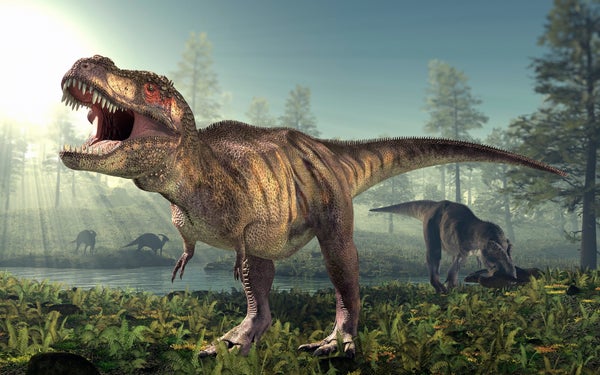
Artistic representation of a Tyrannosaurus rex.
ROGER HARRIS/SPL/Getty Images
Dinosaur bones are like trees: Each year is represented by a new ring, and paleontologists can count these concentric circles to determine the age of a fossil. But new research suggests that in the case of Tyrannosaurus rex, some growth rings have so far escaped detection. This means that the tyrant lizard king lived longer than experts thought and never stopped growing.
Previous estimates put T. rexLifespan is around 30 years, and dinosaurs are thought to have reached their maximum size at around 20 to 25 years old. The new research, published today in PeerJ, rewrites this life cycle: bones from 17 specimens indicate that these hulking predators actually stopped growing between 35 and 40 years of age and typically reached at least 8.8 tons.
“It took a lot longer for the prince to become king,” says Steve Brusatte, a paleontologist at the University of Edinburgh, who was not involved in the new study.
On supporting science journalism
If you enjoy this article, please consider supporting our award-winning journalism by subscription. By purchasing a subscription, you are helping to ensure the future of impactful stories about the discoveries and ideas shaping our world today.
The clues were hidden in T. rex leg bones all the way: while some growth rings are clearly visible, others, it turns out, only reveal themselves under cross-polarized light. Previous research has neglected these weaker rings. Holly Woodward, a paleontologist at Oklahoma State University and lead author of the new study, almost did it, too.
“At first I kind of ignored it,” she says, “until I started looking at all these specimens and seeing it in a lot of them.”
It’s not clear what the more subtle rings mean – perhaps pressure on the growth brakes rather than a complete stop. But the team’s analysis shows that it paints a more complete picture of T. rexThis is the true age.
Counting growth rings is not as simple as counting tree rings. As bones expand, “early records of growth are destroyed,” Woodward explains, so that all that remains is a record of the animal’s later years. But she and her team had access to specimens of different ages, each capturing a fragment of the species’ lifespan, which allowed them to mathematically nest smaller, younger bones within larger, older bones. This analysis gave a more complete reconstruction of dinosaur growth.
Since the first study on T. rex growth in 2004, all evidence pointed to a creature that had reached adulthood, much like humans and other modern vertebrates. A more recent study from 2024 describes “explosive growth during adolescence.” In the absence of additional data, many paleontologists accepted these findings, but some were not convinced.
“It seemed pretty quick,” says Thomas Carr, a paleontologist at Carthage College who was not involved in the study. PeerJ study. “Prolonging the age… makes sense for such a large animal.”
Experts say Woodward and his team’s approach could force paleontologists to reevaluate the growth rate of other dinosaurs and extinct animals. And there is still work to be done to understand the life cycle of T. rexparticularly because the fossil record contains few juveniles.
Still, Lindsay Zanno, a paleontologist at the North Carolina Museum of Natural Sciences who was not involved in the new study, describes the results as a landmark for the field. “We finally have a growth curve for Tyrannosaurus who we can trust,” she says.
Editor’s note (01/14/26): This article was edited after publication to correct the title. The text had already been modified on January 14 to correct the description of growth rings in Tyrannosaurus rex clearly visible bones.
It’s time to defend science
If you enjoyed this article, I would like to ask for your support. Scientific American has been defending science and industry for 180 years, and we are currently experiencing perhaps the most critical moment in these two centuries of history.
I was a Scientific American subscriber since the age of 12, and it helped shape the way I see the world. SciAm always educates and delights me, and inspires a sense of respect for our vast and magnificent universe. I hope this is the case for you too.
If you subscribe to Scientific Americanyou help ensure our coverage centers on meaningful research and discoveries; that we have the resources to account for decisions that threaten laboratories across the United States; and that we support budding and working scientists at a time when the value of science itself too often goes unrecognized.
In exchange, you receive essential information, captivating podcasts, brilliant infographics, newsletters not to be missed, unmissable videos, stimulating games and the best writings and reports from the scientific world. You can even offer a subscription to someone.
There has never been a more important time for us to stand up and show why science matters. I hope you will support us in this mission.


