Fossil analysis changes what paleontologists know about how long T. rex took to grow full size

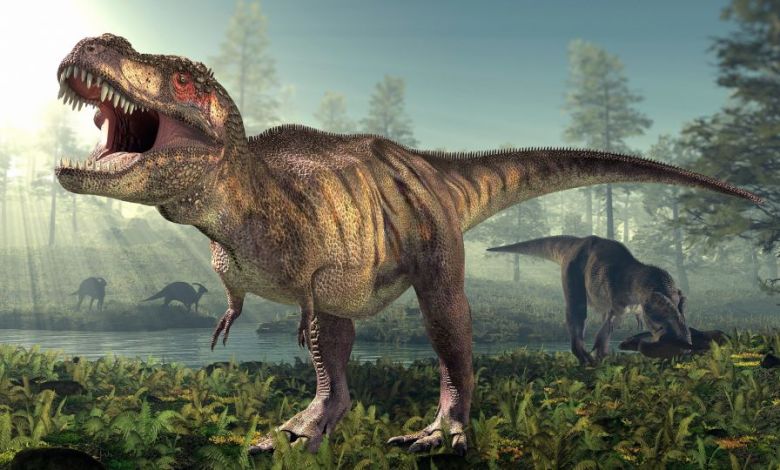
Tyrannosaurus rex lived longer and took longer to reach its maximum size than previously thought, according to a new study.
Scientists have long counted annual growth rings in the fossilized leg bones of Tyrannosaurus rex to calculate both their age at death and the rate at which they grew to adult size. These dinosaurs typically stopped growing around age 25 and lived to be around 30, research shows.
However, a new study published Wednesday in the journal PeerJ details how a team of scientists used polarized light to reveal previously unseen growth rings in 17 individual specimens. According to the analysis, T. rex would only have reached its maximum size of around 8 tonnes at the age of 35 to 40 years.
Unlike tree growth rings, dinosaur growth rings only capture the last 10 to 20 years of an individual’s life.
But because the specimens ranged in age from early juveniles to adults, the researchers were able to chart their growth using a new statistical approach combining records from individuals of different ages.

A diagram shows the percentage of a Tyrannosaurus rex’s adult size it would have reached at different stages of its life. – Dr. Holly Woodward Ballard
Drawing on the largest data set ever assembled on Tyrannosaurus rex, researchers were able to reconstruct their growth history year by year and discovered that dinosaurs grew much more slowly than previously thought.
“Instead of growing rapidly, T. rex spent most of its life in the medium-sized range rather than quickly reaching a total length of 40 feet,” lead study author Holly Woodward, an anatomy professor at Oklahoma State University, told CNN on Thursday.
“Additionally, we found that growth ring spacing varied within individuals, with some years showing substantial growth and others showing very little,” she said. “This variability suggests that growth was flexible and likely influenced by resource availability and possibly environmental conditions.”
The results help scientists better understand the king of the dinosaurs and his role in the world tens of millions of years ago, Woodward said.
“I think the study helps reveal why T. rex was so successful as an apex carnivore – that by growing slowly over a longer period of time, T. rex occupied many dietary niches throughout its life, eventually becoming large enough to only really compete with other T. rexes for resources,” she said.
Growth rings in T. rex fossils
Additionally, differences in the growth curves of some of the specimens involved in the study are fueling scientific debate over whether what paleontologists thought was a single species named Tyrannosaurus rex is actually a complex including other species or subspecies.
For example, a study published in October found that a specimen believed to have belonged to an adolescent T. rex actually belonged to a different species known as Nanotyrannus.
Although the growth rates examined in this study cannot definitively prove the existence of distinct species, “the evidence suggests this intriguing possibility, among other possible explanations,” according to the researchers’ statement.
The results of the new study fit well with recent work on Nanotyrannus, said Steve Brusatte, a professor of paleontology and evolution at the University of Edinburgh in Scotland, who was not involved in the study.
“It’s good, provocative work that also suggests that there was more variation among T. rex than we thought, and that some fossils that have long been called T. rex might actually belong to different species,” Brusatte said.
The discovery of a new type of dinosaur growth ring could also have broader implications for paleontologists studying dinosaur growth rates.
“It is tricky to interpret multiple growth marks close together,” Nathan Myhrvold, a mathematician and paleobiologist at the invention and investment firm Intellectual Ventures, co-author of the study, said in the release.
“We found strong evidence that protocols typically used in growth studies may need to be revised,” he said.
Sign up for CNN’s Wonder Theory science newsletter. Explore the universe with information on fascinating discoveries, scientific advances and much more.
For more CNN news and newsletters, create an account at CNN.com