Dodgers score again in signing Kyle Tucker; baseball world cries foul

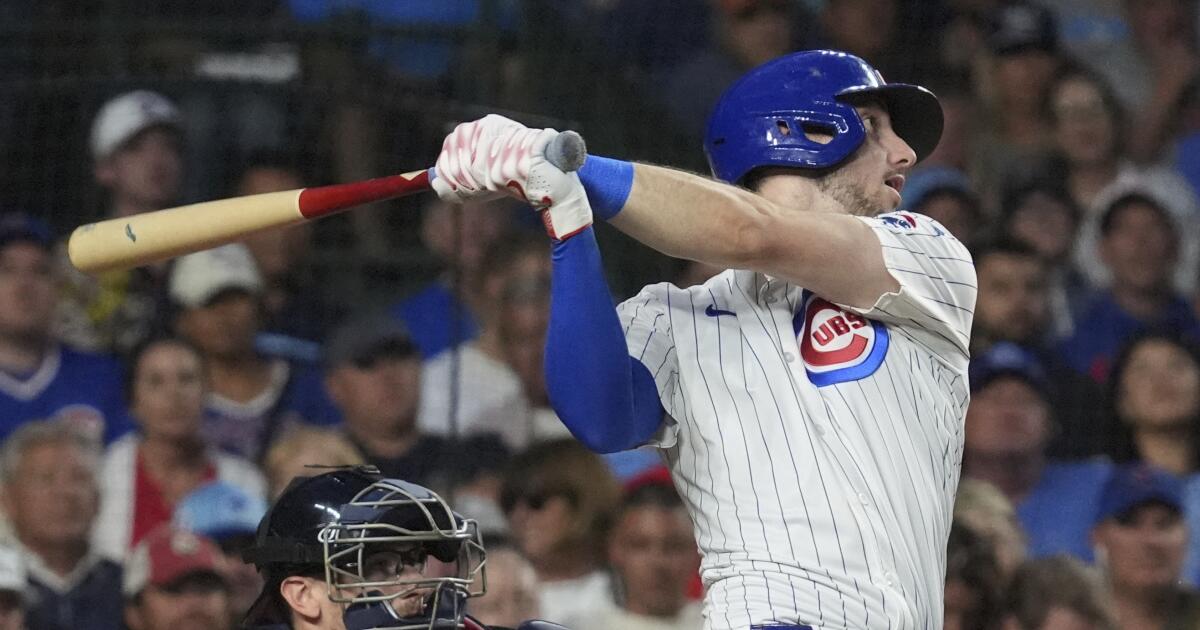
Using a playbook familiar to their front office, the Dodgers waited until the market for outfielder Kyle Tucker dwindled before making him a stunning, short-lived but dollar-generous offer.
The result is that the defending two-time World Series champion team fills the only hole on its roster with another superstar – considered by many analysts to be the prize of this free agency class. The contract Tucker agreed to Thursday night is worth $240 million over four years, with a $64 million signing bonus and $30 million in deferred money. He will also be able to opt out of the deal after the 2027 and 2028 seasons.
This is a stunning development that caused immediate consternation throughout baseball. The Dodgers are in a league of their own when it comes to salary spending.
Or as ESPN baseball analyst Jeff Passan put it: “Fans feel like this game is unfair. »
To which Times columnist Bill Plaschke wrote: “So what? Who cares? If three straight titles blow up the game, so be it. The Dodgers’ only responsibility is to their fans, and they have more than fulfilled their civic duty, and that’s all that matters.”

Tucker homered in Game 4 of the Cubs’ National League Division Series against the Milwaukee Brewers on October 9.
(Nam Y. Huh / Associated Press)
At the start of the offseason, Tucker was projected to receive $400 million over 10 years, but the only team that reportedly made a deal that long was the Toronto Blue Jays. The New York Mets made an offer close to that of the Dodgers, but Tucker opted for LA
The Dodgers used a similar strategy to snare first baseman Freddie Freeman and starting pitcher Blake Snell in recent years and move closer Edwin Díaz last month, patiently allowing the hype to dissipate and waiting out the market before jumping into short-term deals with astronomical annual salaries.
Tucker’s average annual contract value (AAV), as calculated by Major League Baseball, will reach a record $57.1 million, surpassing previous highs set by the Mets’ Juan Soto ($51 million) and the Dodgers’ Shohei Ohtani ($46.06 million) over the past two offseasons.
Ohtani, of course, is now Tucker’s teammate, as are fellow highly paid stars Mookie Betts, Yoshinobu Yamamoto, Will Smith, Tyler Glasnow, Roki Sasaki, Freeman and Snell. And so on. The Dodgers’ competitive payroll, estimated at $402.5 million, is more than the combined spending of the A’s, Rays, Guardians and Marlins.
Who do the Dodgers have to thank for such generosity?
Start with Ohtani. When the two-way star signed a record $700 million, 10-year contract with the team two years ago, he agreed to take home a measly $2 million per year and defer the remaining $68 million, resulting in a reduction in his AAV. That covers Tucker’s salary and more.
Don’t forget the 25-year, $8.35 billion deal with Time Warner Cable (now Spectrum) in 2013 that gave birth to the Dodgers SportsNet LA television channel. A bankruptcy settlement a year earlier allowed the Dodgers to cap television revenue shared with MLB at around $84 million per year, even though experts projected the true value at more than $200 million. Meanwhile, many teams have seen their TV revenues significantly reduced.
The settlement also approved the sale of Frank McCourt’s Dodgers to Guggenheim Baseball Management, the Magic Johnson-led, Mark Walters-led group that green-lighted the lavish payroll spending.

The Dodgers celebrate after winning Game 7 of the World Series against the Blue Jays in Toronto last fall.
(Robert Gauthier/Los Angeles Times)
And don’t forget to thank the fans who fill Dodger Stadium for each of their 81 home games, spending on parking, concessions and merchandise in addition to increasingly expensive tickets. Attendance in 2025 was 4,012,470, a Dodgers record, the highest in MLB and nearly 600,000 more than the next highest attendance, the San Diego Padres. The Dodgers averaged 49,537 fans per home game.
The response around baseball to Tucker’s contract was as heated as it was predictable. Calls for a salary cap as negotiations for a new collective agreement begin at the end of the season have peppered social media. Some have even advocated that owners lock out players if they don’t agree to level the playing field.
Everything to stem the expenses of a franchise benefiting from a revenue model that allows it to spend on salaries without control, without breaking any rules.
“In theory, the Dodgers aren’t doing anything wrong,” ESPN analyst Chris “Mad Dog” Russo said Friday on the Dan Patrick Show. “But the rules have to change. This is starting to be a joke.”
Russo then listed the reasons why players gravitate to Chavez Ravine: “Play on the winning team in Los Angeles. Great organization. Great weather. Get a chance to go to the World Series every year.”
Under current rules, the Dodgers are financially punished for their happy spending. Competitive balancing taxes – also known as luxury taxes – are imposed when payroll reaches certain thresholds. The Dodgers are over the top tier and must pay 110 percent of every dollar spent above $304 million, meaning their commitment to Tucker will cost them $500 million — $240 million for the player and about $264 million for MLB in taxes.
By any measure, that’s a lot to pay for a player who hit a ho-hum .266 with 22 homers, 73 RBIs and 25 stolen bases during an injury-plagued 2025, his only season with the Chicago Cubs. Tucker was a three-time All-Star during seven seasons with the Houston Astros.
What does MLB do with luxury tax revenue? Half is distributed to small-market teams, ostensibly to increase their salary expenses.
Tony Clark, executive director of the MLB players’ union, admits the system might need an overhaul, but he is adamantly opposed to a salary cap.
“We just completed one of the greatest seasons in MLB history, with unprecedented fan interest and revenue,” he told Bill Shaikin of the Times. “Even though the free agent market is far from over, it is gratifying to see players of all levels rewarded for their incredible achievements by these clubs who are trying to win without excuses.”
MLB Commissioner Rob Manfred, who will sit at Clark’s negotiating table when a new collective bargaining agreement is hammered out in a year’s time, is careful not to place blame on the Dodgers while acknowledging that other teams and their fans are frustrated.
“The Dodgers are a very well-run, successful organization,” Manfred said during the team’s spending spree a year ago. “Everything they do and have done is within our rules. They try to give their fans the best product possible. These are all positives.
“I recognize, however – and my email certainly reflects this – that there are fans in other markets who are concerned about their team’s ability to compete. We should always be concerned when our fans are concerned about something. But to blame that on the Dodgers? I’m not in that camp.”
And if CBA negotiations reach an impasse and players are effectively cut and remain unpaid until their return, Tucker’s contract provides a hedge against that, too: $54 million of his signing bonus is payable now.


