Hubble Telescope watches star blast out jet of hot gas 32 light-years long

When you purchase through links on our articles, Future and its syndication partners may earn a commission.

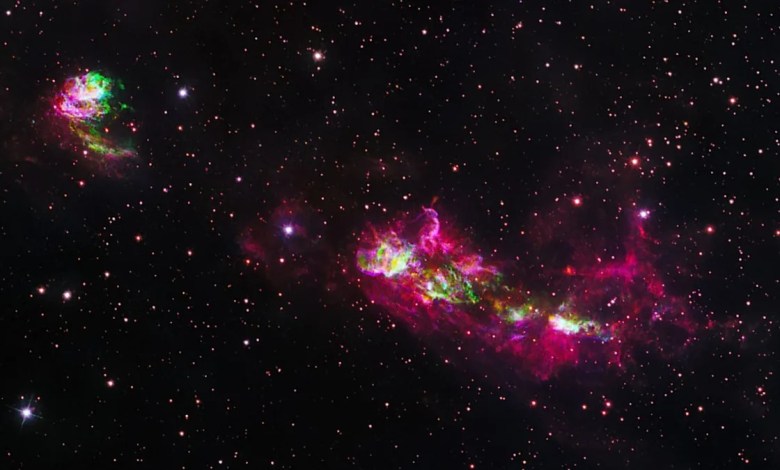
Explosions of a nascent star illuminate interstellar clouds HH 80 and HH 81. | Credit: NASA, ESA and B. Reipurth (Planetary Science Institute); Treatment: Gladys Kober (NASA/Catholic University of America)
Using the Hubble Space Telescope, astronomers observed a nascent star 20 times larger than the sun igniting interstellar clouds. The source of this cosmic conflagration is a stellar jet traveling at an incredible speed of 2.2 million miles per hour (3.5 million kilometers per hour), the fastest such spacewalk ever seen.
This particular exit is also the longest exit of a forming star or protostar ever seen by astronomers, spanning 32 light years. For context, that’s about 8 to 10 times the width of our entire solar system.
THE superb image of this cosmic eruption of Hubble shows two so-called Herbig-Haro (HH) objects, designated HH 80 and HH 81 respectively, glowing neon green and pink. HH 81 is at the top left of the image, while HH 80 is at the bottom right.
The star illuminating them is IRAS 18162-2048, located about 5,500 light years away, and the most massive protostar in the entire molecular cloud known as L291.
Protostars like IRAS 18162-2048 are powered by gas falling to them from surrounding clouds of gas and dust that initially condensed to form them. This question cannot fall directly to these hungry cosmic children because it still has angular momentum. This means that it forms a swirling cloud around the protostar called accretion diskwhich gradually feeds this stellar newborn like a bottle.
However, just as human infants are rather messy, so are protostars. Powerful magnetic fields channel plasma in accretion disks toward the poles of protostars, accelerating it to high speeds, then ejecting it as jets.

Explosions of a nascent star illuminate interstellar clouds HH 80 and HH 81 | Credit: NASA, ESA and B. Reipurth (Planetary Science Institute); Treatment: Gladys Kober (NASA/Catholic University of America)
HH objects are created when jets of ionized gas, or plasma, are thrown away from protostars at incredible speeds. These jets hit previously ejected gas, creating shock waves that heat that gas, causing the brilliant glows demonstrated by HH 80 and HH 81 in this Hubble image.
First observed by Hubble in 1995, HH 80 and HH 81 are striking examples of HH objects, not only because of the size and speed of the jet propelling them, but also because they are the only jets astronomers have ever seen driven by a massive young star, not a low-mass young star.
This spectacular image of HH 80 and HH 81 and its ability to allow astronomers to study minute changes in the structure of these incredible cosmic bodies was only possible thanks to the sensitivity and resolution of Hubble’s Wide Field Camera 3.
So, this image is further proof that even after 36 years of service, Hubble remains a vital tool for astronomers.


