Emirati rescue, Saudi fury: Middle East heavyweights split over Yemen

ADEN, Yemen — Stuck at Aden airport with an invitation from Saudi Arabia that he could not – but absolutely wanted to – refuse, Aidarous al-Zubaidi played to gain time, quibbling over points of protocol which delayed the departure of the plane from Yemen by a few hours.
The Yemeni leader, head of a separatist group supported by the Emirates but at odds with Saudi Arabia, knew he would not like what awaited him in Riyadh. So he continued to gain time.
Then a call came telling him that the evacuation plan was ready.
Al-Zubaidi applied and took five of his top lieutenants to a military camp in Aden. From there, it sent two convoys as decoys, then traveled to the nearby coast while an Emirati drone monitored the sky. Early in the morning he was on a boat bound for Somalia, and from there he flew to the Emirati capital, Abu Dhabi.

Al-Zubaidi’s daring escape this month — details of which were confirmed by Aden-based officials, militiamen, port workers and enraged statements from Saudi military officials — was the breaking point in an increasingly bitter feud between two of the United States’ main allies in the Middle East; it is a conflict that calls Yemen’s very existence into question, even as it promises even more suffering for a people already grappling with one of the world’s worst humanitarian disasters.
“I’ve never seen the Saudis this angry. Period,” said Mohammed Al-Basha, a U.S.-based expert and founder of the Basha Report, a U.S. risks report focused on the Middle East and Africa.
“The Saudis believe that the UAE has not been an honest broker in Yemen and beyond,” he said. “They feel betrayed.”

The head of the Yemeni South Transitional Council, Aidarous al-Zubaidi, speaks for a 2023 interview in New York as he attends the United Nations General Assembly meeting.
(Ted Shaffrey/Associated Press)
This divide, the result of widely divergent geopolitical and trade policies that over the years transformed Riyadh and Abu Dhabi from close allies to friendly rivals to bitter adversaries, has strained relations across the Middle East, Africa and Southeast Asia. And the showdown between two energy heavyweights is likely to upend markets and investments, not to mention disrupt the plans of a U.S. president who sees the two countries as key partners in trade and diplomacy.
The fight erupted dramatically last month when the al-Zubaidi-led separatist group, the Southern Transitional Council, or STC, captured much of the country’s south from Yemen’s internationally recognized government and appeared poised to declare a breakaway state in the resource-rich territory.
The offensive came as a surprise to Riyadh, which more than a decade ago joined Abu Dhabi in a ruinous military campaign against the Houthis, an Iran-backed faction that commandeered the Yemeni capital Sanaa in 2014. The STC — formed in 2017 to reestablish South Yemen as an independent state and which the Emirates has lavished with military support and funds — joined the campaign anti-Houthi in 2022 alongside the Yemeni government supported by Saudi Arabia. But the front lines were stalemate until the recent STC advance.
Saudi Arabia, which borders one of the regions seized by STC separatists, initially appeared to accept the STC’s strategy to control more territory.
But he quickly launched airstrikes on what he said was a shipment of Emirati weapons to the separatists (a charge the Emirates denied), then followed up with a ferocious blitz driving the STC from all the territory it had conquered, allowing government forces to seize the group’s stronghold in Aden. Meanwhile, the Yemeni government has asked the Emirates to end its military presence in the country.
With the separatists all but defeated, Saudi Arabia invited – or ordered, depending on who you talk to – al-Zubaidi and more than 50 other STC delegates to Riyadh to discuss the future of southern Yemen. Al-Zubaidi had good reason to fear being imprisoned or at least forced to capitulate. That’s why he ran away.
Saudi Arabia called him a “fugitive,” while the Yemeni government accused him of high treason.
A day later, an STC delegate in Riyadh appeared on Yemeni state television: he declared the group’s dissolution – a decision that many STC members outside of Saudi Arabia insisted was void because it was made under duress and Saudi Arabia was holding the STC delegation hostage.
But on Sunday, STC members in Riyadh joined other Yemeni politicians in what was described as a “consultative meeting” on the future of southern Yemen – a move, observers say, intended to refute any coercion from Riyadh.

Pro-government tribal forces take control of several military sites belonging to the UAE-backed Southern Transitional Council in the city of Mukalla, Yemen, on January 3.
(Anadolu via Getty Images)
At the heart of the disagreement between Saudi Arabia and the UAE over Yemen is a difference in worldview between Saudi Crown Prince Mohammed bin Salman and UAE President Sheikh Mohamed bin Zayed al-Nahyan.
When bin Salman first rose to prominence as Saudi defense minister in 2015, he adopted a pugilistic foreign policy that saw him launch an unsuccessful offensive against the Houthis and kidnap the Lebanese prime minister. In 2017, Saudi Arabia joined with the United Arab Emirates and Bahrain to establish a blockade against Qatar that lasted for four years. But its vision has since changed and now prioritizes regional stability in the name of economic prosperity.
The UAE, on the other hand, has proven to be a disruptor. Not only did it normalize diplomatic relations with Israel during President Trump’s first term, going against Saudi Arabia’s long-standing conditions for a pan-Arab peace with Israel, but over the past decade it has forged a network of proxies, military bases, ports and secret assets on the Red Sea and across Africa that threaten the governments of several countries.
Nowhere is this more evident than in Sudan, where critics lambast the UAE’s support for the Rapid Support Forces, a paramilitary faction accused of genocide in the country’s civil war. (The UAE denies aiding the RSF and says its goals are Sudan’s territorial integrity, despite ample evidence to the contrary.)
Since the Yemen rift, Saudi Arabia and the United Arab Emirates have engaged in a full-blown media war, with influencers and media figures sniping at each other on social media while state-funded channels publish hit stories. On Monday, Saudi Arabia hosted a media visit to the southern Yemeni port city of Mukalla, where the Yemeni government has accused the UAE of running a secret prison.
Elsewhere in the region, a rapid reorganization of relationships and alliances is underway.

Members of the Yemeni armed forces take control of the town of Seiyun after the withdrawal of Southern Transitional Council forces, supported by the United Arab Emirates.
(Mohammad Daher/NurPhoto via Getty Images)
Shortly after al-Zubaidi fled, the Somali government destroyed its security and trade cooperation agreements with the United Arab Emirates, including a concession that allowed Emirati logistics giant DP World to operate out of the port of Berbera – the port al-Zubaidi used for his escape.
Observers add that the United Arab Emirates appears to have lost military permission to fly over Egypt, Sudan and Saudi Arabia. The management of Al-Kufra, a Libyan airport that has become an important part of the United Arab Emirates’ logistics pipeline to its allies in Sudan, said it would close its doors for a month.
Even as Saudi Arabia dismantles the UAE’s military network, it builds its own.
A Somali official, who spoke on condition of anonymity to discuss regional dynamics, said Saudi Arabia was considering a military alliance with Egypt and Somalia, and that Saudi officials had pressured Somaliland not to allow Israel to build bases on its territory. Turkey is also making inroads with Saudi Arabia; a huge about-face for two long-time rivals. And Riyadh intends to buy Chinese warplanes from Pakistan to give to Yemen.
Meanwhile, Saudi Arabia has worked to eliminate Emirati influence from Yemen. Aden commanders interviewed by The Times say Riyadh has agreed to pay all of the fighters’ salaries, amounting to about $80 million a month. UAE-backed politicians have been sacked from Yemen’s Presidential Council and replaced with figures more sympathetic to Saudi Arabia.
Despite the weakening of the STC, it is unclear whether the UAE will accept losing its foothold in the country.
“For now, the UAE appears to be focused on soft power in southwest Yemen, just as it did in Somaliland. It remains an open question whether this will ultimately turn into support for an armed insurgency,” Al-Basha said.
For now, Aden is calm, despite fury over what many see as Saudi Arabia’s sabotage of a long-overdue secession. (Yemen was two separate nations before unification in 1990; a decision southerners came to resent. They tried, unsuccessfully, to secede in 1994).
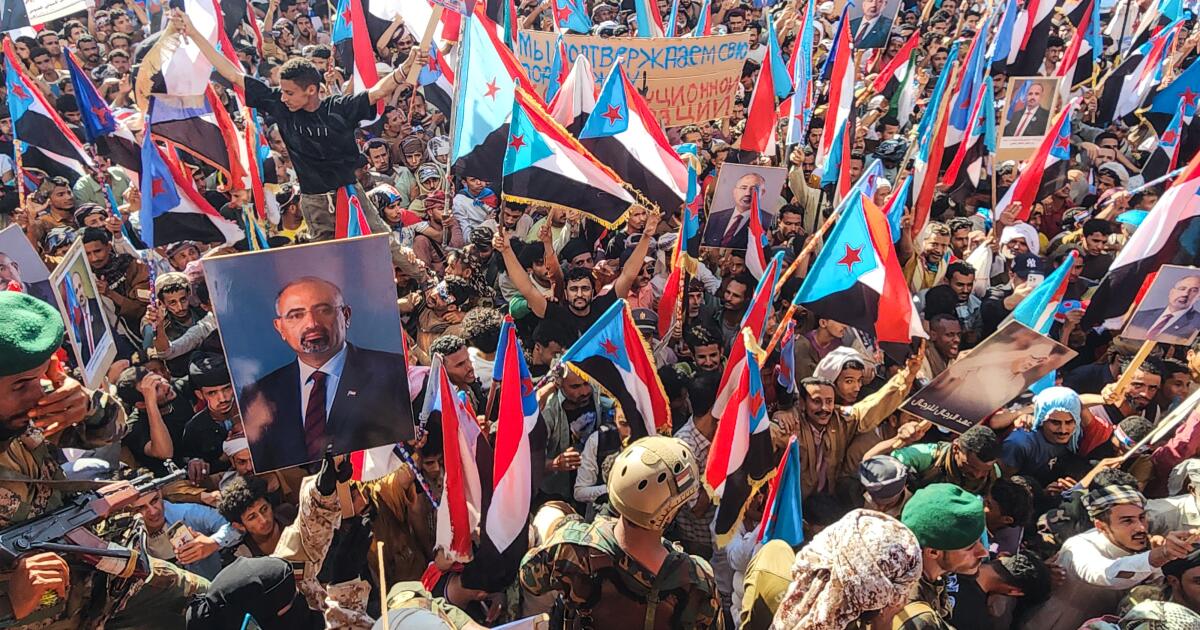
In downtown Aden on Friday, several thousand people took part in a pro-STC rally, waving South Yemen state flags as well as posters of al-Zubaidi and, occasionally, an Emirati banner. They chanted slogans promising to “sacrifice for the South,” while an MC issued a call and response.
“Do you want the Yemeni president? Do you want a federal Yemen? Do you want half-solutions?”
“No!” » the crowd roared each time.
“So what do you want?”
“The south!” »
Dhiaa Al-Hashimi, a 44-year-old English teacher, said Saudi Arabia had crossed the line.
“It wasn’t about the UAE or anyone else. We called for [a separate country] since 1994, and we are behind President Al-Zubaidi.
“We have entered into a partnership with the northerners to liberate the capital from the Houthis,” she said. “But unfortunately they want an alternative homeland in the south.”
Nearby, Sanad Abdul Aziz, 37, was more emphatic.
“We want the South and we will fight for it,” he said. “After that, we view Saudi Arabia as a target.”