February 2026: Science history from 50, 100 and 150 years ago


January 20, 2026
3 min reading
 Add us on GoogleAdd SciAm
February 2026: History of science 50, 100 and 150 years ago
Giant atoms; corpses for science
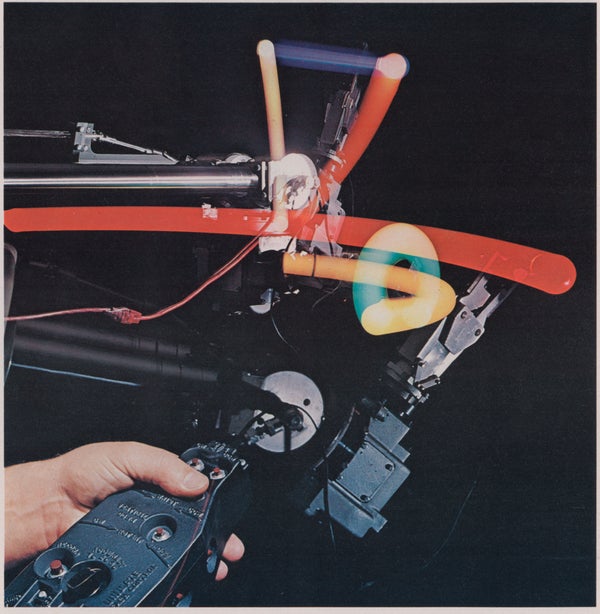
1976, Industrial Robot: Manufactured by Unimation, Inc., of Danbury, Connecticut, the Unimate robot can perform six basic movements. In this multiple exposure photograph, the robot’s gripper or hand holds lights of different colors to distinguish the six movements. The piston-shaped arm is capable of three movements: entry-exit (blue), from top to bottom (white) and left-right (red). In any position of the robot arm, the gripper can perform three additional movements: bend (orange), swivel (Green) and the lace (YELLOW).
Scientific AmericanVol 234, No. 2; February 1976
1976
Giant atoms
“The largest atoms are not those of a heavy transuranic element, but quite light atoms in a highly excited state. Although the diameter of a normal atom is about 10–8 centimeter, some excited atoms have a diameter of 10–5 centimeter and are as large as some bacteria. The energy state of an atom is indicated by its principal quantum number, designated nwhich defines the probability of finding an electron at a particular distance from the nucleus. In the lowest energy state, n is 1, and the electrons are effectively confined in a fairly small volume. In higher energy states, n increases as electrons are likely to be at greater distances from the nucleus. Interest in these swollen atoms has been sparked in part by new methods for creating, manipulating and detecting them. The atoms have now been prepared in the laboratory with n up to 105. Such atoms are about to be ionized and, with only a small input of energy, they separate.
On supporting science journalism
If you enjoy this article, please consider supporting our award-winning journalism by subscription. By purchasing a subscription, you are helping to ensure the future of impactful stories about the discoveries and ideas shaping our world today.
1926
What is life?
“We are so far from a perfect understanding of life that even researchers active in biological research cannot agree on the real nature of life – whether it is purely a matter of chemistry, physics, evolution and chance, or whether it will indeed turn out that there is an element of the “spark of life” nature of the ancients, transcending mortal understanding. It is now generally known that the unit of living matter is the cell. The cell is the building block, the brick from which all plants and animals are built. Life can indeed be seen as the resulting action of the cells that make up the organism. What could be more natural, then, than to focus one’s attention on a single cell?
Global Wireless Network
“The various colonies of the British Empire are linked by a new shortwave beam transmitter, which concentrates radio energy while a searchlight reflects light in a defined and desired direction. The final touches of installations of this up-to-date system are in progress near Montreal, by the Marconi Wireless Telegraph Company of Canada, for direct communication with England and Australia. These Canadian beams will be the first links to be forged in the global wireless network. The Canadian company Marconi will construct a beam station in the Dominion of Canada for communication with stations to be built in England Each station must be capable of communicating at a speed of 100 five letter words per minute in each direction, for a daily average of 18 hours.
Point of view: is science insensitive?
“What science needs most today is a true vision rising above spectrometers, cell walls, vapor tensions, microtomes and polarities, and seeing beyond them – as far as man can hope to see – the end towards which all these humbler things are but small steps. Such a vision is that of Professor Theodore DA Cockerell of the University of Colorado – biologist, zoologist, a renowned entomologist, but known, because of his writings, throughout the biological world as “America’s Huxley”; a man who made a little corner of science into a real philosophy, who gave to those who care more about life itself than about a test tube full of green precipitate, a foreshadowing of what science, under better management than that of today, could mean to “the man in the street.”
1876
Do we need to have a dissection?
“To lay down our lives for the advancement of science is something that few of us would be willing to do, but to abandon our bodies as a sacrifice on the altar of truth and knowledge, after we have no further use for it, is not a very difficult thing; and therefore we are not surprised to read that a society has been formed in Paris, the members of which undertake, by a special testamentary provision, not to be buried after death. Their bodies must be delivered to the dissection rooms of the various medical schools for We are not afraid that the whole world will follow this example and flood the market with useless corpses. There will still be those who want an old-fashioned burial.

It’s time to defend science
If you enjoyed this article, I would like to ask for your support. Scientific American has been defending science and industry for 180 years, and we are currently experiencing perhaps the most critical moment in these two centuries of history.
I was a Scientific American subscriber since the age of 12, and it helped shape the way I see the world. SciAm always educates and delights me, and inspires a sense of respect for our vast and beautiful universe. I hope this is the case for you too.
If you subscribe to Scientific Americanyou help ensure our coverage centers on meaningful research and discoveries; that we have the resources to account for decisions that threaten laboratories across the United States; and that we support budding and working scientists at a time when the value of science itself too often goes unrecognized.
In exchange, you receive essential information, captivating podcasts, brilliant infographics, newsletters not to be missed, unmissable videos, stimulating games and the best writings and reports from the scientific world. You can even offer a subscription to someone.
There has never been a more important time for us to stand up and show why science matters. I hope you will support us in this mission.


:max_bytes(150000):strip_icc()/Health-GettyImages-1479193126-2b11d2146efc4794a8e07debf4f029a7.jpg?w=390&resize=390,220&ssl=1 "How to Boost Your Fiber Intake Without Feeling Bloated")