Hand stencil made almost 68,000 years ago is the oldest cave art ever found

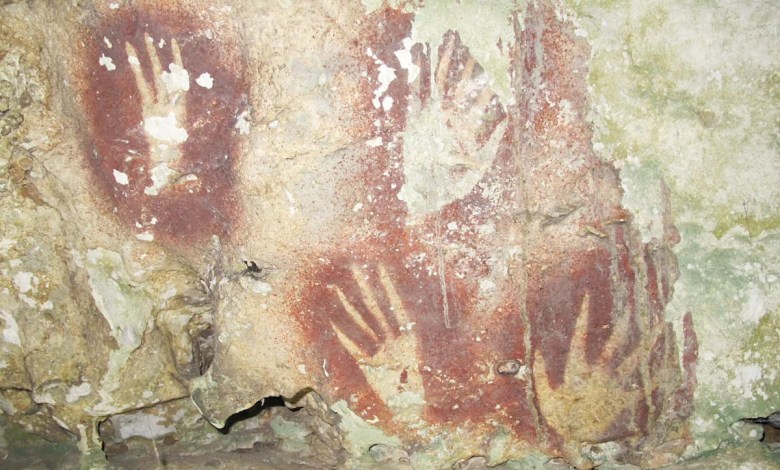
The world’s oldest known example of rock art, dating back at least 67,800 years, has been discovered by researchers studying handprints in Indonesia.
This discovery, along with other recent discoveries in the Southeast Asian country, is helping scientists determine when and where early humans learned to create art, and when their art became more complex.
The reddish hand stencils, although discolored and barely visible, were found inside the limestone cave of Liang Metanduno on Muna, an island off the largest eastern Indonesian island of Sulawesi. One of them would be at least 67,800 years old.
Indonesian and Australian researchers said the stencils were made by blowing pigment onto a hand pressed against the rock surface, leaving an outline. Fingertips reshaped to appear more pointed suggest the hands belonged to humans, perhaps linked to the ancestors of early Australians.
The paintings were dated by analyzing the mineral crusts that had gradually formed on them.
The discovery “is quite extraordinary, because generally rock art is very difficult to date, and it doesn’t go back that far,” said Adam Brumm, professor of archeology at Griffith University in Brisbane and co-author of the study published Wednesday in the journal Nature.

Indonesian scientists Adhi Agus Oktaviana, left, and Shinatria Adhityatama study handprints on the cave walls. (Maxime Aubert via AP)
(Maxime Aubert via AP)
The hand stencil is more than 15,000 years older than a painting located in another cave in Sulawesi and dated by the same team to 2024. That painting, which depicted three human-like figures interacting with a pig, is believed to be around 51,200 years old.
“I thought we were doing pretty well at the time, but that image completely blew the other one out of the water,” Brumm said.
“It really shows how long people have been creating rock art in this part of the world,” he said. “It’s very long.”
Researchers hope to uncover even older works of art, including storytelling art, in and around Indonesia, much of which remains archaeologically unexplored, he added.
Liang Metanduno is a well-known site for rock art open to tourists. But most of the artwork found so far is paintings of chickens and other domestic animals, thought to be much more recent, around 4,000 years old.
In 2015, Adhi Oktaviana, an Indonesian rock art specialist and lead author of the paper, noticed faint images behind more recent images that he thought might be handmade stencils.
“No one had ever observed them before. No one even knew they were there,” Brumm said. “But Adhi spotted them.”
For generations, researchers studying Ice Age cave paintings in places like France and Spain, about 30,000 to 40,000 years old, “thought, wow, this is really where real art began, real modern human artistic culture,” Brumm said.
Recent discoveries in Indonesia, he says, show that humans outside of Europe were creating “incredibly sophisticated” rock art tens of thousands of years earlier, “before our species even set foot in this part of the world.”

Prehistoric cave paintings of Sulawesi. (Maxime Aubert / AFP – Getty Images)
(Maxime Aubert)
Brumm said the discovery was also interesting because it could shed light on when the first humans arrived in its home country of Australia.
Although it is widely believed that Aboriginal people have lived in Australia for at least 50,000 years, one archaeological site in the country is believed to be 65,000 years old.
“Now that we’re finding rock art from 67 to 68,000 years ago on the island of Sulawesi, which is basically on Australia’s doorstep, it’s much more likely that modern humans were actually in Australia at least 65,000 years ago,” Brumm said.
This article was originally published on NBCNews.com


