New Cosmological Simulations Shed Light on Growth of Black Holes in Early Universe


New cutting-edge simulations by Maynooth University astronomers show that in the dense, turbulent dawn of the cosmos, “lightseed” black holes could rapidly swallow matter and rival the colossal black holes seen at the centers of early galaxies.
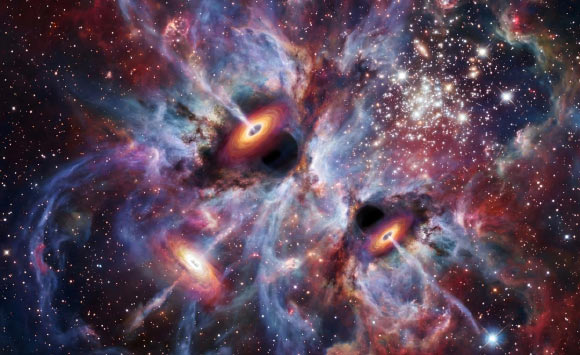
Computer visualization showing baby black holes growing in a young galaxy in the early Universe. Image credit: Maynooth University.
“We discovered that the chaotic conditions that existed in the early Universe triggered the early growth of smaller black holes to become the supermassive black holes we would later see, following a feeding frenzy that devoured matter all around them,” said Daxal Mehta, a doctoral student. candidate at Maynooth University.
“We revealed, using cutting-edge computer simulations, that the first generation of black holes – those born just a few hundred million years after the Big Bang – grew incredibly quickly, reaching tens of thousands of times the size of our Sun. »
“This breakthrough reveals one of the great enigmas of astronomy,” said Dr Lewis Prole, a postdoctoral researcher at Maynooth University.
“This is how black holes born in the early Universe, observed by the NASA/ESA/CSA James Webb Space Telescope, managed to reach such supermassive sizes so quickly.”
The dense, gas-rich environments of early galaxies allowed short bursts of “super Eddington accretion”; a term used to describe what happens when a black hole “eats” matter faster than is normal or safe.
So fast he should blow his food away with the light, but he continues eating it anyway.
The results provided a “missing link” between the first stars and the supermassive black holes that appeared much later.
“It was previously thought that these tiny black holes were too small to become the giant black holes observed at the centers of early galaxies,” Mehta said.
“What we have shown here is that these early black holes, although small, are capable of growing at spectacular speed, under favorable conditions.”
Black holes are of the “heavy seed” and “light seed” type.
Light seed types are relatively small to start with, no more than ten to a few hundred times the mass of our Sun, and must grow from there to become “supermassive” – millions of times the mass of the Sun.
Heavy types, on the other hand, begin life with an already much more massive mass, perhaps as much as a hundred thousand times the mass of the Sun at birth.
Until now, astronomers believed that heavy seed types were necessary to explain the presence of supermassive black holes residing at the centers of most large galaxies.
“Now we’re not so sure,” said Dr John Regan, an astronomer at Maynooth University.
“Heavy seeds are a bit more exotic and may require rare conditions to form.”
“Our simulations show that your garden-type stellar-mass black holes can grow at extreme rates in the early Universe.”
The research reshapes the understanding of the origins of black holes, but also highlights the importance of high-resolution simulations for unlocking the first secrets of the Universe.
“The early Universe is much more chaotic and turbulent than previously thought, with a much larger population of massive black holes than we expected,” Dr Regan said.
The results also have implications for the ESA/NASA Laser Interferometer Space Antenna (LISA) mission, which is scheduled to launch in 2035.
“Future gravitational wave observations from this mission could help detect the merger of these tiny, early, fast-growing baby black holes,” Dr Regan said.
An article on the results was published this week in the journal Natural astronomy.
_____
DH Mehta and others. The growth of light-seeded black holes in the early Universe. Nat Astronpublished online January 21, 2026; doi: 10.1038/s41550-025-02767-5


