These Oddball Organisms May Spawn a Brand New Branch of Life That’s Now Extinct


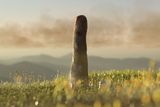
A towering trunk-like organism that sprouted from the ground 400 million years ago has become a true prehistoric mystery. These organisms – known as genus Prototaxites — look a bit like living stalagmites or armless cacti. They have long been considered mushrooms, making them an ancient relative of modern mushrooms. However, it turns out that Prototaxites are something entirely different.
A new study published in Scientific advances determined that Prototaxites are a unique life form that does not fit the description of either fungi or plants. After examining a fossil from the 407-million-year-old Rhynie chert (a sedimentary deposit in Scotland), the researchers discovered that the organisms were chemically and anatomically distinct from fungi.
Learn more: Mold feasts on radiation at abandoned Chernobyl nuclear power plants
First fossil evidence of Prototaxites
At the time when Prototaxites lived from the late Silurian to the Late Devonian (about 420 to 370 million years ago), they were the largest land organisms before being overtaken by larger trees – some Prototaxites grew to be 8 meters (26 feet) tall.
The first fossil of Prototaxites was collected in 1843, but since then scientists have been uncertain about its position in the tree of life. Although these organisms do not fit into the same classification as algae groups or land plants, they contain some characteristics reminiscent of fungi.
For example, they may have survived on dead or decaying organic matter (making them saprotrophs, just like most fungi). Prototaxites The fossils also contain masses of intertwined tubes, another trait that has led some scientists to believe they were fungi.
Prototaxites: Unfit to be a mushroom
The new study, however, debunked the idea that Prototaxites were fungi after inspecting a fossil preserved in Rhynie chert, which shed light on the structural and chemical properties of the organisms.
“It’s really exciting to take a big step forward in the debate on Prototaxites“They are life, but not as we know it today, they exhibit anatomical and chemical characteristics distinct from fungal or plant life, and therefore belong to an entirely extinct evolutionary branch of life.”
The team of researchers behind the study examined the fossil – from a species known as Prototaxites taiti — with 3D imaging techniques involving lasers, making it possible to see the structural differences between Prototaxites and mushrooms. Upon closer inspection, they discovered a network of three types of tubes, thought to be more complex than the internal structure of mushrooms.
Additionally, the fossil had medullary spots (areas with a mixture of tiny, dense tubes and larger, branched tubes) that appeared distinct from any known fungus.
An unknown branch of life
The researchers also created a machine learning model to identify the chemical fingerprints of Prototaxiteswhich were compared to those of fungi and five other groups of organisms preserved in Rhynie chert.
This model reliably recognized Prototaxites as a distinct group, and further analysis revealed a chemical contrast between these organisms and fungi; Fossilized fungi from Rhynie chert contained compounds derived from chitin and glucan (key fungal molecules), but these were completely absent in the Prototaxites taiti fossil.
With this updated knowledge of Prototaxites With their structure and molecular composition, the researchers concluded that the extinct organisms are associated with an unknown lineage of multicellular life.
“As previous researchers have ruled out Prototaxites other groups of complex life, we concluded that Prototaxites belonged to a distinct and now entirely extinct lineage of complex life,” said co-first author Laura Cooper, a doctoral student at the University of Edinburgh.Prototaxites, it therefore represents an independent experiment that life has made in constructing large, complex organisms, the existence of which we can only know from exceptionally preserved fossils.
Learn more: Deadly fungus turns beetles’ chemical shields into deadly weakness
Article sources
Our Discovermagazine.com editors use peer-reviewed research and high-quality sources for our articles, and our editors review the articles for scientific accuracy and editorial standards. See the sources used below for this article:


