Point Nemo, a Remote Underwater Graveyard, Will Be the Final Resting Place of the ISS


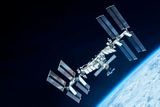
Point Nemo has the distinction of being the most remote place on the planet. Situated in the middle of the Pacific Ocean, its extreme isolation makes it the ideal site for a spacecraft graveyard – and the final resting place of the International Space Station (ISS), which is due to be decommissioned in 2030 or 2031 after three decades of service.
Point Nemo: an underwater cemetery (for spaceships)
When it comes to finding peace and quiet, few places top Point Nemo. The sea zone lies at the bottom of the Pacific Ocean, 1,670 miles (2,688 kilometers) from shore.
With coordinates 48°52.6′S 123°23.6′W, Point Nemo is equidistant from Ducie Island, one of the Pitcairn Islands, which lies to its north; Motu Nui, one of the Easter Islands, located in the northeast; and Maher Island, which is part of Antarctica and lies to the south, according to NOAA. Often, the closest humans are those traveling aboard the ISS.
This makes it particularly suited (although not entirely controversial) to its role as an underwater graveyard for decommissioned spacecraft. According to an article published in the California Western International Law Journal, Point Nemo has been used as a space junk repository since the early 1970s. According to another article published in Criminology and criminal justicemore than 260 space debris have landed there.
Learn more: Medical emergency 250 miles above Earth forces NASA to make rare decision
The final resting place of the ISS
The ISS was launched into orbit in 1998 and has been welcoming astronauts since 2000, when a NASA astronaut (Bill Shepherd) and two Russian cosmonauts (Yuri Gidzenko and Sergei Krikalev) boarded the craft, kicking off more than two decades of continuous human presence in space, according to the ISS National Laboratory.
Since then, it has allowed researchers to conduct experiments that have helped improve weather monitoring, medical research and agricultural development, while providing a testing ground for technologies that could prove crucial to interplanetary communication and future space exploration.
Under current plans, the ISS will continue to operate until it turns 32, in 2030, at which point it will be decommissioned safely and in a way that avoids contact with humans – in short: by crashing into the Pacific Ocean at Point Nemo.
This involves first lowering the 463-ton (420-ton) space station using propulsion technology and exploiting Earth’s atmospheric drag. Once this operation is completed and the astronauts on board return to Earth, the ISS will be directed towards its target (Point Nemo) and the operators will launch a large re-entry operation. Parts of the spacecraft are expected to vaporize along the way. Other sections will crash into the Pacific, joining the remains of other decommissioned spacecraft.
This process will be managed by NASA, the Canadian Space Agency (CSA), the European Space Agency (ESA), the Japan Aerospace Exploration Agency (JAXA) and the State Space Corporation Roscosmos, all five of which have been responsible for operating the ISS since its launch.
Without the ISS, NASA will rely on private industry and join the “robust commercial market in low Earth orbit.” According to NASA: “In the future, the United States plans to shift its operations in low Earth orbit to commercially owned and operated destinations to ensure continued access to critical research and technology development. »
How Point Nemo got its name
For many, Pixar’s animated clownfish may be the main reference when it comes to the name Nemo. But the inspiration comes from the conflicted sailor, Captain Nemo, in Jules Verne’s book Twenty Thousand Leagues Under the Sea.
Nemo also means “no one” in Latin, which seems rather fitting given its location.
Learn more: Bacteria-killing viruses become better antibiotic fighters in space
Article sources
Our Discovermagazine.com editors use peer-reviewed research and high-quality sources for our articles, and our editors review the articles for scientific accuracy and editorial standards. See the sources used below for this article:


