Astronomers watch 1st black hole ever imaged launch a 3,000‑light‑year‑long cosmic jet from its glowing ‘shadow’

When you purchase through links on our articles, Future and its syndication partners may earn a commission.

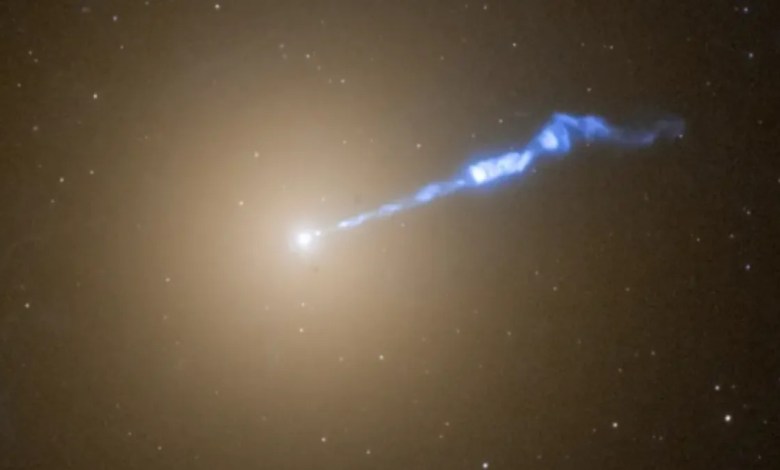
M87* and its blowtorch-like cosmic jet as seen by the Hubble Space Telescope. | Credits: NASA, ESA, A. Lessing (Stanford University), E. Baltz (Stanford University), M. Shara (AMNH), J. DePasquale (STScI)
Using the Event Horizon Telescope (EHT), astronomers followed a cosmic torch 3,000 light years long to its source, the supermassive black hole M87*, which has the distinction of being the first black hole photographed by humanity. This breakthrough could help scientists better understand what creates these powerful jets of charged particles that travel at speeds close to the speed of light.
M87* lies at the heart of the galaxy Messier 87 (M87), located approximately 55 million light years from Earth. The historical image of this supermassive black holewhich has a mass equivalent to that of 6.5 billion suns, was captured by the EHT in 2017 and was made public in April 2019.
Not only is this supermassive black hole more massive than the one at the heart of the Milky Way, Sagittarius A* (Sgr A*), which has a mass of about 4 million solar masses, but M87* is also an active black hole. This means that it greedily devours surrounding gases and dust and shoots powerful jets from its poles. However, the exact source of these jets around their central black hole engines and the precise mechanism that powers them still remains a mystery.
To better understand the jet from this supermassive black hole, astronomers turned to observations of M87* made by the EHT in 2021 using a technique called very long baseline interferometry (VLBI). This technique can reveal structures around supermassive black holes on a small scale, such as the bright golden ring of superhot material that dominates the 2019 image of M87*, which is actually the “shadow” of this black hole. With these new observations, the team was finally able to connect the bright ring around M87* to the base of the jet coming out of this supermassive black hole, providing a likely point of origin for this jet.
“This study represents a first step toward connecting theoretical ideas about jet launches with direct observations,” team leader Saurabh of the Max Planck Institute for Radio Astronomy (MPIfR) said in a statement. “Identifying the origin of the jet and how it connects to the black hole’s shadow adds a key piece to the puzzle and opens the way to a better understanding of how the central engine works.”

This photo is the first historic image of a supermassive black hole ever recorded. It shows the shadow of the monster black hole inside the distant galaxy M87. | Credit: EHT Collaboration
By modeling the supermassive black hole, Saurabh found that radio emissions missing from EHT observations of M87* taken between 2017 and 2019 but present in 2021 observations likely came from a compact region less than a tenth of light year far from the black hole. This region is associated with the base of the M87* jet and corresponds to the southern arm of another jet seen in radio waves.
“We observed the inner part of M87’s jet with global VLBI experiments for many years, with ever-increasing resolution, and finally succeeded in resolving the black hole shadow in 2019,” said team member Hendrik Müller of the National Radio Astronomy Observatory (NRAO). “It is amazing to see that we are gradually moving toward combining these groundbreaking observations across multiple frequencies and completing the picture of the jet launch region.”
The team will now aim to make more observations of M87* to better understand the structure of its jet and image the smallest details. This could lead to a better understanding of how supermassive black holes shape the environments around them.
The future is bright for black hole images.
The team’s results were published Wednesday January 28 in the journal Astronomy and astrophysics.


