These four astronauts are about to travel farther from Earth than anyone before them

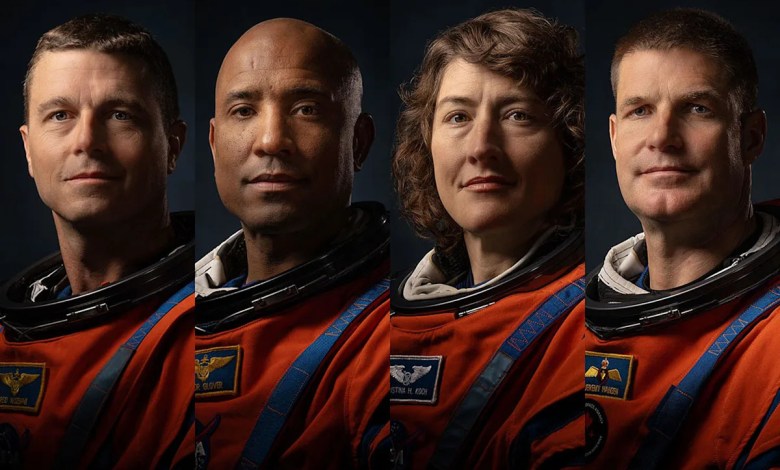
In just over a week, four astronauts could launch to the Moon for the first time in more than 50 years.
The crew, made up of NASA astronauts Reid Wiseman, Christina Koch and Victor Glover, as well as Canadian astronaut Jeremy Hansen, is preparing to participate in NASA’s Artemis II mission, a 10-day journey that will take them around the Moon. Their journey through space will take the group further from Earth than humanity has ever gone, surpassing the Apollo 13 record of 248,655 miles set in 1970.
The group will not land on the Moon’s surface, but the flight aims to launch a new era of lunar exploration, paving the way for a moon landing in the coming years. This will be the first time that NASA’s next-generation Space Launch System rocket and Orion capsule will carry human passengers.
If this arouses any apprehension, the astronauts have not let it show.
“There’s nothing left on my to-do list. I’m ready to go,” Wiseman said Wednesday in an article on X.

Astronauts Reid Wiseman, Victor Glover, Christina Koch and Jeremy Hansen in front of NASA’s Space Launch System rocket and Orion capsule at the Kennedy Space Center in Cape Canaveral, Fla., Jan. 17, before entering quarantine. (Joe Raedle/Getty Images)
(Joe Raedle)
He and his fellow crew members entered quarantine in Houston a week ago — a standard part of prelaunch activities aimed at limiting astronauts’ exposure to germs. They are expected to arrive at the Kennedy Space Center in Cape Canaveral, Florida, about six days before their launch, which could be as early as February 8, although NASA has not yet set a firm date.
Wiseman will command the Artemis II mission, with Glover as pilot and Koch and Hansen as mission specialists. NASA announced its selection in 2023.
“Among the crew are the first woman, the first person of color and the first Canadian to participate in a lunar mission,” Vanessa Wyche, director of NASA’s Johnson Space Center, said at the time. “And the four astronauts will represent the best of humanity as they explore for the benefit of all.”

The Artemis II crew during water survival training at NASA’s Neutral Buoyancy Laboratory in Houston in 2024. (Josh Valcarcel/NASA)
(Josh Valcarcel)
The three NASA astronauts participating in the mission are spaceflight veterans. Wiseman, who previously served in the Navy and became an astronaut in 2009, spent six months aboard the International Space Station in 2014.

Reid Wiseman with his daughters. (Courtesy of Reid Wiseman)
(Courtesy of Reid Wiseman)
Since losing his wife in 2020, Wiseman has been raising his two children alone. Being an astronaut, he says, puts a lot of stress and anxiety on family members, and his enthusiasm for the mission is often tempered by feelings of selfishness about the toll it takes on his loved ones.
“I’m a single father of two girls,” he told NBC’s “TODAY” show during an interview with his fellow crew members earlier this month. “It would be a lot easier to sit on my couch and watch football on the weekend, but at the same time, four humans were put in a position to be able to go explore and do something very unique and rare in this civilization.”
Wiseman added that he hopes the outcome of the mission will justify the sacrifices made by his loved ones.
“We always looked at the moon and said, ‘We’ve been there.’ But for this whole generation, for our generation, for the younger generation, for the Artemis generation, they’re going to look at the moon now and say, ‘Here we are,'” he said.

Jeremy Hansen’s pendants featuring his family’s birthstones and the words “moon and back.” (Courtesy of Jeremy Hansen)
(Courtesy of Jeremy Hansen)
The four astronauts plan to bring small tokens and souvenirs on their flight around the Moon. Wiseman and Koch said they each plan to take letters from their families. Glover said he brought a Bible, his wedding rings and family heirlooms for his daughters. For Hansen, it’s a moon pendant with her family’s birthstones and the words “moon and back” engraved.
Such items, having flown in space, make special keepsakes and are a way for astronauts to include their family members in the journey.
Koch is no stranger to extended stays in space, nor to historic firsts. She spent almost all of 2019 on the International Space Station – 328 days – the record for the longest spaceflight by a woman. There, Koch and fellow astronaut Jessica Meir performed NASA’s first all-female spacewalk.

Christina Koch with her husband and dog. (Courtesy of Christina Koch)
(Courtesy of Christina Koch)
She said she wasn’t bothered by the fact that another major milestone — leaving boot prints on the lunar surface — eluded her.
“I will be so excited to see someone I know be nominated to be the person and people who walk on the moon, but if it’s not in my space destiny to do it, that’s totally fine with me,” Koch said. (NASA has not yet named the crew for the Artemis III mission.)

Victor Glover and his family. (Courtesy of Victor Glover)
(Courtesy of Victor Glover)
Glover, meanwhile, was participating in the first operational flight of SpaceX’s Crew Dragon capsule to the space station in 2020. A U.S. Navy captain and test pilot, Glover was a member of the U.S. Senate when NASA recruited him. He was selected to become an astronaut in 2013. Glover and his wife have four children.
Hansen, the only crew member to debut in space, will also have the distinction of being the first Canadian to venture to the Moon. Selected by the Canadian Space Agency to become an astronaut in 2009, he was previously a fighter pilot and colonel in the Canadian Armed Forces.
Hansen and his wife have three children. After years of training for this flight, he said, the crew members have also become “like family at this point.”

Jeremy Hansen and his family. (Courtesy of Jeremy Hansen)
(Courtesy of Jeremy Hansen)
The Artemis II launch will be only the second spacewalk for NASA’s Space Launch System rocket and Orion capsule. The first was the Artemis I uncrewed flight around the moon more than three years ago.
Wiseman, Koch, Glover and Hansen know the flight is a critical stepping stone to the Artemis III mission, which aims to land four astronauts near the Moon’s south pole in 2027. While in space, the crew will be responsible for demonstrating docking procedures in Earth’s orbit, conducting scientific experiments and testing various systems aboard the Orion capsule as a sort of test run for this future landing.
“For us, success lies in Artemis III,” Koch said. “Success is Artemis 100, whatever the moment. And we really define everything from that.”
This article was originally published on NBCNews.com


